
Customer success is defined as “a long-term, scientifically engineered, and professionally directed strategy for maximizing customer and company sustainable proven value,” by the The Customer Success Association. But for most organizations, customer success is a series of tactics that aligns the objectives of the company and the customer, and can provide a positive impact on the company’s financial operations.
Research conducted in 2018 by ProfitWell analyzed data from nearly 2,000 companies in the subscription space and found that customer success teams yielded up to 125% in expansion revenue and contributed to a 27% decrease in customer churn.
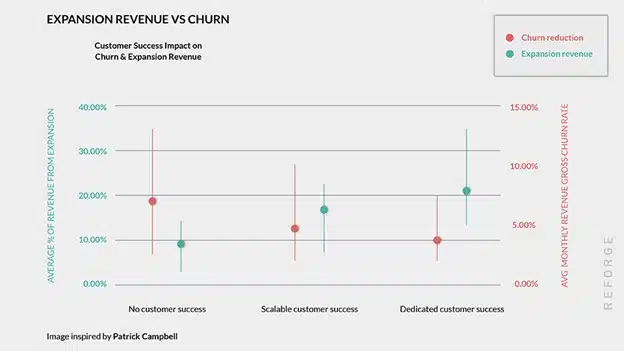
Clearly, there are financial reasons for focusing on customer success. Implementing the right strategies and teams to help customers achieve success with a product or service can be challenging, but may be best addressed by focusing on the following tactics:
- Focusing on customer adoption: Companies should work with customers to identify their needs and goals for using the product or service, and then deploy a friction-free process for onboarding that customer. Make adequate training or resources easily accessible for ensuring the customer can dig deeper into the product to extract maximum value.
- Maintain contact to drive customer retention: Once a customer has been acquired, it is imperative to check in to ensure they are still deriving value from the product and are not seeking out alternatives. Some activities that can help retail customers and lower churn rates include:
- Ensure the product functions in the way customers need it to.
- Conduct regular reviews to reassess customer needs.
- Offer timely support and constant assistance via support and success teams.
- Ensure customers are always listened and responded to promptly.
Focus on revenue expansion: Once customers are engaged and satisfied with the product, they are primed to expand their business relationship, presenting opportunities to upsell or cross-sell additional products and services, which can drive incremental and recurring revenue streams.
For example, customers of subscription services can be upsold additional features or offered more frequent product deliveries, while customers who have purchased a base model of an item could be offered additional accessories to further improve the functionality of a product. Service-based companies could present higher-tier offerings at a nominal cost upgrade.
Ask for advocacy: Turning happy customers into advocates is another element of customer success efforts, as advocates can drive additional sales, often to audiences that may not have discovered a product or service on their own. Customers that rate a product or service a 9 or 10 on a net promoter score (NPS) survey can be considered advocates, and can reached out to via the following methods:
- Ask for a referral: By targeting satisfied customers for referrals, companies can personalize the referral experience, increasing the likelihood of success.
- Referral programs: Affiliate link schemes, referral codes, or email invites also can be used to track where referrals came from and appropriately award the customers who set them up.
- Case studies and testimonials: Leverage product or service enthusiasm through the creation of case studies or testimonials, which can be segmented by customer type, product, or other attribute, and then deployed across sales and marketing efforts.
Customer Success Metrics
Although several metrics can be used to measure customer success, a few stand out, due to their relative simplicity and ability to home in on the factors that most clearly address customer success.
- Customer lifetime value (CLV): This is one of the most fundamental customer success metrics, and it shows the total revenue that you can expect a single customer to generate over the course of the relationship with a company. CLV can be measured by identifying the touchpoints where a customer creates value, measuring the revenue generated at each touchpoint, assessing the frequency of purchases, and then assessing the average projected lifetime of the customer. Essentially, this metric can be used to identify what is driving higher CLV, as well as uncover opportunities to make less valuable customers more valuable.
- NPS: An NPS asks whether someone is likely to recommend your company to someone else. The NPS survey asks a single question: “On a scale of 1 to 10, how likely are you to recommend this product or service?” and allows for an open-ended section to allow respondents to explain their score. Businesses can analyze this feedback based on the scores, and then examine CXs if abnormal or outlying results are detected.
- Customer effort score (CES): This metric is designed to measure the ease of customers to get the help they want and need. The metric is also useful in prediction customer loyalty, which aids in reducing customer churn. The CES is measured by surveying customers on how easy or difficult it was to accomplish a specific action, allowing companies to understand the frequency and location of where service bottlenecks are occurring.
Ultimately, a focus on customer success is essentially about shifting a company’s focus to the customer and ensuring that the customer has the tools needed to extract maximum value from the product or service offered. When done properly, enhanced customer success programs can generate additional revenue, while also improving the overall perception of a company.
Author Information

Keith Kirkpatrick is VP & Research Director, Enterprise Software & Digital Workflows for The Futurum Group. Keith has over 25 years of experience in research, marketing, and consulting-based fields.
He has authored in-depth reports and market forecast studies covering artificial intelligence, biometrics, data analytics, robotics, high performance computing, and quantum computing, with a specific focus on the use of these technologies within large enterprise organizations and SMBs. He has also established strong working relationships with the international technology vendor community and is a frequent speaker at industry conferences and events.
In his career as a financial and technology journalist he has written for national and trade publications, including BusinessWeek, CNBC.com, Investment Dealers’ Digest, The Red Herring, The Communications of the ACM, and Mobile Computing & Communications, among others.
He is a member of the Association of Independent Information Professionals (AIIP).
Keith holds dual Bachelor of Arts degrees in Magazine Journalism and Sociology from Syracuse University.