Analyst(s): Mitch Ashley
Publication Date: March 4, 2026
Microsoft executives Mark Russinovich and Scott Hanselman argue in Communications of the ACM that AI-driven productivity gains are creating a dangerous incentive to stop hiring early-career developers. Organizations acting on that incentive will face pipeline recovery timelines measured in years, not months, and will arrive at a future without the engineers capable of governing the AI systems they are deploying today. Russinovich and Hanselman introduce the preceptorship model to address developing junior engineers into senior engineers for the AI era.
What is Covered in This Article:
- AI is creating a dangerous economic incentive: stop hiring junior developers. Organizations acting on that incentive are making a workforce decision whose consequences may not surface for years, and could cost far more than the savings captured.
- Labor data already shows the damage. Employment of 22-25 year olds in AI-exposed roles dropped roughly 13% following GPT-4’s release. The narrowing pyramid has started. Most organizations have not noticed yet.
- Microsoft’s Azure CTO and VP Developer Community propose a preceptorship model that redefines the EiC role for the AI era: not writing code, but learning to direct, verify, and govern agents alongside senior engineers who externalize their judgment.
- The EDS Systems Engineering Development program was paused with a three-month recovery estimate. Actual recovery took over 18 months. The talent pipeline is not a headcount lever. It is a supply chain, and supply chains do not restart; they are rebuilt.
- AI tools designed for Socratic coaching rather than code generation could accelerate structured mentorship at scale. The first vendors to build it credibly will earn a differentiated enterprise position that productivity metrics alone cannot deliver.
The News: Recent studies show that entry-level and junior software developer opportunities have fallen on the order of 15–35% over the past few years in roles most exposed to generative AI, as firms look to automate early‑career work rather than backfilling junior headcount. Across the broader entry-level labor market, data from labor‑market analytics firms and academic studies similarly indicate double‑digit percentage declines in AI‑exposed entry roles, even as less‑exposed occupations have remained stable or grown.
Microsoft Azure CTO Mark Russinovich and VP Developer Community Scott Hanselman published in Communications of the ACM, arguing that generative AI amplifies senior engineers while creating AI drag on early-in-career (EiC) developers who lack the systems knowledge to steer and correct agent output. The economic incentive follows: hire seniors, stop hiring juniors. Project Societas illustrated the upside: seven part-time engineers, 10 weeks, 110,000 lines of code that were 98% AI-generated, with human work shifting from authoring to directing.
The risk surfaces in what agents get wrong and who catches it. The paper documents agents masking race conditions with sleep calls, claiming success on buggy code, and implementing hacks that pass tests but don’t generalize. Catching those failures requires systems knowledge that early-career developers are still building. The proposed fix is a preceptorship model: senior mentors paired with early-in-career developers at 3:1 to 5:1 ratios, with AI tools defaulting to Socratic coaching rather than immediate code generation, running at least one year per cohort.
Microsoft Leaders Have an Answer To AI Gutting the Developer Pipeline
Analyst Take — The Economic Incentive Is Obvious. The Recovery Cost Is Not: The short-term math favors eliminating junior hiring. Organizations acting on that math are making a decision whose consequences may not surface for years, and possibly costing far more than the savings captured. If the past is prologue, an experience at Electronic Data Systems (EDS) illustrates the costs of over-rotating in anticipation of strategic shifts.
The EDS Systems Engineering Development (SED) program served as the core of its internal training pipeline to turn new hires into “systems engineers,” typically over an intensive multi‑month curriculum combining classroom work and practical projects. EDS decided to pause its SED recruiting and training program, anticipating that offshore work migration would fill the capacity gap and capture lower costs. Leadership projected a three-month recovery window should they need to restart the program. When the realities of starting new offshore operations materialized, the actual recovery took more than 18 months.
Rebuilding a talent pipeline is not like restarting a server. It’s akin to rebuilding a talent supply chain. The capabilities that develop and compound through early-in-career experience, systems knowledge, architectural intuition, and operational judgment degrade quickly when the pipeline stops feeding talent into the system. People equipped with those skills and experiences do not return on demand.
The skills at risk here are not interchangeable coding tasks. They are the foundational experiences that produce engineers capable of governing AI agents: debugging under uncertainty, recognizing architectural anti-patterns, building judgment about when to trust automation and when to override it. Agents can produce code. Governing agents require something that agents cannot develop on their own.
The Pipeline Is A System
Early-in-career hiring does not produce additional capacity. It produces future senior engineers. Cut it, and you eliminate the source of technical skills and leadership that will govern AI systems eighteen months, three, five, or more years from now. Futurum’s 1H 2026 Software Lifecycle Engineering Decision Maker Survey shows 93% of development organizations are already using, evaluating, or plan to use generative AI. That adoption curve is not slowing as organizations push from planning to evaluating and using AI in development. More AI in the pipeline, with fewer humans able to steer it, is not a productivity story. It is a story of risk accumulation, a delayed failure.
The preceptorship model proposed by Russinovich and Hanselman outlines a structural response to that risk.
Figure 1: Preceptor-Based Organization
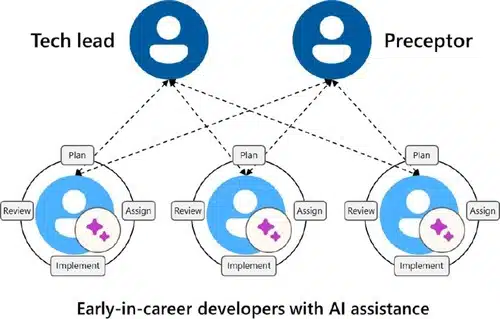
It pairs early-in-career (EiC) developers with senior mentors in real product teams, with the explicit goal of making learning, not throughput, a core part of engineering work. MIT research from early 2025 makes the mechanism concrete: adults who used ChatGPT to complete writing tasks showed reduced brain activity and lower recall compared to those who worked unaided. AI does not just replace tasks. It replaces the cognitive struggle that builds durable capability.
The preceptorship model addresses this directly. EiC developers are engaged in all aspects of real work, prompting, debugging, and reviewing, so they can observe how senior judgment interacts with agent output. Senior engineers externalize that judgment, turning expertise into teachable moments. The goal is to convert the AI drag of inexperience into the next generation’s capacity for discernment. Each preceptor supports three to five EiC developers, forming a structured layer of mentorship that keeps the pyramid intact as agent-driven development scales.
The Agent Accountability Gap Is the Real Risk
2026 is the year developers become engineers of agent-driven development. The critical skill required to achieve this is directing and governing how agents build, test, deploy, and operate software. The agents building software (often other agents) must themselves be directed, observed, and governed. That requires systems experience and intuition: knowing when agent output is plausible but wrong, catching failure modes that only appear at scale.
EiC developers are the cohort building intuition during their development. Organizations cutting junior hiring are not just losing near-term capacity; they are also losing long-term capacity. They are producing the next generation of senior engineers without the experience, then enabling them to govern the AI systems they will build and inherit.
EDS relied upon a three-month estimate to recover a shuttered pipeline. It took over 18. The mistake was not pausing the program. The mistake was assuming a talent deficit could be reversed on a schedule.
Organizations making AI-driven hiring cuts today are making the same assumption with a harder problem. You cannot compress the time it takes to develop systems intuition, and you cannot buy it back once the cohort that would have built it was never hired
What to Watch:
- Watch for early signs that organizations are correcting course on junior developer hiring. Resumption of recruiting programs, reinstated early-career rotations, and public commitments to EiC pipelines will signal that the AI-eliminates-juniors narrative is losing credibility with engineering leadership. The correction will not be announced. It will show up in headcount data and hiring patterns before anyone calls it a trend.
- Track adoption of the preceptorship model or structurally similar approaches. Formal mentorship paired with real product work, explicit learner-to-mentor ratios, and AI tools configured for coaching rather than generation are the markers to watch. Early adopters will likely be organizations that have already experienced pipeline recovery pain. The companies that have been here before will move first.
- Watch how the junior developer role itself evolves under AI-native development. The EiC contribution is shifting from writing implementation code to learning how to direct, verify, and correct agent output alongside senior engineers. Organizations that redefine that role deliberately will develop a structural advantage. Those who leave the role undefined will lose junior developers to attrition before the pipeline investment pays off.
- Watch whether AI tools accelerate the preceptorship model itself. Coding assistants that can track EiC developer patterns, surface knowledge gaps to preceptors, and adapt coaching approaches based on observed mistakes could compress the 12-to-18-month program timeline. The MIT cognitive debt research cuts both ways: AI designed for active learning rather than passive generation could make structured mentorship more effective at scale, not less.
See Redefining the Software Engineering Profession for AI, Communications of the ACM (DOI: 10.1145/3779312), and Your Brain on ChatGPT: Accumulation of Cognitive Debt when Using an AI Assistant for Essay Writing Task for more information.
Disclosure: Futurum is a research and advisory firm that engages or has engaged in research, analysis, and advisory services with many technology companies, including those mentioned in this article. The author does not hold any equity positions with any company mentioned in this article.
Analysis and opinions expressed herein are specific to the analyst individually and data and other information that might have been provided for validation, not those of Futurum as a whole.
Other Insights from Futurum:
IBM vs. Anthropic: A Tale of the COBOL Modernization Tape
The Seven Principles of Observability-Native
Enterprises Prioritize Agent Observability Before They’ve Deployed Agents
AWS’s Deploy-to-AWS Plugin: Frictionless Deployment or Developer Honeypot?
Claude Found 500 Zero-Days. Who Patches Them Before Attackers Arrive?
Author Information

Mitch Ashley is VP and Practice Lead of Software Lifecycle Engineering for The Futurum Group. Mitch has over 30+ years of experience as an entrepreneur, industry analyst, product development, and IT leader, with expertise in software engineering, cybersecurity, DevOps, DevSecOps, cloud, and AI. As an entrepreneur, CTO, CIO, and head of engineering, Mitch led the creation of award-winning cybersecurity products utilized in the private and public sectors, including the U.S. Department of Defense and all military branches. Mitch also led managed PKI services for broadband, Wi-Fi, IoT, energy management and 5G industries, product certification test labs, an online SaaS (93m transactions annually), and the development of video-on-demand and Internet cable services, and a national broadband network.
Mitch shares his experiences as an analyst, keynote and conference speaker, panelist, host, moderator, and expert interviewer discussing CIO/CTO leadership, product and software development, DevOps, DevSecOps, containerization, container orchestration, AI/ML/GenAI, platform engineering, SRE, and cybersecurity. He publishes his research on futurumgroup.com and TechstrongResearch.com/resources. He hosts multiple award-winning video and podcast series, including DevOps Unbound, CISO Talk, and Techstrong Gang.