
Austin, Texas, USA, April 20, 2026
The Sales, Marketing, and Service Platforms market is undergoing a structural transformation from siloed CRM applications to unified, AI-orchestrated customer lifecycle engines, as reflected in Futurum’s newly updated Signal report.
Vendor Zone Changes
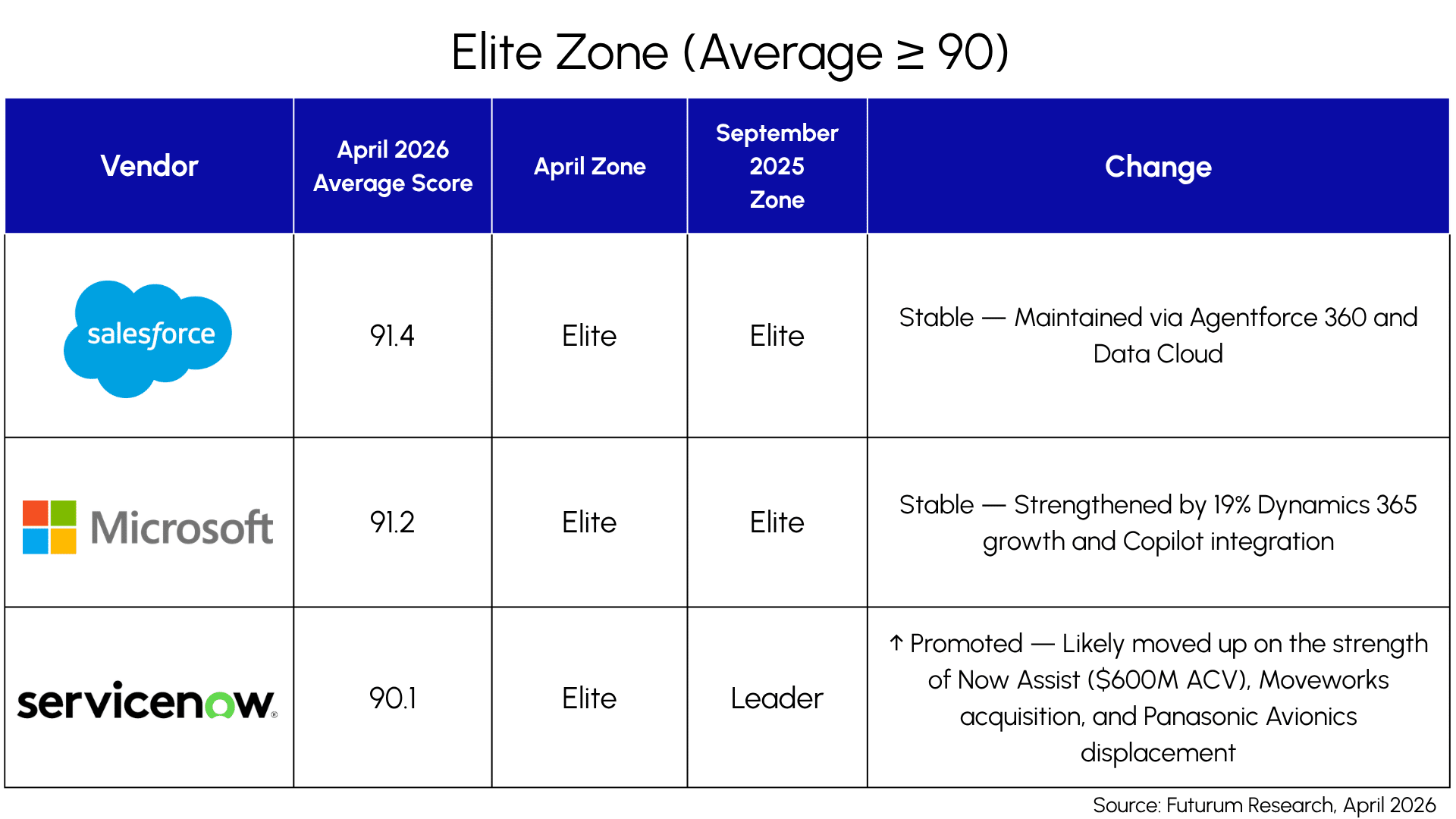
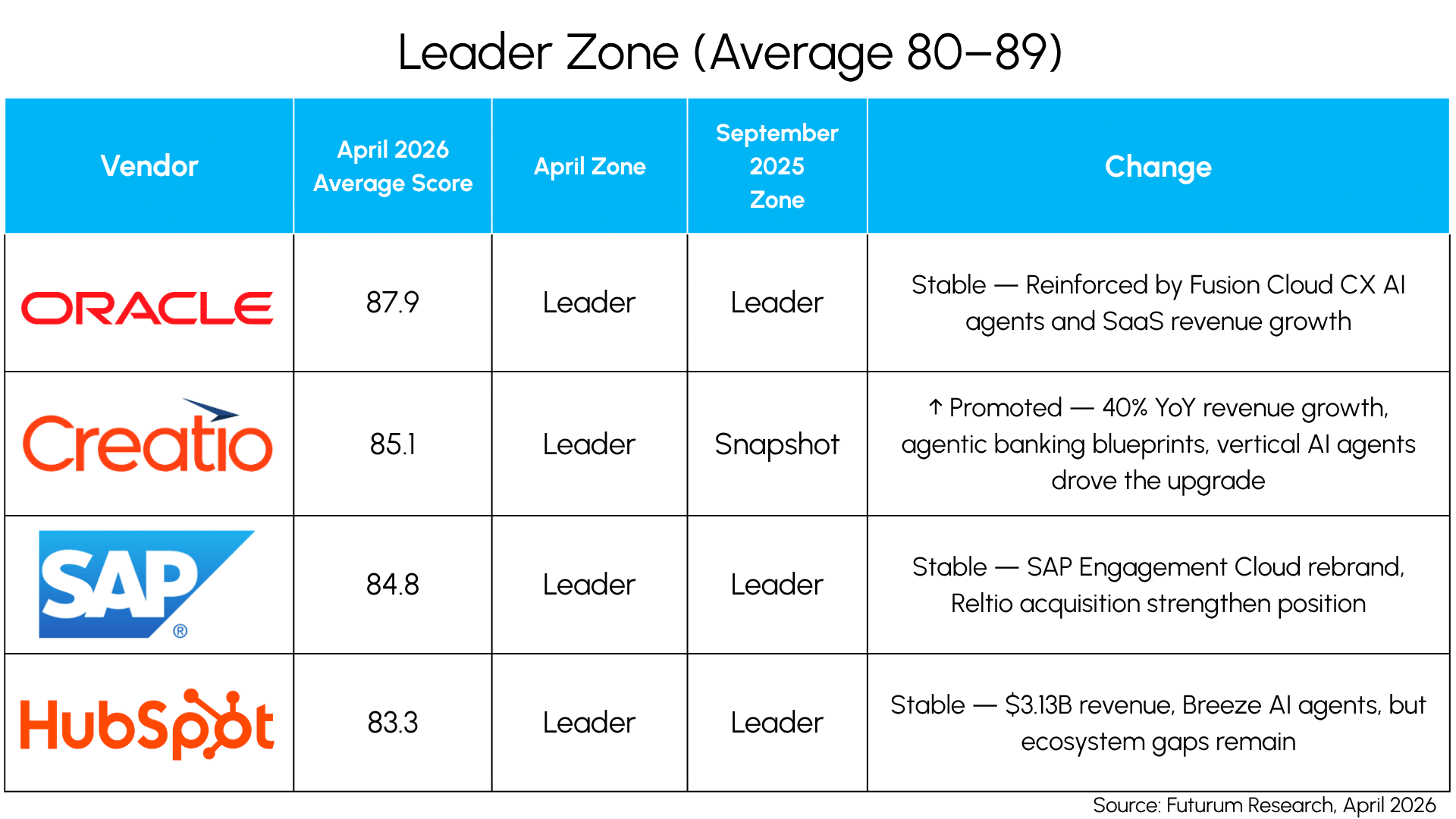
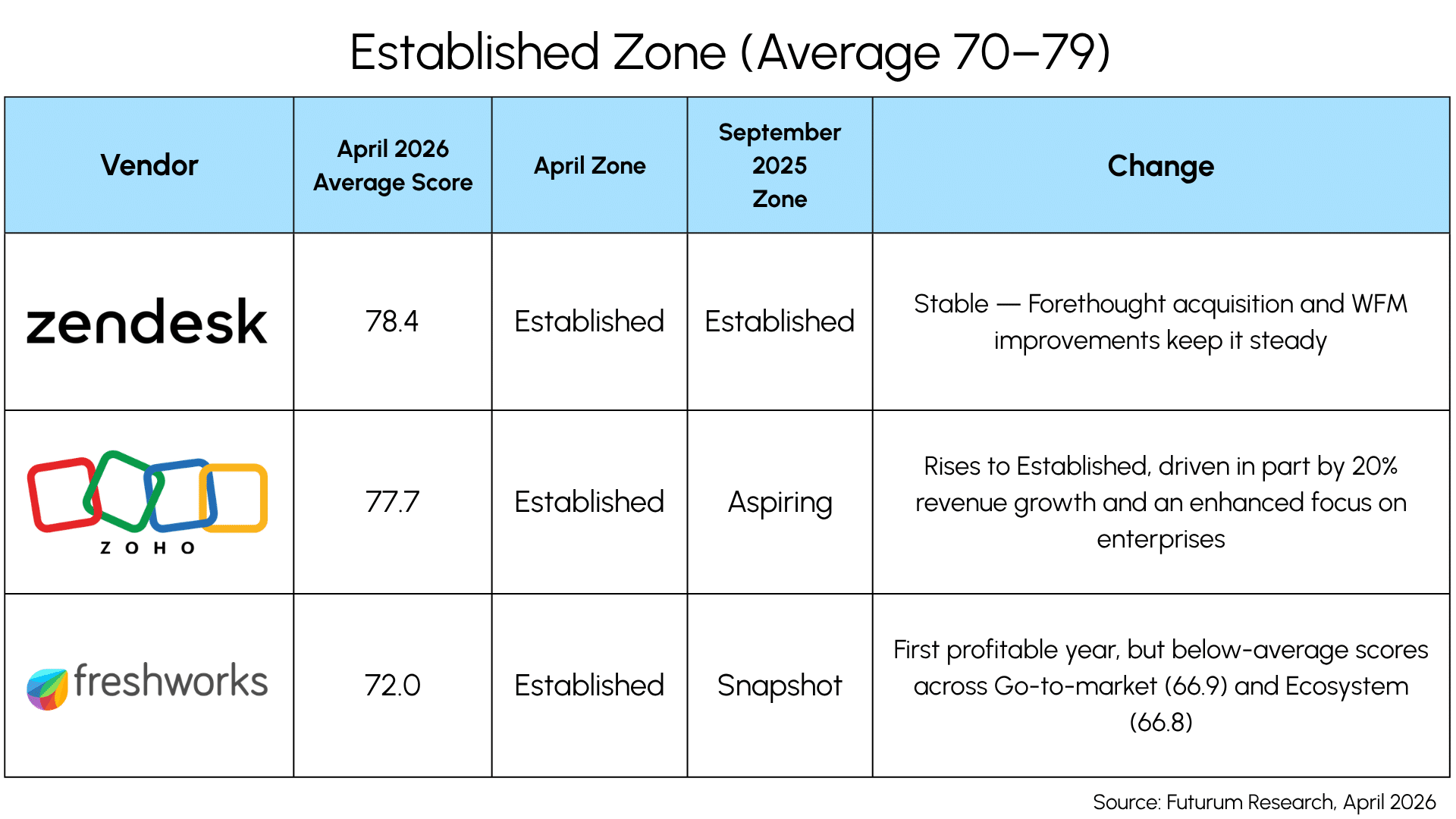
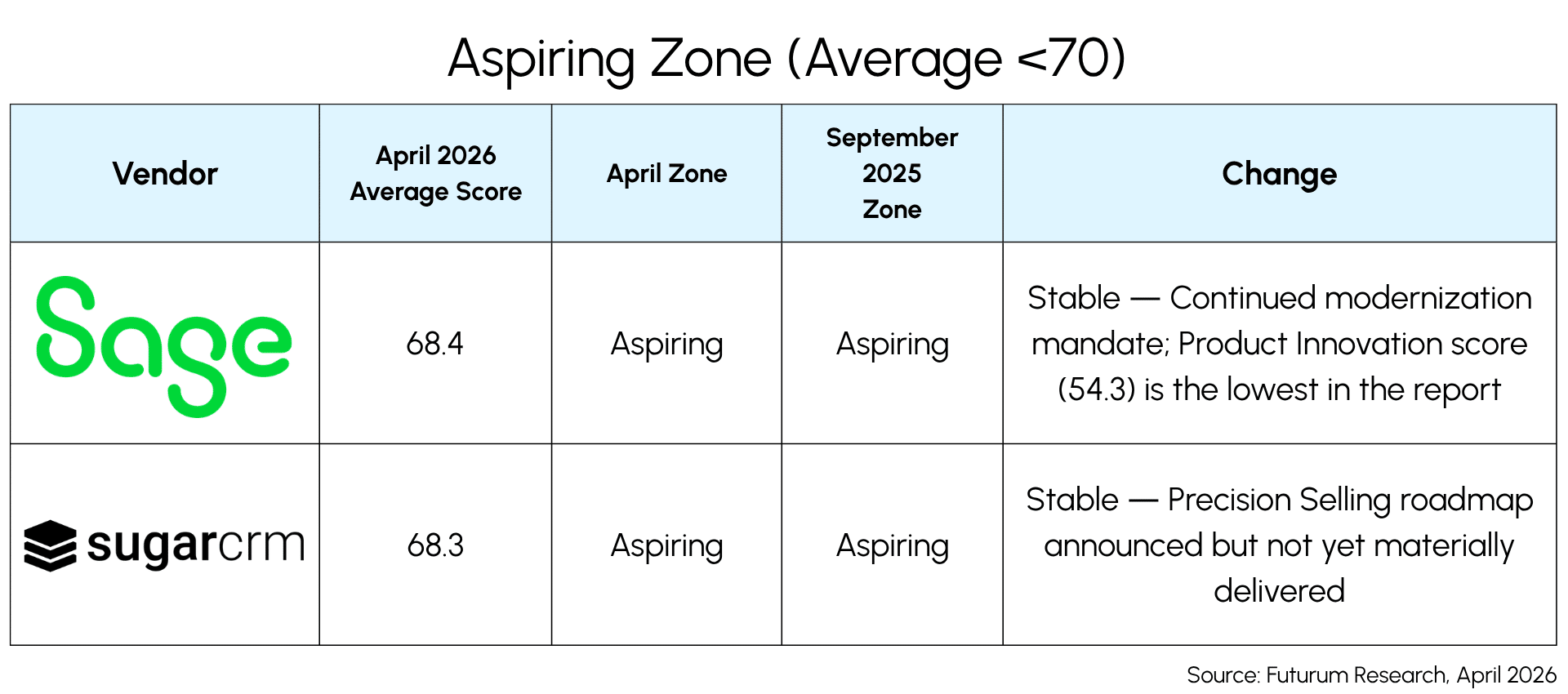
Based on the April 2026 zone placements and the trajectory language used, several vendors shifted zones or solidified their positions:
Score Changes: Signal Heat Map Analysis
The April 2026 scores reveal several notable shifts in category leadership:
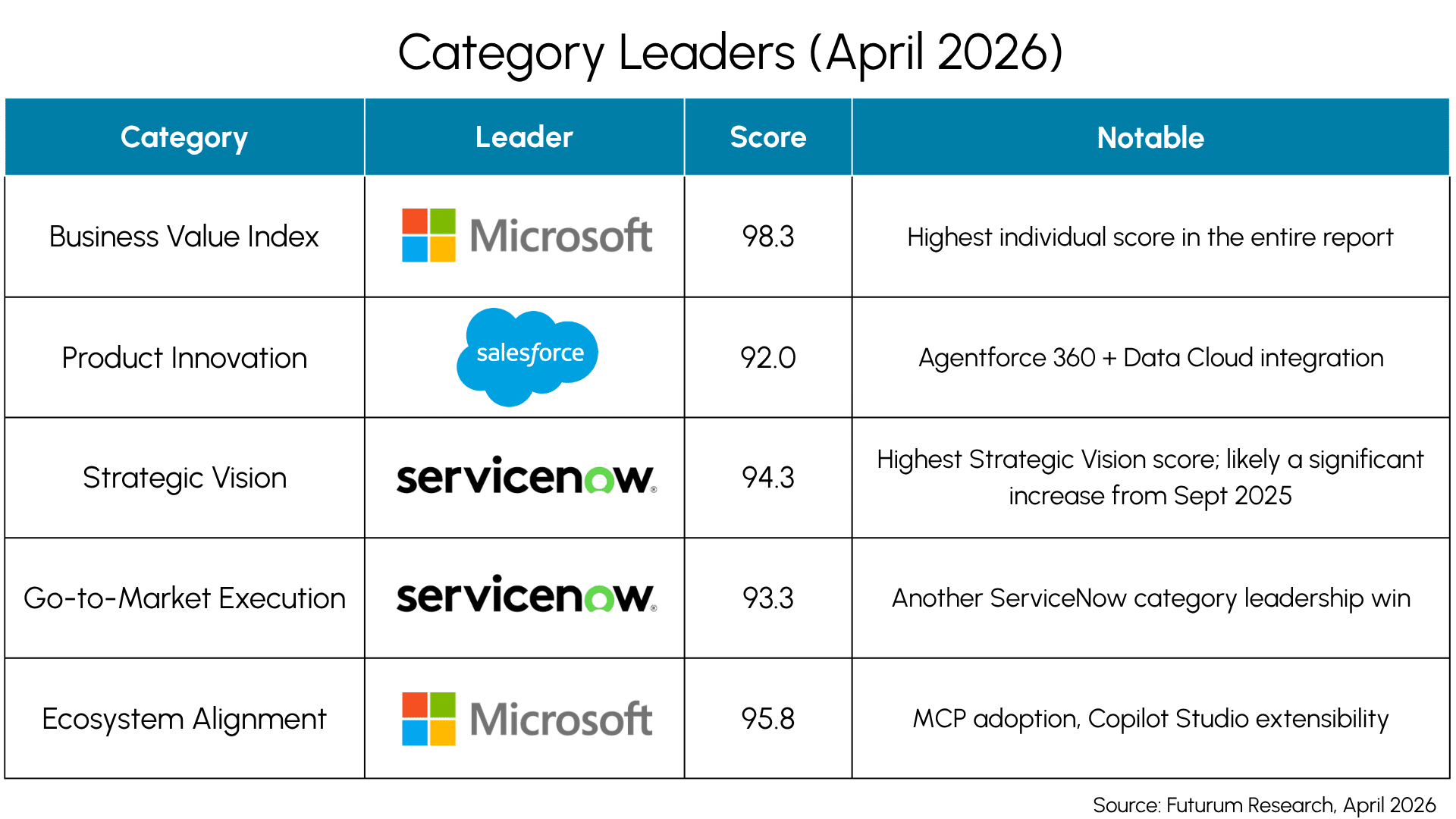
ServiceNow’s surge across Strategic Vision (94.3) and Go-to-market Execution (93.3) is the most dramatic scoring shift. These scores almost certainly increased substantially from September 2025, driven by:
- Now Assist surpassing $600M ACV
- Moveworks acquisition (EmployeeWorks, Autonomous Workforce framework)
- Panasonic Avionics full-stack CRM displacement of legacy systems
- OpenAI partnership deepening
In addition to ServiceNow being elevated to the Elite Zone, along with Zoho’s elevation to the Established Zone, the latest version of the Signal report highlights several critical developments shaping the Sales, Marketing & Service competitive landscape between September 2025 and now:
- The Agentic AI Arms Race: Every vendor in this Signal is investing in agentic AI, but maturity varies dramatically.
- Data Unification as the Strategic Moat: The report consistently identifies unified data as the foundation for AI effectiveness.
- The Complexity-Simplicity Paradox: UI/UX is the #1 purchase decision criterion (73.1%) in the Futurum 1H 2026 Enterprise Software Decision Maker survey, yet the most powerful platforms (Microsoft, ServiceNow, SAP, Oracle) consistently receive the lowest ease-of-use scores in G2 reviews. This paradox creates opportunities for simpler platforms (Zendesk, Zoho, SugarCRM), but also raises the bar for these vendors as they add enterprise capabilities.
- ERP-CRM Convergence: With 41% of enterprises planning app consolidation, according to Futurum’s 1H 2026 Enterprise Software Decision Maker survey, and cost reduction as the #1 consolidation driver, vendors that unify front-office and back-office data hold a natural advantage in the platform-consolidation wave.
- Ecosystem as Competitive Gravity: The adoption of open standards (MCP, A2A) by the largest vendors is forcing the market toward interoperable architectures. Vendors operating in proprietary silos face existential ecosystem challenges.
Additional Evaluation Framework
For the first refresh of the Sales, Marketing, & Service Signal report, an additional seven (7) questions were added to the assessment framework, focusing on industry-specific offerings, pricing and packaging, AI governance and risk, change management and adoption, operational intelligence and continuous improvement, linkage to overall corporate initiatives and goals, and future roadmap and strategic vision. These additional questions were designed specifically to address the core issues, questions, and concerns raised by enterprise software buyers and decision influencers.
Strategic Vision
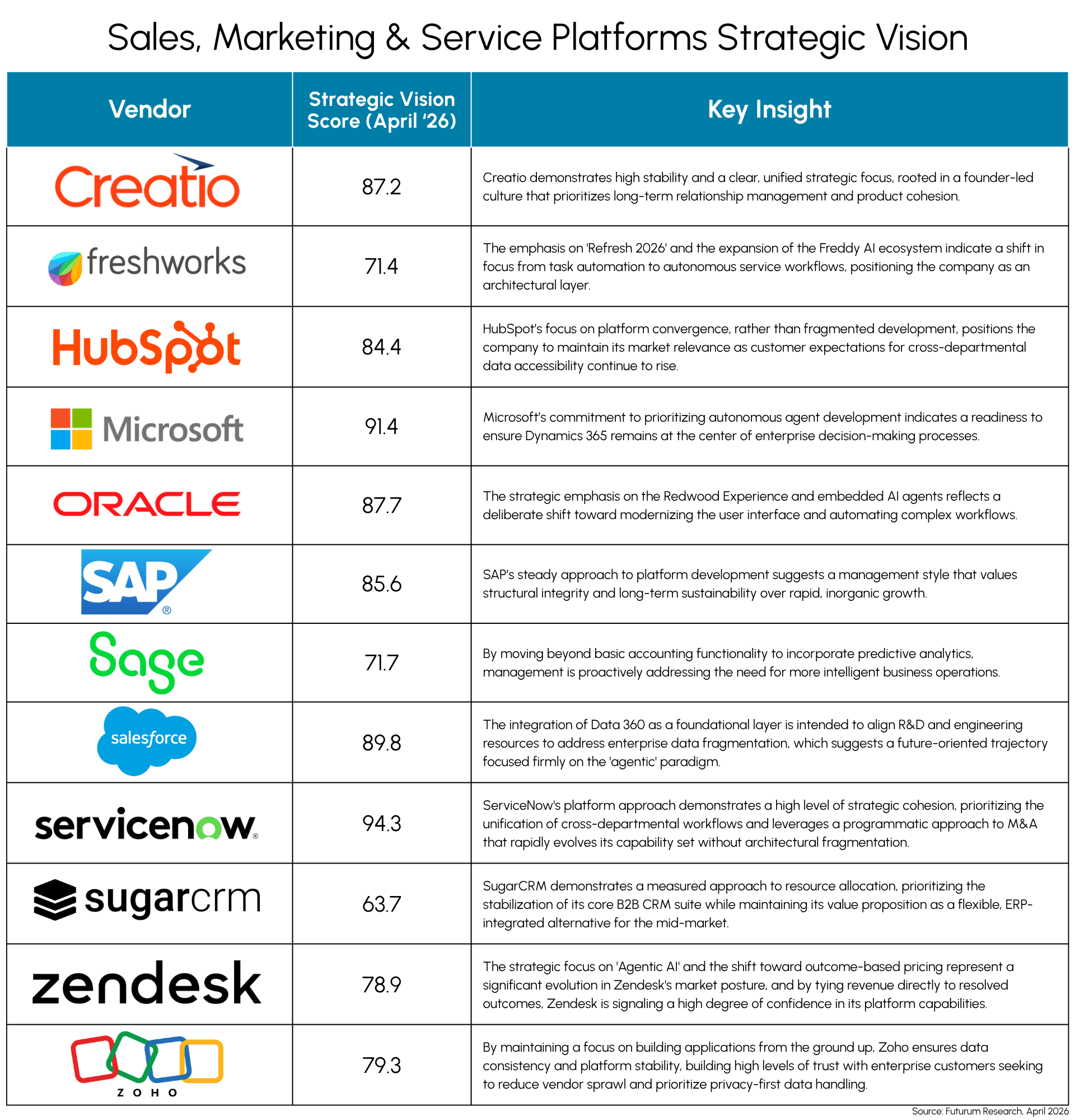
As the Futurum Signal is designed to be forward-looking, a key evaluation consideration is around the vendor’s clarity of a company’s long-term strategy and its ability to anticipate market shifts. The Strategic Vision metric assesses market messaging, resource allocation, the quality and stability of leadership, functional alignment, R&D, and M&A activities, and is often a strong predictor of a vendor’s ability to meet customers’ future needs, particularly in a period of high-velocity change.
Figure 1: Sales, Marketing & Service Platforms Strategic Vision
“The shift from siloed CRM systems to unified, AI-orchestrated customer lifecycle engines marks a fundamental replatforming of enterprise software, where data unification becomes the primary competitive moat rather than feature depth alone,” said Keith Kirkpatrick, VP and Research Director at The Futurum Group. “What we’re seeing is a clear bifurcation in the market: vendors with production-grade agentic AI and integrated data layers are pulling ahead, while others risk being relegated to fragmented point solutions without the context needed to deliver meaningful automation. At the same time, the growing tension between platform power and usability, combined with accelerating ERP-CRM convergence and ecosystem openness, will ultimately determine which vendors can translate technical capability into sustained enterprise adoption and measurable business value.”
Read more in the Futurum Signal Report on Sales, Marketing, & Service Platforms to find out how each vendor scored across five categories. Subscribers can also view the aforementioned Futurum 1H Enterprise Applications Market Data and the Enterprise Software Decision Maker Survey reports on the Futurum Intelligence Platform.
About Futurum Intelligence for Market Leaders
Futurum Intelligence’s Data Intelligence, Analytics, and Infrastructure IQ service provides actionable insight from analysts, reports, and interactive visualization datasets, helping leaders drive their organizations through transformation and business growth. Subscribers can log into the platform at https://app.futurumgroup.com/, and non-subscribers can find additional information at Futurum Intelligence.
Follow news and updates from Futurum on X and LinkedIn using #Futurum. Visit the Futurum Newsroom for more information and insights.
Other Insights from Futurum:
Will Technology Friction Derail the ROI Promise of Enterprise AI Investments?
Who Will Win the Agent Orchestration Layer Battle?
Agentic AI Surges 31.5% to Become the Fastest-Growing Enterprise Tech Priority
Author Information

Keith Kirkpatrick is VP & Research Director, Enterprise Software & Digital Workflows for The Futurum Group. Keith has over 25 years of experience in research, marketing, and consulting-based fields.
He has authored in-depth reports and market forecast studies covering artificial intelligence, biometrics, data analytics, robotics, high performance computing, and quantum computing, with a specific focus on the use of these technologies within large enterprise organizations and SMBs. He has also established strong working relationships with the international technology vendor community and is a frequent speaker at industry conferences and events.
In his career as a financial and technology journalist he has written for national and trade publications, including BusinessWeek, CNBC.com, Investment Dealers’ Digest, The Red Herring, The Communications of the ACM, and Mobile Computing & Communications, among others.
He is a member of the Association of Independent Information Professionals (AIIP).
Keith holds dual Bachelor of Arts degrees in Magazine Journalism and Sociology from Syracuse University.

