
Austin, Texas, USA, April 27, 2026
New Futurum research explores how enterprises are ditching vague AI efficiency goals for measurable wins in documentation and coding.
The phase of viewing generative AI as a mystical force capable of lifting all enterprise boats simultaneously has ended. As we examine the findings from the 1H 2026 Data Intelligence, Analytics, and Infrastructure Decision Maker Survey Report, a clear narrative emerges: the enterprise has traded its rose-colored glasses for a magnifying glass. The broad, nebulous aspirations of 2025 are giving way to a disciplined, task-oriented approach to automation, one that emphasizes accountability, transparency, and value.
The latest data indicates a fundamental transition in how enterprises derive value from generative AI, moving away from broad efficiency promises toward specific, localized automation. Interest in overall workflow efficiency dropped by 6 percentage points compared to the second half of 2025, while targeted use cases such as documentation generation and code acceleration saw significant growth.
Figure 1: How GenAI Use Cases Shifted in 12 Months
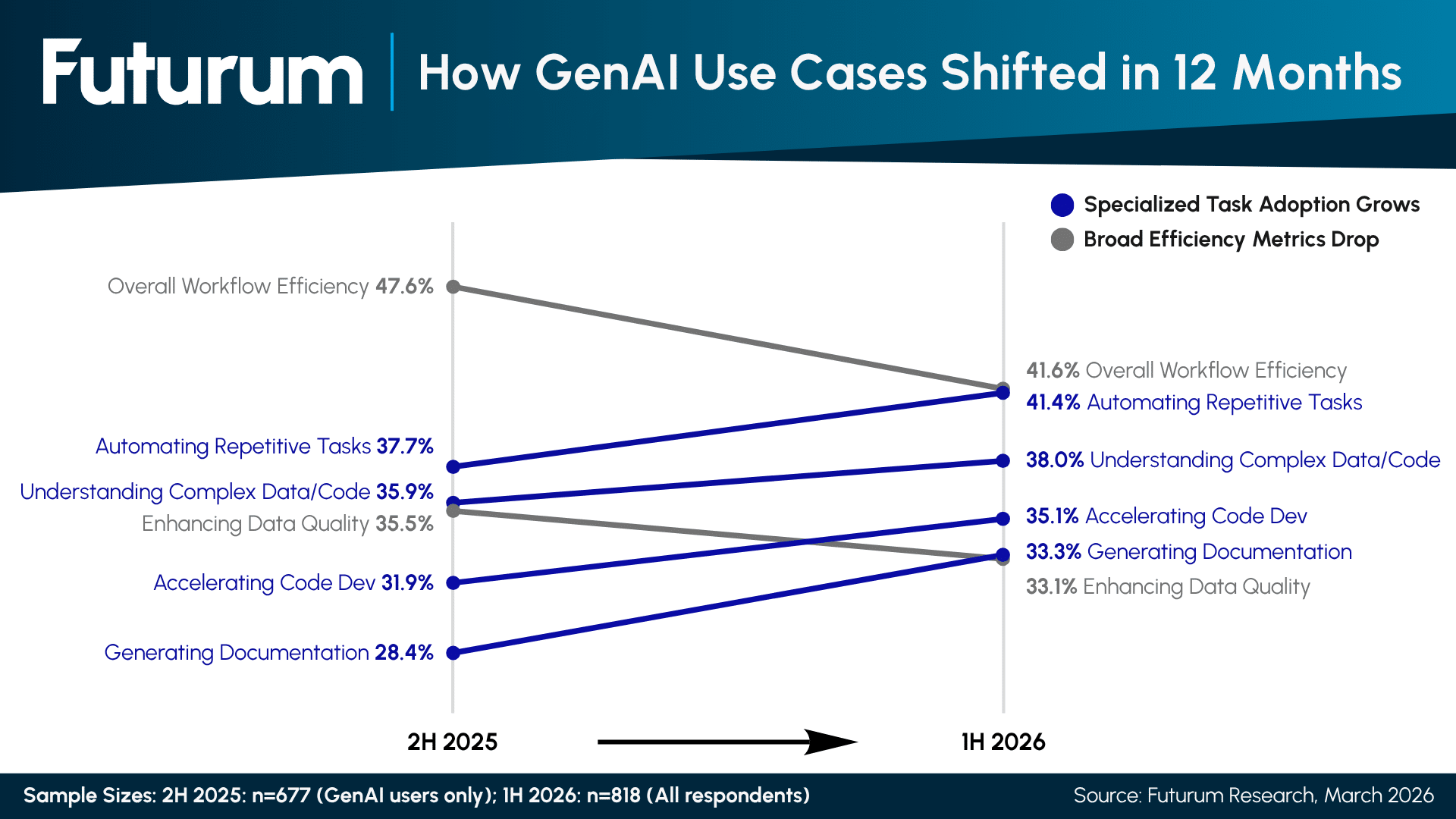
Q: “What are the primary reasons or benefits driving your use of Generative AI to augment and automate your daily data-related workflows?” | Sample Sizes: 2H 2025: n=677 (GenAI users only); 1H 2026: n=818 (All respondents) Source: 1H 2026 Data Intelligence, Analytics, and Infrastructure Decision Maker Survey, March 2026
“The enterprise has officially stopped buying AI according to ‘vibes’ and is now demanding receipts, or at least measurable outcomes,” said Brad Shimmin. “While waiting for agentic tooling and supportive data platforms to mature in terms of delivering full lifecycle agentic reliability and accuracy, organizations are increasingly using GenAI as a precision tool for the pragmatic, often mundane chores of data work.”
The research reveals several key developments shaping the technical AI landscape:
- Technical Reality Check. The six-point drop in overall workflow efficiency as a primary driver suggests that the initial implementation of horizontal AI assistants hit a wall of architectural complexity. Improving a broad workflow requires deep integration across disparate data silos, complex identity and access management (IAM) frameworks, and integration across heterogeneous legacy systems. Technically, creating a general assistant that understands every facet of a business process is a massive data orchestration undertaking that many firms are not yet equipped to handle.
- Documentation and Code as LLM-Native Wins. The surge in specific tasks, such as generating documentation (up 4.9 points) and accelerating code development (up 3.2 points), reveals where the technology actually fits into the current stack. These are essentially LLM-native tasks. Documentation relies on the model’s ability to ingest structured metadata or code and output human-readable explanations—a process that is relatively self-contained and does not require a complete overhaul of the enterprise data fabric. This represents a significant win in reducing technical debt.
- The Data Quality Gap. The decline in the use of AI to enhance data quality (from 35.5% to 33.1%) is interesting. While marketing teams often pitch AI as a cure for “dirty data,” practitioners are finding that LLMs excel at generating new content but struggle to audit existing datasets for absolute truth. Using a probabilistic model to ensure deterministic data quality remains a difficult architectural feat, often leading to hallucinations that require more human oversight, not less. The market is waking up to the fact that AI is a tool for creation and synthesis, rather than a replacement for robust data governance and master data management (MDM) protocols.
- A Movement in Vendor Pressure. This transition puts pressure on general-purpose AI platform providers to move beyond simple chat-window interfaces. To stay relevant, vendors must now offer deeply embedded, task-specific agents that live within the Integrated Development Environment (IDE), CLI, database, or the data catalog. We are seeing an evolution away from the platform-as-a-service model toward a more specialized feature-as-a-service model.
“The findings underscore a grounded approach that builds trust between IT departments and business leadership,” noted Shimmin. “Proving the value of a tool that handles your documentation is straightforward; proving the value of a tool that promises to optimize the entire organization is a much harder climb. This shift toward task-specific utility allows teams to reclaim thousands of engineering hours through sustainable, bottom-up transformation.”
For infrastructure providers, these movements mean greater demand for semantic/knowledge graphs and for retrieval-augmented generation (RAG) models that can support specific, high-context tasks without requiring massive retraining of foundational models. Niche players focusing on AI for DataOps or automated data governance are suddenly in a much stronger position than giants selling broad enterprise AI licenses.
As teams adopt specialized GenAI and agentic AI tools to manage their data estate, they must be careful not to create new AI silos. If the AI documenting data does not play within the same business context as the AI writing the code, organizations risk a new form of technical debt. Success in this next phase of adoption will depend on standardizing the handshake between AI as a generator and human experts as the final reviewers. This ensures that gains in speed do not come at the expense of accuracy, security, or the long-term maintainability of AI-generated assets.
Read more in the report “Enterprise Data Analytics Survey Finds 59% Investing in Semantic Layers as Critical AI Infrastructure” on the Futurum Intelligence Platform.
About Futurum Intelligence for Market Leaders
Futurum Intelligence’s Data Intelligence, Analytics, and Infrastructure IQ service provides actionable insight from analysts, reports, and interactive visualization datasets, helping leaders drive their organizations through transformation and business growth. Subscribers can log into the platform at https://app.futurumgroup.com/, and non-subscribers can find additional information at Futurum Intelligence.
Follow news and updates from Futurum on X and LinkedIn using #Futurum. Visit the Futurum Newsroom for more information and insights.
Other Insights From Futurum:
Gemini Enterprise: Governing and Scaling the Agentic Enterprise
1H 2026 Data Intelligence, Analytics, & Infrastructure Market Sizing & Five-Year Forecast Report
Author Information

Brad Shimmin is Vice President and Practice Lead, Data Intelligence, Analytics, & Infrastructure at Futurum. He provides strategic direction and market analysis to help organizations maximize their investments in data and analytics. Currently, Brad is focused on helping companies establish an AI-first data strategy.
With over 30 years of experience in enterprise IT and emerging technologies, Brad is a distinguished thought leader specializing in data, analytics, artificial intelligence, and enterprise software development. Consulting with Fortune 100 vendors, Brad specializes in industry thought leadership, worldwide market analysis, client development, and strategic advisory services.
Brad earned his Bachelor of Arts from Utah State University, where he graduated Magna Cum Laude. Brad lives in Longmeadow, MA, with his beautiful wife and far too many LEGO sets.

