
Analyst(s): Mitch Ashley
Publication Date: April 3, 2026
Governing agents at production scale is the structural challenge enterprises have yet to solve. The Futurum Agent Control Plane Framework defines a five-layer reference architecture that bridges the gap between agent capability and governability, providing a structural roadmap to guide vendors and buyers through the dizzying array of vendor announcements.
Key Points:
- The Futurum Agent Control Plane Framework (ACPF) addresses the structural gap between abundant agent capability and scarce governability, establishing five capability layers and three cross-cutting foundations as a reference model for the production deployment of AI agents.
- The framework provides systematic evaluation criteria for enterprise procurement, roadmap guidance for vendor product development, and architectural context for standards bodies defining agent governance protocols and interoperability specifications.
- The ACPF enables enterprises to expand agent autonomy incrementally as platforms demonstrate control maturity and evidence generation, rather than forcing a binary choice between no agents and fully autonomous agents operating without oversight.
- Organizations deploying AI agents face a constraint no model capability resolves: they will only grant agents as much autonomy as they can safely observe and control. Agent capability has become abundant across software development, deployment, and operations. Structural governability remains scarce. Without it, enterprises have half a solution.
Figure 1: Deployment Speed Requirements
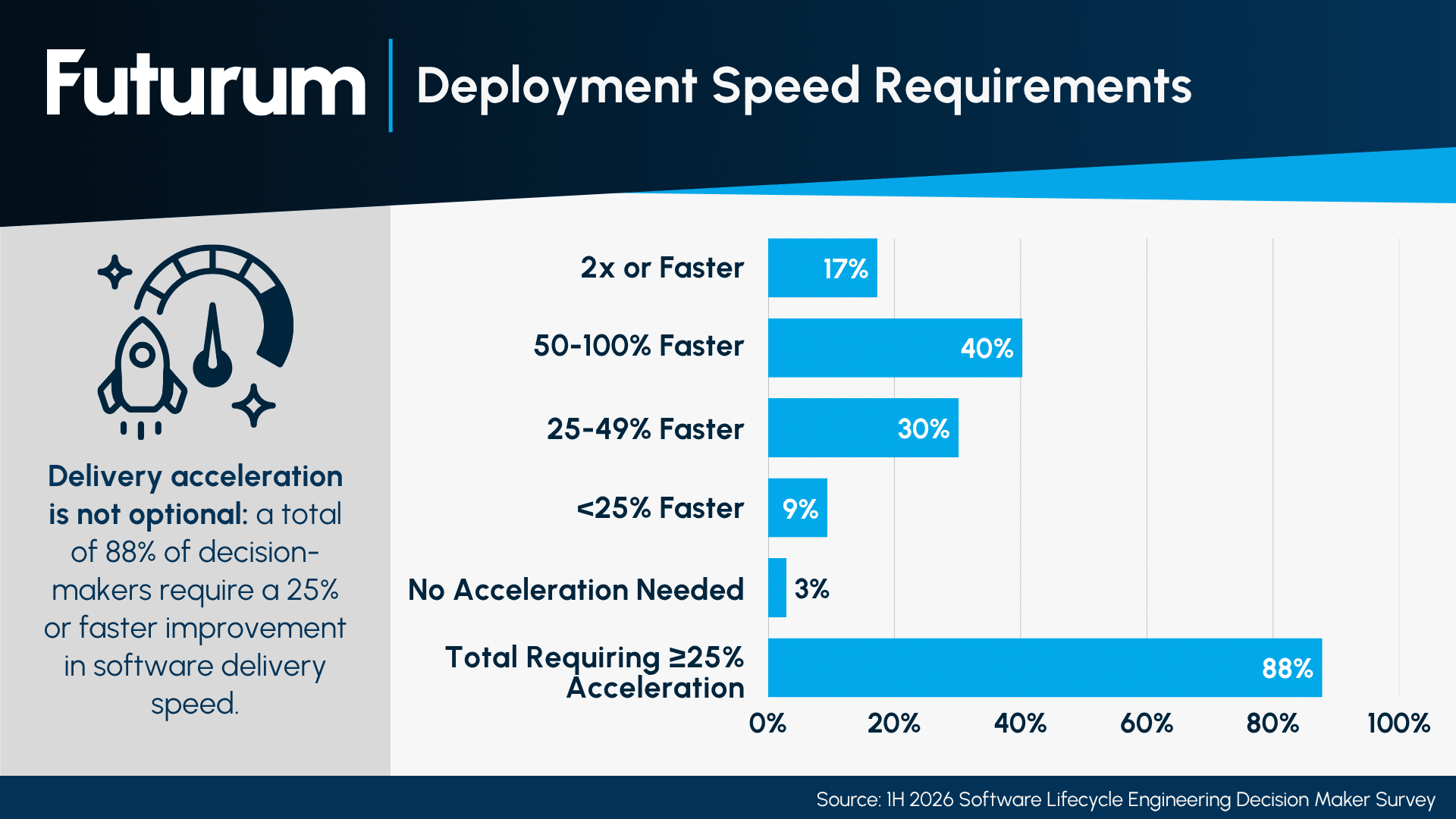
Figure 2: Top 5 Drivers for Accelerating Software Delivery
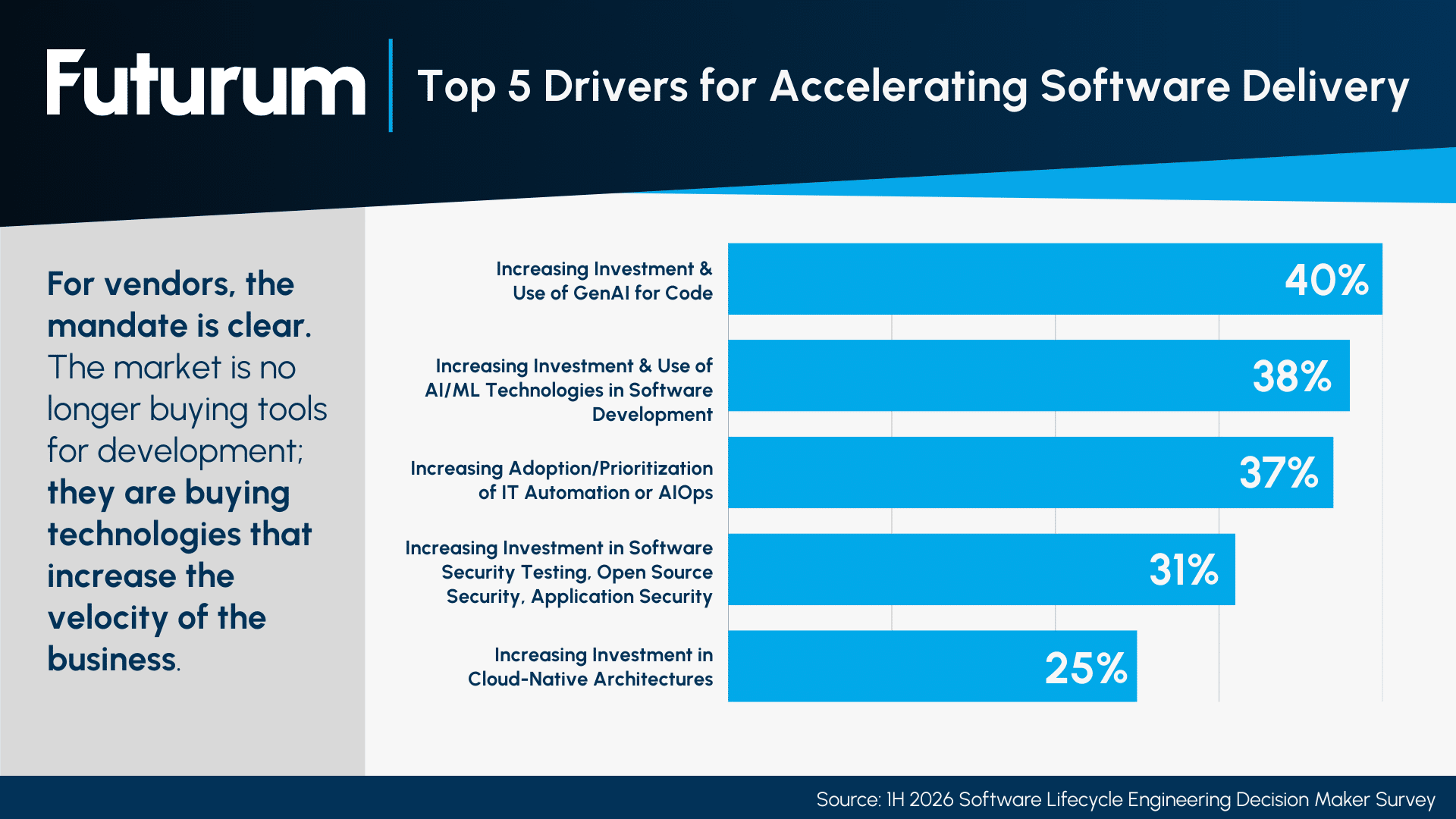
Figures 1 and 2 tell a connected story. Delivery acceleration is not optional: a total of 87.8% of decision-makers require a 25% or faster improvement in software delivery speed. The top two mechanisms they are deploying to get there are GenAI code generation (40.2%) and AI/ML across development (38.4%).
Both translate directly to agent execution at scale across the software lifecycle. Agents are the acceleration strategy. That creates the structural condition ACPF exists to address: organizations are deploying agents at the speed of competitive necessity, while governance infrastructure has not kept pace. The enterprises in that 87.8% are already in the market for agent control planes.
The Governability Gap Enterprises Won’t Ignore: Agent capability is abundant. If enterprises choose to, they can deploy AI agents across software development, deployment, and operations today. Development environments ship autonomous coding agents. Deployment platforms enable agent-driven pipelines. Operations tools provide agent-controlled remediation. Structural governability remains scarce. Without it, organizations cannot safely grant agents the authority those agents are capable of exercising.
By the end of 2026, agent control planes will determine whether AI-centered software engineering moves from experimentation into fully sustained, production-scale execution. Organizations that do not establish unified control planes for agent identity, permissions, lifecycle, policy enforcement, and execution oversight will remain constrained to isolated, low-trust use cases.
The Agent Control Plane Framework: The Futurum ACPF defines what governability requires at the architectural level. The foundational principle: agents decide, control planes govern, execution environments enforce, and systems generate evidence. This principle separates agent intelligence from agent authority, capability from permission, and explanation from forensics.
The framework serves three distinct purposes. For enterprises, it provides systematic evaluation criteria for assessing platform maturity and structuring procurement requirements. For vendors, it provides architectural guidance for product development using a shared vocabulary aligned with buyer expectations. For standards bodies, it provides architectural context for where governance standards apply and what problems they solve.
Five Capability Layers: The ACPF organizes control into five layers. Layer 0 (Execution Environment) is where governance becomes physical: without it, all control above is advisory. Layer 1 (Knowledge Authority) scopes what agents are permitted to know. Layer 2 (Behavior Guardrails) makes unsafe actions structurally impossible, not just prohibited. Layer 3 (Governance) enforces the authorization checkpoint between the reading context and the writing state. Layer 4 (Coordination) aligns multi-agent workflows through observable, auditable protocols.
Figure 3: Agent Control Plane Framework
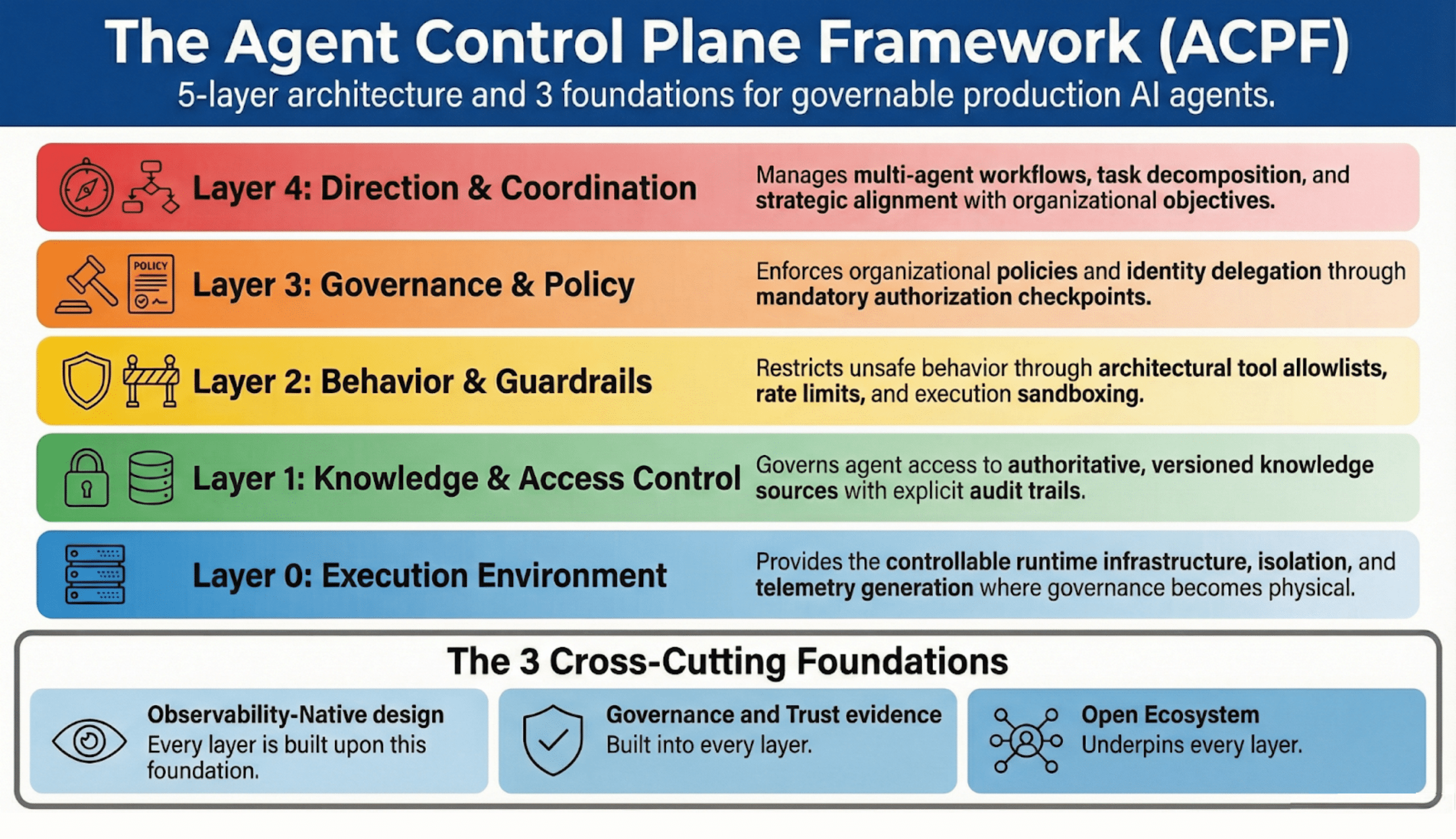
Three Cross-Cutting Foundations: Three foundations are embedded across all five layers and are non-negotiable for production deployment. Observability-Native captures the complete decision cycle: intent, reasoning, constraints, outcomes. Without it, control planes cannot provide the evidence required for real-time governance or regulatory audit. Machine-speed governance is impossible without it. Governance and Trust provides evidence generation with tamper resistance, chain of custody, and non-repudiation through cryptographic identity verification. Organizations in regulated industries require these properties to meet SOC 2, HIPAA, PCI, and EU AI Act requirements. Open Ecosystem prevents vendor lock-in at three levels: runtime portability across infrastructure, control-plane portability to ensure governance policies are infrastructure-agnostic, and state portability to enable execution state to migrate across platforms. Open standards adoption (OpenTelemetry, MCP, A2A) is required, not aspirational.
ACPF in Practice: Enterprise procurement teams use five layers and three foundations as RFP requirements, scoring vendors on maturity across each capability layer and requiring demonstration of execution environment control surfaces, authorization checkpoint implementation, and Open Ecosystem support.
Vendor product teams map current capabilities against framework layers to identify gaps and prioritize roadmap items using shared terminology that aligns with buyer expectations. Compliance teams use the Governance and Trust foundation to establish evidence requirements for regulatory audit, mapping SOC2, HIPAA, PCI, and EU AI Act obligations to specific framework capabilities. Standards bodies reference this model when defining agent governance specifications, telemetry conventions, and interoperability protocols.
Conclusion
The market need is established. Enterprise procurement is moving ahead of broad agent deployment. Vendors are responding, but with incompatible terminology, inconsistent priorities, and no shared architectural frame. Without a common reference model, buyer confusion becomes the default outcome, and the most capable vendors lose to the best-marketed ones.
The ACPF provides the common frame. Vendors who map against five layers and three foundations expose their gaps and clarify their differentiators. Enterprises that evaluate against framework criteria separate architectural evidence from marketing claims. The gap between those two categories will widen as production deployments scale.
The window to establish control infrastructure before broad agent deployment is closing. Vendors must map their architecture against the framework now. Enterprises require vendors to demonstrate maturity layer by layer, with evidence. Agent control planes will determine whether AI-driven software engineering scales from experimentation into sustained production. The market will reward those who deliver it.
The full report, “Futurum Agent Control Plane Framework: A Reference Model for Production AI Agents,” is available via subscription to Futurum Intelligence’s Software Lifecycle Engineering IQ service—click here for inquiry and access.
About the Futurum Software Lifecycle Engineering Practice
The Futurum Software Lifecycle Engineering Practice provides actionable, objective insights for market leaders and their teams so they can respond to emerging opportunities and innovate. Public access to our coverage can be seen here. Follow news and updates from the Futurum Practice on LinkedIn and X. Visit the Futurum Newsroom for more information and insights.
About Futurum Intelligence for Market Leaders
Futurum Intelligence’s IQ service provides actionable insight from analysts, reports, and interactive visualization datasets, helping leaders drive their organizations through transformation and business growth. Subscribers can log into the platform at https://app.futurumgroup.com/, and non-subscribers can find additional information at Futurum Intelligence.
Follow news and updates from Futurum on X and LinkedIn using #Futurum. Visit the Futurum Newsroom for more information and insights.
Other Insights from Futurum:
The Seven Principles of Observability-Native (Subscribers)
Securing Agentic AI Is the Multi-Level Challenge for Security Teams
1H 2026 Software Lifecycle Engineering Decision-Maker Survey Report
AWS’s Deploy-to-AWS Plugin: Frictionless Deployment or Developer Honeypot?
Claude Found 500 Zero-Days. Who Patches Them Before Attackers Arrive?
Author Information

Mitch Ashley is VP and Practice Lead for the CIO & Technology Buyers and Software Lifecycle Engineering practices at The Futurum Group. A multi-time CIO and CTO with 30+ years leading technical organizations, Mitch built and operated production systems spanning cybersecurity for the U.S. Department of Defense, PKI services for the broadband and 5G industries, SaaS platforms, large-scale telecom and banking systems, and a national broadband network. His work with AI began early, developing expert systems that diagnosed and repaired complex mainframe environments. That operator foundation grounds his analysis in operational consequence, covering the technology buyer's world of software engineering, cybersecurity, DevOps, cloud, and AI.

