Analyst(s): Olivier Blanchard
Publication Date: February 5, 2026
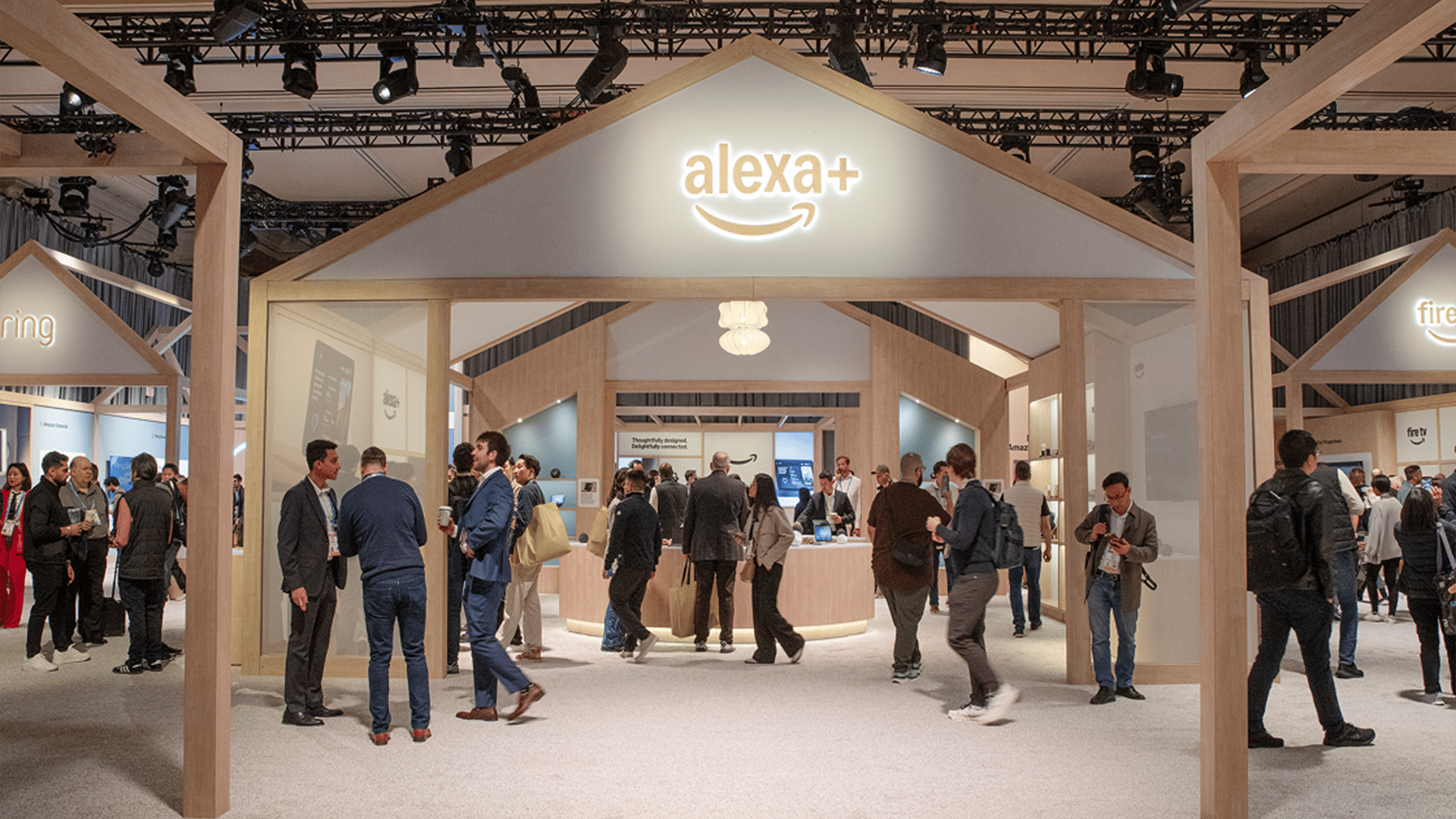
At CES 2026, just over a month ago, Amazon announced major updates across its Ring, Fire TV, and Alexa+ ecosystems, spanning AI-powered security, a redesigned TV interface, and expanded assistant integrations across web, home, and vehicles.
What is Covered in this Article:
- Ring’s new AI-powered alerts, sensors, Fire Watch, and Sidewalk-based expansion
- Fire TV’s redesigned user interface and launch of the Amazon Ember Artline lifestyle TV
- Alexa+ expansion to the web and integrations with Samsung TVs, BMW vehicles, and other partners
- The scope and pace of Amazon’s multi-surface device and service updates announced at CES 2026
The News: Barely a month ago, at CES 2026, Amazon announced a broad set of product and service updates across its Ring, Fire TV, and Alexa+ segments: Ring introduced new AI-powered security features, Sidewalk-enabled sensors, Fire Watch with Watch Duty, a Ring Appstore for third-party applications, and expanded jobsite and vehicle security offerings. Fire TV received a redesigned interface with considerable speed improvements, alongside the launch of the Amazon Ember Artline lifestyle TV and a redesigned Fire TV mobile app. Amazon also expanded Alexa+ across new surfaces, including the launch of Alexa.com for web-based access and new integrations with third-party partners.
Alexa+ will be built into select Samsung TVs, BMW vehicles via Alexa Custom Assistant, Bosch coffee machines, and health devices such as Oura, extending the assistant across home, vehicle, web, and wellness use cases.
Amazon CES 2026: Do Ring, Fire TV, and Alexa+ Add Up to One Strategy?
Analyst Take: Amazon’s CES 2026 announcements reflect a coordinated effort to advance device experiences, AI-driven services, and cross-surface access under the Alexa+, Ring, and Fire TV brands. In other words, Amazon is currently prioritizing faster interfaces, broader integrations, and expanded availability across security, entertainment, and personal assistance over traditional flagship product releases.
Collectively, the updates highlight Amazon’s continued investment in embedding AI capabilities into everyday devices and environments. But one question that keeps nagging me is whether Amazon’s communication strategy, or rather its messaging around how all of those pieces fit under its Alexa+ umbrella of capabilities, is landing with consumers.
Ring Expands From Home Security Into Sensors, Vehicles, and Jobsites
Ring introduced a wide range of AI-powered features and new devices focused on alerts, sensors, and always-on connectivity to help augment the utility of Ring products and make it a more attractive investment for consumers.
New capabilities such as AI Unusual Event Alerts and Active Warnings use Video Descriptions and computer vision to adapt alerts to routine patterns and deliver context-aware deterrents, while Fire Watch integrates community-shared visuals with Watch Duty for real-time fire awareness. The new Ring Sensors lineup, built on Amazon Sidewalk, removes reliance on Wi-Fi, hubs, or base stations and introduces three layers of protection spanning security, safety, and control. All good features.
Ring also extended its footprint beyond the home with the Ring Car Alarm, Sidewalk-based GPS monitoring, and enterprise-oriented offerings such as the Ring Mobile Security Trailer and Ring Elite. Taken together, these announcements position Ring as a broader, multi-environment security platform rather than a camera-centric home product.
Having said that, many of these features seem to, at best, fit niche use cases, and at worst, raise questions about privacy at a time when most consumers are becoming weary of being the victims of surveillance they didn’t consent to. On the matter of niche use cases, I have no issue. Niche use cases often drive some of the best innovations because they focus on core users, and while a new feature emerging from a niche use case may not immediately bring value to mainstream users, it tends to evolve into popular feature sets a generation or two later. I actually like that the Ring team listens to feedback and acts on it. No notes. On the privacy front, however, the tension between AI-enhanced utility in smart cameras and users’ need for privacy still hasn’t been effectively solved for by Amazon. This isn’t to say that Amazon isn’t doing many things right. The Ring product team has gone to great lengths to give as much control to users as it can (I love the zone setup, for example), and users can opt out of many of the more networked features that could prove problematic if they want to ensure maximum privacy. Still though, Amazon should rethink its Ring messaging to emphasize user privacy and controls in order to paint its new AI features in a light that creates excitement rather than raising questions.
Fire TV Focuses on Interface Speed, Discovery, and Lifestyle Hardware
Amazon overhauled the Fire TV experience with a redesigned interface that is cleaner, more organized by content type, and rebuilt at the code level to deliver reported speed gains of up to 20–30% in some cases. The update expands app pinning from 6 to 20, adds shortcut panels for settings and connected devices, and integrates Alexa+ features such as scene-level navigation in Prime Video. Having tested the new voice-enabled search and navigation features for months now, I have to give the Fire TV team its due: The new functionality is smoother, faster, and more useful by orders of magnitude. No more clunky, programmatic prompts and navigation. Everything feels more fluid, natural, native, and smart now. Finally.
Alongside the interface update, Amazon launched the Amazon Ember Artline, its first lifestyle TV, featuring a matte 4K QLED display, far-field microphones, Omnisense presence detection, and access to more than 2,000 pieces of free art. The Artline also introduces AI-powered art recommendations based on room photos and integrates tightly with Amazon Photos and the new Fire TV UI. The most critical element of this release is the matte display, which works well when in art mode, to look less like a TV and more like an analog piece of art on the wall. Using a frame completes the illusion, which is the point: Rather than having a black piece of rectangular glass on the wall when the TV isn’t in use, or a TV rotating through screensaver-style art and photos, Artline helps erase physical technology from its analog environment, in an effort to be less interruptive. This follows Amazon Devices & Services SVP Panos Panay’s general vision for Amazon devices becoming more embedded and less interruptive to make environments feel calmer, serene, and natural.
Collectively, these changes reinforce Fire TV’s emphasis on faster discovery and ambient experiences rather than incremental streaming features. While overdue, these new features both reset expectations for Fire TV’s value and performance, and for the future of Amazon devices in general.
Alexa+ Extends Across Web, Home, and Vehicle Surfaces
Amazon expanded Alexa+ beyond voice and mobile with the launch of Alexa.com, bringing the assistant to web browsers with persistent context across devices. Since launch, Alexa+ has scaled to tens of millions of customers, with reported increases in conversation frequency, purchases, and recipe requests.
New integrations extend Alexa+ into third-party devices for the first time, including select Samsung smart TVs, Bosch coffee machines, and BMW vehicles using Alexa Custom Assistant. In vehicles, Alexa Custom Assistant enables natural dialogue for vehicle functions, navigation, and connected services, supported by integrations with HERE Technologies and TomTom. These announcements underscore Amazon’s intent to make Alexa+ accessible across environments rather than confining it to Amazon-owned hardware.
Perhaps even more importantly, the expansion of Alexa+ to environments outside of the home points to new market penetration possibilities for Alexa: Automotive environments, obviously, but also the very real possibility of seeing Alexa+ enter the AI glasses space, where a voice-first assistant makes the most sense.
Breadth Over Depth Defines Amazon’s CES 2026 Strategy
Across Ring, Fire TV, and Alexa+, Amazon’s CES announcements emphasized simultaneous progress across security, entertainment, and AI assistance rather than deep focus on a single domain.
Amazon highlighted speed improvements, expanded availability, and new integrations, while relying on existing platforms such as Sidewalk, Alexa+, and Fire TV as its connective tissue. This approach demonstrates Amazon’s ability to ship frequent updates across multiple product lines within short timeframes, as seen with Bee team updates and rapid Alexa+ expansion. I expect that as the Alexa+ ecosystem grows, the ability to add more speed to that process, while minimizing user friction, will continue to give Amazon devices an edge (no pun intended) over other AI-enabled device vendors. That and Amazon’s growing reliance on its own silicon to deliver differentiated experiences, but that is a topic for another time.
Managing coherence across so many product categories and product team silos, however, may prove challenging. The connective tissue between Ring, Fire, Alexa+, Bing, and other products is still growing and having to displace old sinews and scar tissue. Messaging around privacy still needs a lot of work. Retraining users to abandon outdated prompts and old (often lackluster) UX expectations will also take time. It may not seem like it at first glance, because Ring, Fire TV, and Alexa are all familiar names, but Amazon’s device division is going through a fascinating and exciting transformation, thanks in part to AI but also to a new aesthetic and UX vision from its design leadership team, and the announcements at CES 2026 bear this out.
What to Watch:
- Adoption and customer usage of Ring’s Sidewalk-based sensors and Fire Watch features
- Rollout timing and performance of the redesigned Fire TV UI across additional devices and regions
- User engagement trends as Alexa+ expands to web browsers and third-party hardware
- Execution consistency as Amazon continues shipping updates across multiple product categories
See the complete Amazon CES 2026 announcements covering Ring, Fire TV, and Alexa+ on the Amazon website.
Declaration of generative AI and AI-assisted technologies in the writing process: This content has been generated with the support of artificial intelligence technologies. Due to the fast pace of content creation and the continuous evolution of data and information, The Futurum Group and its analysts strive to ensure the accuracy and factual integrity of the information presented. However, the opinions and interpretations expressed in this content reflect those of the individual author/analyst. The Futurum Group makes no guarantees regarding the completeness, accuracy, or reliability of any information contained herein. Readers are encouraged to verify facts independently and consult relevant sources for further clarification.
Disclosure: Futurum is a research and advisory firm that engages or has engaged in research, analysis, and advisory services with many technology companies, including those mentioned in this article. The author does not hold any equity positions with any company mentioned in this article.
Analysis and opinions expressed herein are specific to the analyst individually and data and other information that might have been provided for validation, not those of Futurum as a whole.
Other insights from Futurum:
Amazon EC2 G7e Goes GA With Blackwell GPUs. What Changes for AI Inference?
Amazon Q3 FY 2025 Earnings: AWS Reaccelerates, Retail and Ads Grow
New Amazon Devices Signal the Expansive Market Potential of Alexa+
Image Credit: Amazon
Author Information

Olivier Blanchard is Research Director, Intelligent Devices. He covers edge semiconductors and intelligent AI-capable devices for Futurum. In addition to having co-authored several books about digital transformation and AI with Futurum Group CEO Daniel Newman, Blanchard brings considerable experience demystifying new and emerging technologies, advising clients on how best to future-proof their organizations, and helping maximize the positive impacts of technology disruption while mitigating their potentially negative effects. Follow his extended analysis on X and LinkedIn.