Analyst(s): Nick Patience
Publication Date: January 16, 2026
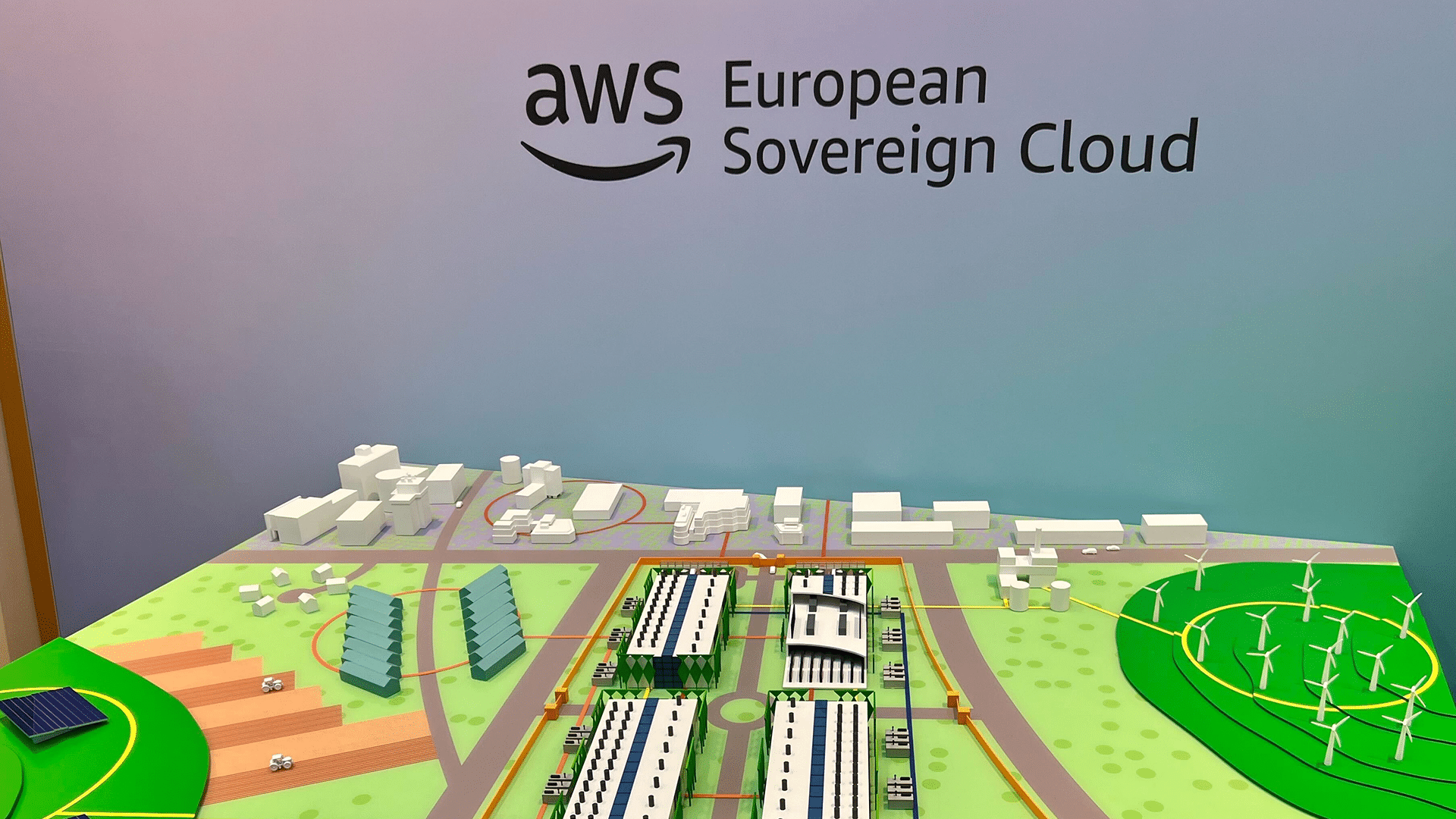
Amazon Web Services has launched its European Sovereign Cloud (ESC) offering at an event in Potsdam, Germany. Four years in the making and representing a 7.8 billion euro investment for the company, ESC offers 90+ cloud services in a physically and logically separate cloud environment, staffed by EU residents and eventually only by EU citizens.
What is Covered in this Article:
- General Availability of the AWS European Sovereign Cloud (ESC): Detailed coverage of the official launch in Potsdam, Germany, representing a €7.8 billion investment and four years of development.
- Technical and Physical Isolation Safeguards: An analysis of the ESC’s independent control, billing, and IAM planes, which are logically and physically separate from existing AWS Regions to ensure operational autonomy.
- Market Competition and the Sovereignty Premium: An evaluation of how AWS compares to rivals like Microsoft and Oracle, including the premiums customers pay for these specialized environments.
- Early Adoption and Regulatory Impact: A look at the public sector and highly regulated industry partners – such as ITZBund, EWE AG, and SAP – already leveraging the ESC to meet stringent compliance needs.
The News: AWS has announced the general availability of the AWS European Sovereign Cloud (ESC) at a launch event in Potsdam, near Berlin. This independent cloud infrastructure is physically and logically separate from existing AWS Regions, designed to meet the stringent data residency, operational autonomy, and sovereignty needs of European governments and enterprises. The launch is supported by a long-term investment of €7.8 billion in Germany. Alongside the ESC, AWS revealed plans to extend the ESC footprint with new sovereign Local Zones in Belgium, the Netherlands, and Portugal that will be connected to the ESC.
AWS European Sovereign Cloud Debuts with Independent EU Infrastructure
Analyst Take: The introduction of the AWS European Sovereign Cloud marks a notable intensification of the competition among hyperscalers over data sovereignty. While AWS previously relied on a sovereign-by-design approach within its existing regions, the ESC represents a total technical decoupling intended to satisfy the most cautious European customers and their regulators. By locating all data – including metadata, billing and identity management – entirely within the EU and staffed exclusively with EU residents (and eventually citizens), AWS is trying to neutralize the legal and geopolitical risks associated with the U.S. Cloud Act, which enables US law enforcement, under certain conditions, to compel US-based cloud providers (such as AWS) to hand over data stored anywhere in the world, even if that data belongs to foreign entities or is stored in a different jurisdiction (e.g. the EU).
While the €7.8 billion investment over the past four years is impressive, AWS enters a market where sovereignty is often viewed through a lens of legal jurisdiction rather than just physical location. European governments and companies may question whether a cloud service wholly owned by a US-headquartered entity can ever be truly sovereign in the eyes of the most stringent EU regulators.
Executives from AWS and its partners, whom we spoke with at the event, held at the Hasso Plattner Institute (founded and initially funded by SAP co-founder Hasso Plattner), were understandably bullish on the opportunities and adamant that the ESC marked a step-change from the numerous cloud regions from other hypercaler and joint ventures and other arrangements US tech companies make to accommodate EU regulations.
A Cloud, not just another region
AWS European Sovereign Cloud (ESC) offers a comprehensive cloud environment from day one, launching with more than 90 services covering areas such as AI, compute, databases, networking, security, and storage. This contrasts with a standard AWS region launch, which typically begins with a limited set of services.
The ESC operates with entirely independent control, billing, and Identity and Access Management (IAM) planes. Security is a core feature; customer data in Amazon EC2 is protected by the AWS Nitro System, which strictly prevents unauthorized access, including by AWS personnel. Additionally, customers can further secure their content using AWS’s advanced encryption, key management services, and hardware security modules. Without the correct decryption keys, encrypted data remains completely unusable.
Customers will pay a sovereignty premium for the services compared to a region in Frankfurt. AWS estimated the premium at 10-15%. AWS users pay a similar premium for AWS’s FedRAMP-compliant cloud in the US and for similar services from rival cloud providers. For enterprises, the value proposition rests on whether this isolation provides enough regulatory peace of mind to justify potentially higher costs.
Customers, Partners & Policy-makers
Although this week saw the official launch, the ESC has been operating since December 8, just after AWS’s re:Invent event in Las Vegas, but it was smart to feature the launch in the heart of Europe rather than Vegas. AWS was supported in its endeavors in Potsdam by policymakers from across Europe – including Ukraine – as well as customers including WE AG, ETERNO, ITZBund and Swiss Life Germany, as well as key partners such as Accenture, adesso SE, Arvato Systems, Capgemini, Dedalus Group, Deloitte, Genesys, PwC, Kyndryl, Nuvibit, Rackspace, and SAP, who plan to use the AWS European Sovereign Cloud to offer more choice to their customers.
It is likely that early additional customers for AWS ESC will come from the European public sector, as well as the most regulated industries, such as financial services and healthcare.
The Battle for EU Control: AWS vs. The Rest
AWS is not moving into a vacuum; it is in part responding to aggressive maneuvers by Microsoft and Oracle. Microsoft rolled out its sovereign cloud to comply with EU regulations in mid-2025 and has since added AI services within its EU Data Boundary. Oracle, meanwhile, has found success with its Cloud@Customer model, which keeps data on the customer’s premises, though AWS has a similar offering. The AWS ESC is a more centralized approach, betting that customers will prefer a fully featured, albeit isolated, cloud over the hybrid compromises offered by competitors.
US hyperscalers control the majority of the European cloud market, but local providers are also finding business where European entities want to disengage from US providers over fears of US jurisdiction effectively extending to US cloud providers operating in Europe, serving European customers. AWS says it will abide by all relevant European laws.
Another risk here is vendor lock-in; by building workloads on a highly specialized sovereign silo, customers may find it technically difficult and expensive to migrate back to global environments or other providers, potentially violating the spirit of the EU Data Act’s mandates for free switching and interoperability. AWS CEO Matt Garman was asked about lock-in at an analyst session at the launch, to which he responded that it’s never been easier to move between vendors, comparing it to the situation pre-cloud, when customers were locked into Windows operating systems and proprietary databases.
What to Watch:
- The next phase of the ESC will be defined by its transition from EU-resident to exclusively EU-citizen staffing, a move that will further harden its “sovereign” status against foreign interference.
- Watch for how Microsoft and Google respond to AWS’s move; they may be forced to increase their own capital expenditures in specific EU member states to keep pace.
- The success of the new sovereign Local Zones in Belgium, Portugal, and the Netherlands will be a litmus test for whether AWS can maintain low-latency performance while scaling the strict isolation required by the ESC framework.
See the press release on AWS’s ESC launch.
Disclosure: Futurum is a research and advisory firm that engages or has engaged in research, analysis, and advisory services with many technology companies, including those mentioned in this article. The author does not hold any equity positions with any company mentioned in this article.
Analysis and opinions expressed herein are specific to the analyst individually and data and other information that might have been provided for validation, not those of Futurum as a whole.
Other insights from Futurum:
AWS re:Invent 2025: Wrestling Back AI Leadership
Amazon Q3 FY 2025 Earnings: AWS Reaccelerates, Retail and Ads Grow
Are We in a New Westphalian World Web? – Report Summary
Author Information

Nick Patience is VP and Practice Lead for AI Platforms at The Futurum Group. Nick is a thought leader on AI development, deployment, and adoption - an area he has researched for 25 years. Before Futurum, Nick was a Managing Analyst with S&P Global Market Intelligence, responsible for 451 Research’s coverage of Data, AI, Analytics, Information Security, and Risk. Nick became part of S&P Global through its 2019 acquisition of 451 Research, a pioneering analyst firm that Nick co-founded in 1999. He is a sought-after speaker and advisor, known for his expertise in the drivers of AI adoption, industry use cases, and the infrastructure behind its development and deployment. Nick also spent three years as a product marketing lead at Recommind (now part of OpenText), a machine learning-driven eDiscovery software company. Nick is based in London.