
Austin, Texas, USA, February 4, 2026
The Futurum Group today announced the release of its latest study, the “1H 2026 Enterprise Software & Digital Workflows Market Sizing & Five-Year Forecast,” which details a pivotal super-cycle of reinvestment. The research highlights a fundamental structural reset of the technology stack, forecasting the global market to grow from $341.4B in 2024 to $762.1B by 2031 at a 12.2% CAGR. This growth is driven by a “K-Shaped” divergence where capital flows aggressively toward alpha-generating, AI-native infrastructure while deflating labor-intensive, seat-based software sectors.
The center of gravity has permanently shifted from “Systems of Record”—which merely document business activity—to “Systems of Agency,” where autonomous AI agents actively execute work and generate revenue. This transition is most evident in the CRM segment, which, by 2031, is expected to reach $248.7B, nearly double the size of the ERP market at $140B. Furthermore, the “SaaS Mandate” is now absolute, with cloud-native deployments expected to capture 86% of the total market by 2031, effectively relegating on-premise solutions to a “legacy tax”.
Figure 1: Market Growth by Segment (%YoY)
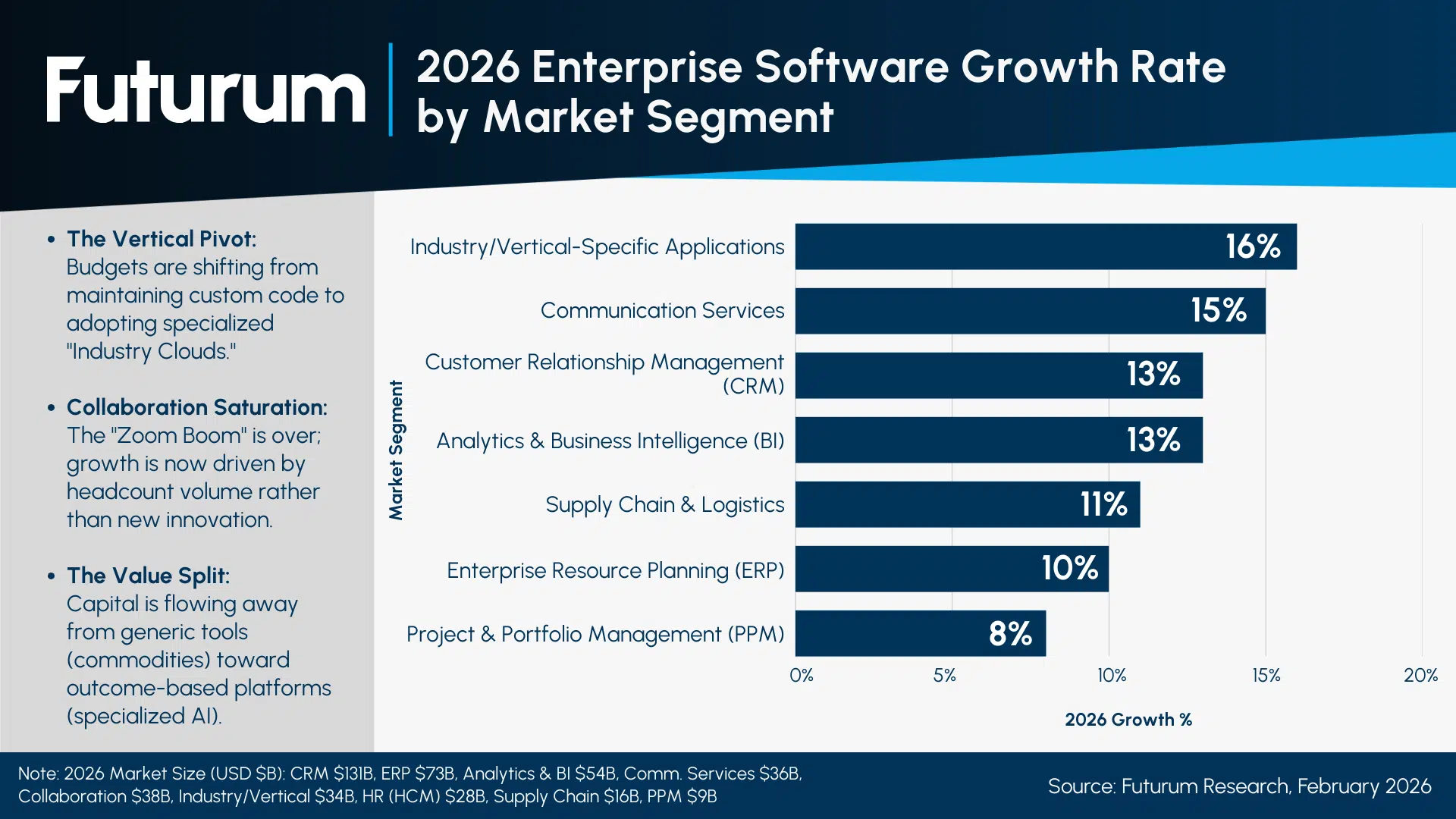
“The enterprise software market is no longer a monolith where a rising tide lifts all boats,” said Keith Kirkpatrick, Vice President and Research Director at The Futurum Group. “We are seeing a stark bifurcation. In sectors like Healthcare and TMT, AI is an additive value creator, but in Business Services, Agentic AI is a deflationary force that automates billable human hours. For vendors, the path forward requires a radical pivot from selling software seats to monetizing AI-driven outcomes. Those who stay tethered to legacy on-premise models or per-user pricing are effectively opting out of the Agentic AI era.”
Our research also highlights several key developments:
- TMT Reclaims the Top Spot: Driven by the massive build-out of AI infrastructure, the Tech, Media, and Telecom vertical will become the largest global market segment, reaching $145.9B by 2031.
- The APAC Growth Engine: Asia Pacific is leapfrogging Western technical debt, moving straight to mobile-first, cloud-native AI platforms to achieve a market-leading 17.2% CAGR.
- The Compliance Paradox: In Financial Services, innovation is being secondary to governance; winners will be those who provide “Safety Stacks” (Control Planes and Observability) that can pass rigorous regulatory audits.
- Healthcare’s Care Automation S-Curve: Healthcare has emerged as the fastest-growing vertical (15.5% CAGR) as providers adopt Agentic AI to solve global clinical staff shortages.
Subscribers can read more in the full report—“1H 2026 Enterprise Software & Digital Workflows Market Sizing & Five-Year Forecast”—on the Futurum Intelligence Platform. Non-subscribers click here for more information.
About Futurum Intelligence for Market Leaders
Futurum Intelligence’s Enterprise Software & Digital Workflows IQ service provides actionable insight from analysts, reports, and interactive visualization datasets, helping leaders drive their organizations through transformation and business growth.
Subscribers can log into the platform at https://app.futurumgroup.com/, and non-subscribers can find additional information at Futurum Intelligence.
Follow news and updates from Futurum on X and LinkedIn using #Futurum. Visit the Futurum Newsroom for more information and insights.
Other Insights from Futurum:
Will the U.S. Army’s $5.6B Salesforce Deal Set the Standard for Modernization?
Will Microsoft’s “Frontier Firms” Serve as Models for AI Utilization?
Will Twilio’s Partnership with AEG Redefine Fan Engagement in Live Events?
Author Information

Keith Kirkpatrick is VP & Research Director, Enterprise Software & Digital Workflows for The Futurum Group. Keith has over 25 years of experience in research, marketing, and consulting-based fields.
He has authored in-depth reports and market forecast studies covering artificial intelligence, biometrics, data analytics, robotics, high performance computing, and quantum computing, with a specific focus on the use of these technologies within large enterprise organizations and SMBs. He has also established strong working relationships with the international technology vendor community and is a frequent speaker at industry conferences and events.
In his career as a financial and technology journalist he has written for national and trade publications, including BusinessWeek, CNBC.com, Investment Dealers’ Digest, The Red Herring, The Communications of the ACM, and Mobile Computing & Communications, among others.
He is a member of the Association of Independent Information Professionals (AIIP).
Keith holds dual Bachelor of Arts degrees in Magazine Journalism and Sociology from Syracuse University.
