
Analyst(s): Alex Smith
Publication Date: March 26, 2026
The enterprise technology marketplace is undergoing a fundamental transformation, evolving from a simple procurement channel into a complex, multi-layered ecosystem. This report explores four primary marketplace archetypes: Hyperscaler, SaaS, Agentic/LLM, and Distributor, and how they are collectively reshaping the discovery and purchasing of software. As these models become increasingly interconnected, understanding their unique commercial logics is essential for enterprise leaders and ISVs to navigate the future of technology commerce.
Key Points:
- The marketplace opportunity extends beyond the major hyperscaler marketplaces. While it is true that hyperscaler marketplaces command the most economic opportunity – currently projected to reach $41.8B by 2029 – they represent just one marketplace model now operating across the enterprise technology landscape.
- The cloud marketplace ecosystem now spans hyperscaler marketplaces, SaaS marketplaces, agentic and LLM marketplaces, and distributor marketplaces. Each serves a distinct buyer need, operates on different commercial logics, and creates value in fundamentally different ways. In addition, there are marketplace management platforms and marketplace-as-a-service platforms, both of which play an important role in activating marketplace opportunities.
- Channel partners are already transacting across multiple marketplace types. Futurum Intelligence data shows that 87% of channel partners see customers purchasing through hyperscaler marketplaces at least somewhat frequently, with 40% reporting very frequent activity.
Overview:
The enterprise technology marketplace has evolved from a single procurement channel into a diverse, multi-layered ecosystem that is fundamentally reshaping how software is discovered, purchased, and deployed. There are four primary marketplace archetypes that enterprise technology leaders, channel partners, and ISVs must understand to navigate this increasingly complex landscape.
Figure 1: Marketplace Landscape 2026
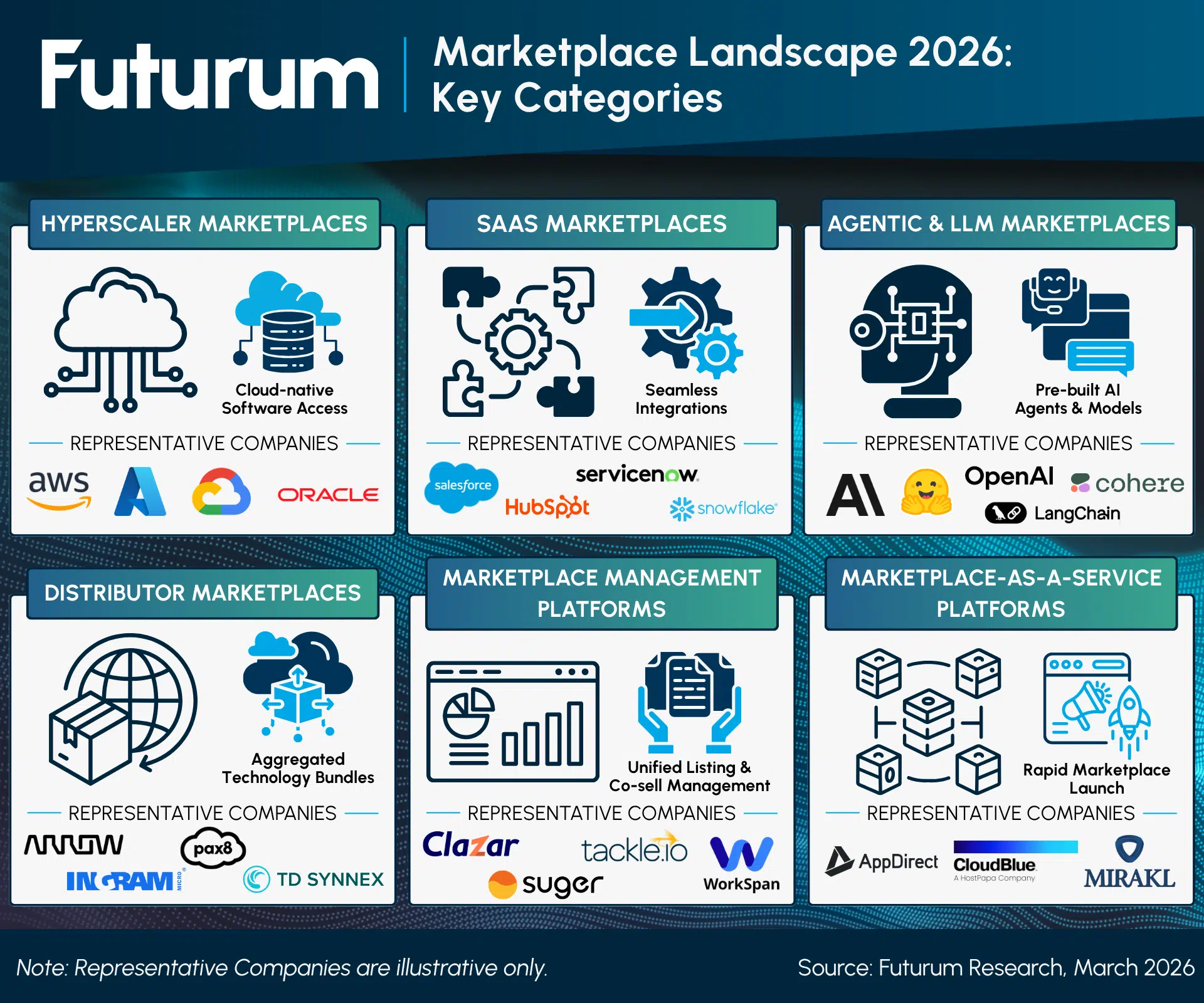
Hyperscaler marketplaces are the commercial center of gravity. Operated by AWS, Microsoft Azure, and Google Cloud, these platforms allow enterprises to purchase third-party software against pre-committed cloud budgets. Futurum’s forecast projects the global hyperscaler marketplace will grow from approximately $21B in 2025 to $41.8B by 2029 (~18% CAGR), now representing roughly 5% of global enterprise software spend. Survey data confirms the depth of adoption: 87% of channel partners report customers purchasing through these marketplaces at least somewhat frequently. AWS retains scale leadership, positioned in the Elite zone in Futurum’s Signal report, while Microsoft and Google Cloud close the gap through co-sell integration and AI-native catalogs.
SaaS Marketplaces (e.g., Salesforce AppExchange, ServiceNow Store) serve a fundamentally different purpose – extending the functionality of specific platforms rather than aggregating software for procurement efficiency. Their value lies in ecosystem cohesion and integration-native discovery. Notably, platforms such as Salesforce are evolving toward transactable capabilities and consumption-based pricing, blurring the lines with hyperscaler models.
Agentic and LLM Marketplaces represent the most nascent yet potentially disruptive category, purpose-built for the discovery and deployment of foundation models and autonomous agent tools. Anthropic’s launch of the Claude Marketplace signals a pivotal shift, adopting the “commitment burn-down” mechanics that fueled hyperscaler marketplace growth.
Distributor Marketplaces (Ingram Micro, TD Synnex, Pax8) serve as the channel’s digital backbone, enabling partners to bundle and deliver multi-vendor solutions. Futurum data shows 85% of channel partners route at least some deals through these platforms.
Complementing these archetypes, marketplace management platforms (Tackle, Clazar, Labra) help ISVs operationalize listings across multiple marketplaces, while Marketplace-as-a-Service platforms (AppDirect, CloudBlue) enable companies to build and operate their own branded marketplaces – trading hyperscaler-level scale for strategic control and data ownership.
The strategic imperative is clear: these marketplace models are deeply interconnected, and a single software transaction may traverse multiple layers simultaneously. Enterprise technology leaders and ISVs must treat this evolving, multi-layered, and increasingly agent-driven marketplace ecosystem as a primary commerce channel – not a secondary one.
The full report, Marketplace Ecosystem Map: Companies Reshaping Software Buying, is available via subscription to Futurum Intelligence’s Ecosystems, Channels, & Marketplaces IQ service—click here for inquiry and access.
About the Futurum Ecosystems, Channels & Marketplaces Practice
The Futurum Ecosystems, Channels & Marketplaces Practice provides actionable, objective insights for market leaders and their teams so they can respond to emerging opportunities and innovate. Public access to our coverage can be seen here. Follow news and updates from the Futurum Practice on LinkedIn and X. Visit the Futurum Newsroom for more information and insights.
About Futurum Intelligence for Market Leaders
Futurum Intelligence’s IQ service provides actionable insight from analysts, reports, and interactive visualization datasets, helping leaders drive their organizations through transformation and business growth. Subscribers can log into the platform at https://app.futurumgroup.com/, and non-subscribers can find additional information at Futurum Intelligence.
Follow news and updates from Futurum on X and LinkedIn using #Futurum. Visit the Futurum Newsroom for more information and insights.
Author Information

Alex is Vice President & Practice Lead, Ecosystems, Channels, & Marketplaces at the Futurum Group. He is responsible for establishing and maintaining the Channels Research program as part of the overall Futurum GTM and Channels Practice. This includes overseeing the channel data rollout in the Futurum Intelligence Platform, primary research activities such as research boards and surveys, delivering thought-leading research reports, and advising clients on their indirect go-to-market strategies. Alex also supports the overall operations of the Futurum Research Business Unit, including P&L segmentation, sales and marketing alignment, and budget planning.
Prior to joining Futurum, Alex was VP of Channels & Enterprise Research at Canalys where he led a multi-million dollar research organization with more than 20 analysts. He played an integral role in helping the Canalys research organization migrate into Omdia after having been acquired in 2023. He is an accomplished research leader, as well as an expert in indirect go-to-market strategies. He has delivered numerous keynotes at partner-facing conferences.
Alex is based in Portland, Oregon, but has lived in numerous places, including California, Canada, Saudi Arabia, Thailand, and the UK. He has a Bachelor in Commerce and Finance Major from Dalhousie University, Halifax Canada.
