
Analyst(s): Olivier Blanchard
Publication Date: December 10, 2025
The impending end of support (EOS) for Windows 10 in October 2025 was the primary catalyst for enterprise AI PC adoption through 2025, rather than on-device AI capabilities themselves. With this mandatory refresh cycle closing, the market is expected to face a deceleration in the rate of AI PC adoption in 2026, setting the stage for a normalization in 2027. Despite this near-term dip, the overall AI PC market is projected to grow at a compound annual growth rate (CAGR) of ~38% between 2025 and 2030, driven by the organizations’ future-proofing needs for AI.
Key Points:
- The principal driver for the accelerated AI PC adoption in the enterprise in 2024 and 2025 was the mandatory upgrade cycle forced by the Windows 10 EOS deadline in October 2025.
- Following the EOS, the next major driver for enterprise adoption shifts to the need to “future-proof organizations for AI,” motivated by expected productivity gains and a more competitive workforce.
- While overall AI PC adoption will continue to grow well into 2028, the market will experience a deceleration in the rate of adoption in 2026, followed by a period of normalization through 2027.
Overview:
The global AI PC market is undergoing a significant transformation, with on-device AI becoming a key differentiator. The market is projected to grow at a CAGR of approximately 38% between 2025 and 2030, reaching an estimated $124B in the base case.
Figure 1. AI PC Market Growth, by Industry Adoption: 2024 to 2030 (*Growth rates normalize with market maturity, though overall revenue keeps expanding)
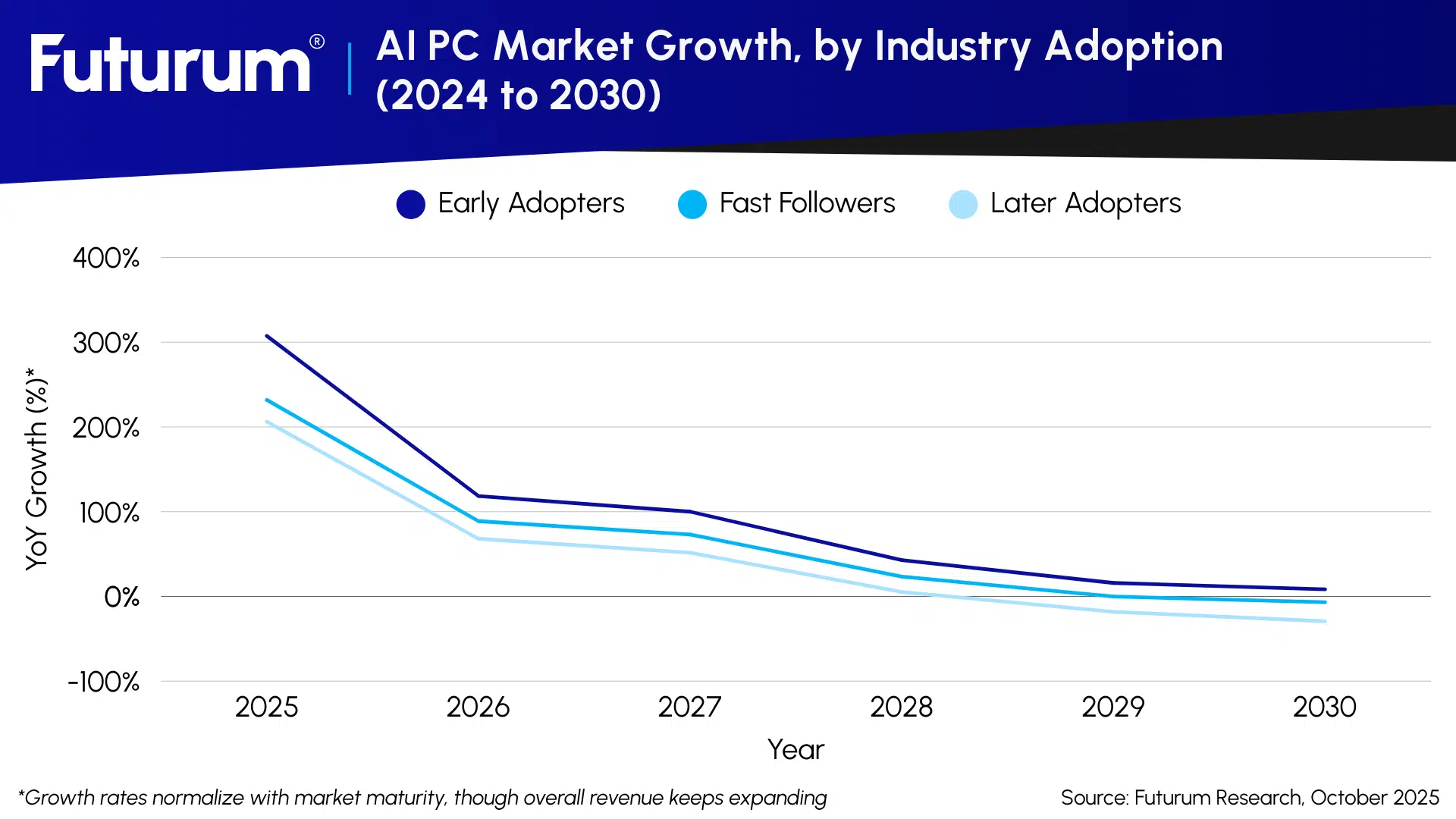
The market follows a two-stage trajectory. The initial surge was led by commercial enterprise users, accounting for roughly 74% of 2025 revenue ($18.5B), primarily driven by large-scale fleet upgrades tied to the Windows 10 EOS deadline. However, this momentum is projected to decelerate in 2026 as IT budgets ease, following the pre-EOS purchasing surge and the front-loading of Windows 11 AI PC inventory.
Consumer adoption, representing about 26% of 2025 revenue ($6.5B), is set for accelerated growth post-2027 as AI PC prices fall below $1,000 and mainstream productivity features are embedded into operating systems. By 2030, consumer revenue is projected to reach nearly $50B.
Vertical market adoption is staggered:
- Early Adopters: IT, Financial Services & Insurance, and Government are leading the first wave through 2027, driven by compliance, security, and data sovereignty, and will account for the majority of AI PC revenue by 2030 (~$93B).
- Fast Followers: Manufacturing & Industrial, as well as Media & Entertainment, are strong mid-decade growth segments.
- Late Adopters: Sectors such as Retail, Real Estate, and Sports will see slower adoption until industry-specific software solutions emerge after 2027.
Vendors are recommended to align product roadmaps with refresh cycles through 2027 and invest in delivering differentiated AI-enabled software features. A critical strategic recommendation is to build a foundation of on-device AI features to drive a second surge of upgrades expected around 2028, centered on systems with >60 TOPS of on-device AI compute capable of securely running agentic AI workloads locally.
The full report is available via subscription to the Intelligent Devices IQ service from Futurum Intelligence—click here for inquiry and access.
Futurum clients can read more in the Futurum Intelligence Platform, and nonclients can learn more here: AI Devices Intelligence Practice.
About the Futurum AI Devices Practice
The Futurum AI Devices Practice provides actionable, objective insights for market leaders and their teams so they can respond to emerging opportunities and innovate. Public access to our coverage can be seen here. Follow news and updates from the Futurum Practice on LinkedIn and X. Visit the Futurum Newsroom for more information and insights.
Other insights from Futurum:
Qualcomm Q4 FY 2025: Record QCT, Auto/IoT Growth, Solid Outlook
AMD Q3 FY 2025 Earnings Highlight Broad-Based Compute Momentum
What the Amazon Devices and Alexa+ Ecosystem Can Teach PC Vendors About the Future of Agentic AI
Author Information

Olivier Blanchard is Research Director, Intelligent Devices. He covers edge semiconductors and intelligent AI-capable devices for Futurum. In addition to having co-authored several books about digital transformation and AI with Futurum Group CEO Daniel Newman, Blanchard brings considerable experience demystifying new and emerging technologies, advising clients on how best to future-proof their organizations, and helping maximize the positive impacts of technology disruption while mitigating their potentially negative effects. Follow his extended analysis on X and LinkedIn.
