Analyst(s): Brendan Burke
Publication Date: February 4, 2026
Teradyne’s Q4 and full-year 2025 earnings report highlights a pivotal transformation, with AI-driven applications now accounting for over 60% of total revenue. As the company pivots from mobile-centric testing to a compute-heavy portfolio fueled by HBM and high-performance networking, its Physical AI strategy in robotics is also gaining traction through significant wins in the e-commerce and logistics sectors.
What is Covered in this Article:
- Teradyne’s Q4 and FY 2025 financial performance and record-breaking product segments
- The massive shift in Semiconductor Test toward AI-driven compute and Memory
- The role of Physical AI in revitalizing the Robotics segment and Universal Robots’ growth
- Strategic investments in data center networking via the new MultiLane joint venture
- Teradyne’s evergreen target earnings model is aiming for $6 billion in annual revenue
The News: Teradyne (NASDAQ: TER) reported record-breaking financial results for the fourth quarter and full year of 2025, significantly exceeding high-end guidance. Fourth-quarter sales reached $1.083 billion, a 41% sequential increase and the second-highest revenue quarter in the company’s history. Non-GAAP earnings per share (EPS) for the quarter stood at $1.80, representing over 100% sequential growth. For the full year 2025, Teradyne delivered $3.19 billion in revenue, up 13% year-over-year, with non-GAAP EPS of $3.96.
The Semiconductor Test segment was the primary driver, contributing $883 million in Q4 revenue, fueled by unprecedented demand for AI compute and memory testing solutions. Within this group, System-on-a-Chip (SoC) revenue grew 47% sequentially to $647 million, while Memory revenue hit a record $206 million, up 61% from the previous quarter. Robotics also showed sustained momentum, reporting its third consecutive quarter of growth with $89 million in revenue.
Teradyne Q4 FY 2025 Shifts the Narrative to Data Center and Physical AI
Analyst Take: Teradyne’s 2025 performance breaks the pattern of its historical revenue cycles. Historically dependent on the cyclicality of mobile phone launches, the company has successfully pivoted to a portfolio where AI testing and robotics capabilities are the primary growth engines.
AI Semiconductor Testing: From Mobile to Compute
The most striking takeaway from the 2025 results is the speed of Teradyne’s transition into an AI-first company. In Q4 2025, over 60% of revenue was AI-driven, a figure Teradyne expects to climb to 70% in Q1 2026. This shift is best illustrated by the SoC product revenue mix: in 2023, Compute accounted for only 10% of SoC revenue; by 2025, it exploded to nearly 50% ($753 million), eclipsing the company’s traditional mobile and automotive segments.
Key drivers within AI semiconductor testing include:
- XPU & Networking: Teradyne maintained approximately 50% market share in the XPU testing market, driven by the rapid build-out of AI data centers and scale-up of custom silicon designs.
- Memory Growth: Demand for High Bandwidth Memory (HBM) and DRAM final test pushed memory revenue to a record high, with DRAM revenue jumping from $80 million in 2021 to $350 million in 2025. HBM test intensity can reach 10x compared to conventional DRAM due to the volume of memory stacking and multiplication in die count.
- Infrastructure Expansion: The company announced a joint venture with MultiLane to address the growing demand for High-Speed I/O and Data Center Interconnect test solutions, extending its position from chip fabrication to data center networking fabrics.
Physical AI Producing Results
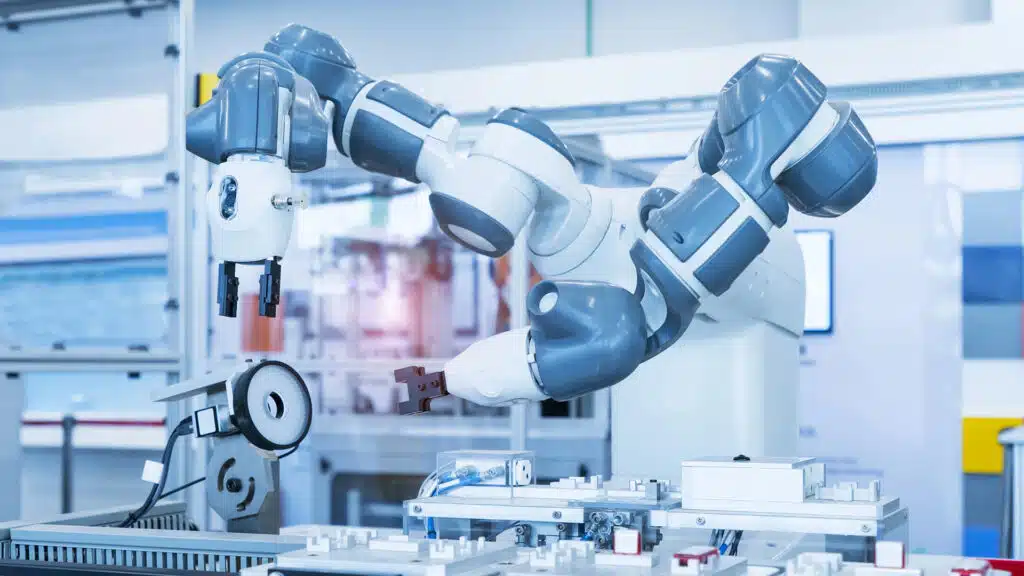
While semiconductor testing drove near-record revenue, the Robotics segment, comprising Universal Robots and MiR, grew steadily in 2025 through a focus on intelligent robotics and Physical AI models. Teradyne is no longer just selling robotics arms; it is selling AI-enabled platforms capable of complex, autonomous operations.
In 2025, Universal Robots significantly enhanced its cobot intelligence through a strategic collaboration with NVIDIA, moving beyond pre-programmed paths to real-time adaptability with an AI Accelerator Toolkit for accelerated software development. The company takes an open-ecosystem approach to application development, with over 300 solution developers, and we believe it is a leading partner community in the robotics OEM market.
The Robotics group saw 19% sequential growth in Q4, reaching $89 million. A critical part of this Physical AI strategy is a shift toward large-scale enterprise accounts. Notably, a single large e-commerce customer accounted for over 5% of Robotics revenue in Q4. This customer uses the MiR1200 Pallet Jack, which leverages AI to recognize and handle pallets with broken or poorly loaded pallets. This outlier highlights a growing trend where advanced robotics is being integrated into logistics to better adapt to global supply chain shocks.
The Roadmap to $6 Billion in Revenue
Teradyne has introduced a new evergreen target earnings model that moves away from fixed-year projections to reflect the inherent lumpiness of AI demand. The model envisions an annual revenue target of $6 billion and non-GAAP EPS between $9.50 and $11.00. This ambitious goal is predicated on an expected automated test equipment total addressable market (TAM) of $12 to $14 billion in the midterm, around 50% larger than the 2025 $9 billion market size.
For Teradyne, AI testing and robotics are no longer just supplementary segments; they are the core identity of the company. By successfully navigating the shift from mobile to AI-driven compute and embedding intelligence into its robotics platform, Teradyne is exceptionally well-positioned to capitalize on the sustained build-out of global AI infrastructure.
See the complete press release on Teradyne’s 2025 financial results on Teradyne’s investor website.
Disclosure: Futurum is a research and advisory firm that engages or has engaged in research, analysis, and advisory services with many technology companies, including those mentioned in this article. The author does not hold any equity positions with any company mentioned in this article.
Analysis and opinions expressed herein are specific to the analyst individually and data and other information that might have been provided for validation, not those of Futurum as a whole.
Other insights from Futurum:
Did SPIE Photonics West 2026 Set the Stage for Scale-up Optics?
Qualcomm Unveils Future of Intelligence at CES 2026, Pushes the Boundaries of On-Device AI
Synopsys and GlobalFoundries Reshape Physical AI Through Processor IP Unbundling
Author Information

Brendan is Research Director, Semiconductors, Supply Chain, and Emerging Tech. He advises clients on strategic initiatives and leads the Futurum Semiconductors Practice. He is an experienced tech industry analyst who has guided tech leaders in identifying market opportunities spanning edge processors, generative AI applications, and hyperscale data centers.
Before joining Futurum, Brendan consulted with global AI leaders and served as a Senior Analyst in Emerging Technology Research at PitchBook. At PitchBook, he developed market intelligence tools for AI, highlighted by one of the industry’s most comprehensive AI semiconductor market landscapes encompassing both public and private companies. He has advised Fortune 100 tech giants, growth-stage innovators, global investors, and leading market research firms. Before PitchBook, he led research teams in tech investment banking and market research.
Brendan is based in Seattle, Washington. He has a Bachelor of Arts Degree from Amherst College.