Analyst(s): Dr. Bob Sutor
Publication Date: November 21, 2024
Three quantum computing companies—IonQ, D-Wave Quantum, and Rigetti Computing—have gone public via SPACs since 2021. With several years of financial reports available, we can now more critically examine their revenue growth and net losses.
What is Covered in this Article:
- Overview of the companies
- Third quarter financial results: good, bad, or meh?
- Continuing net losses
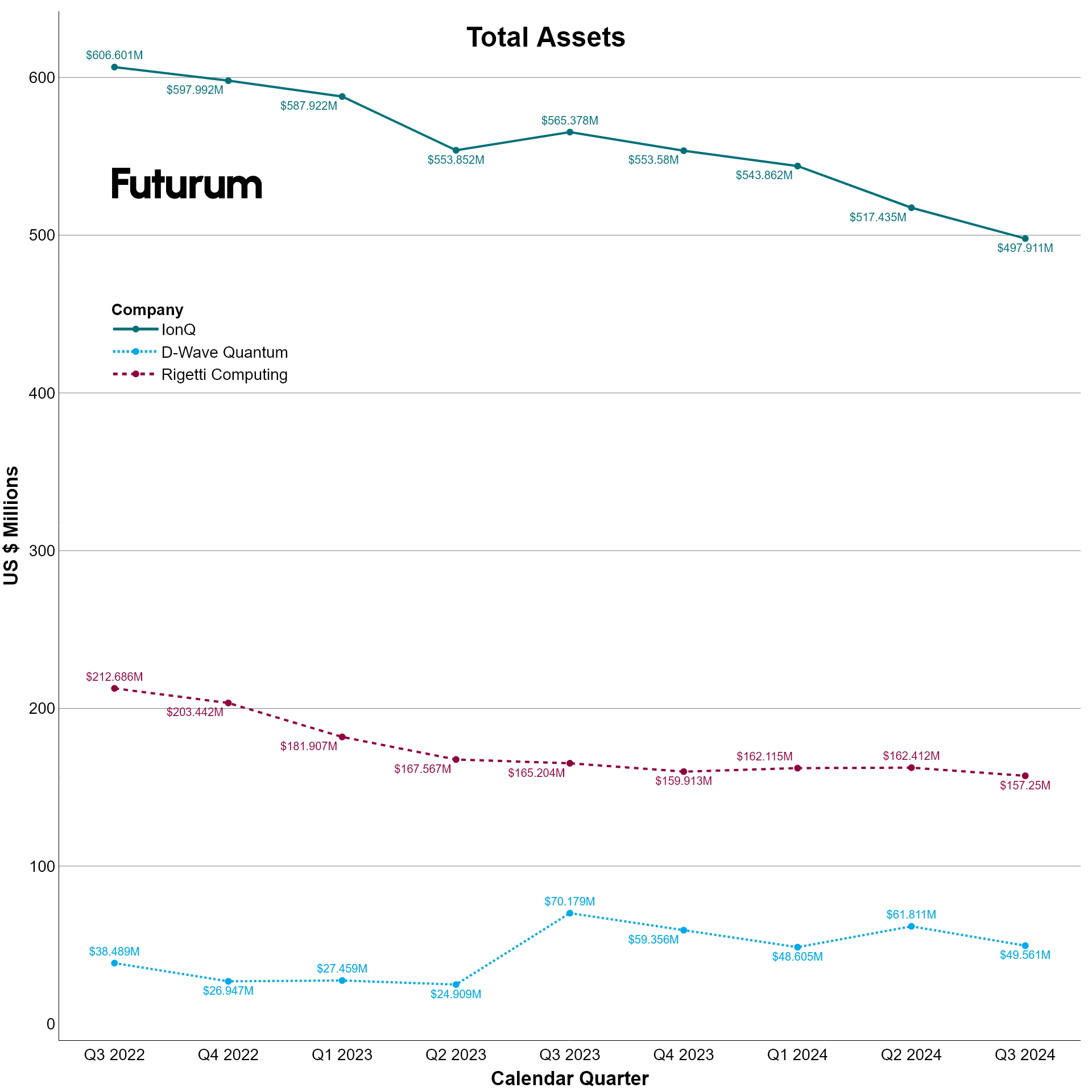
- Cash and total asset positions
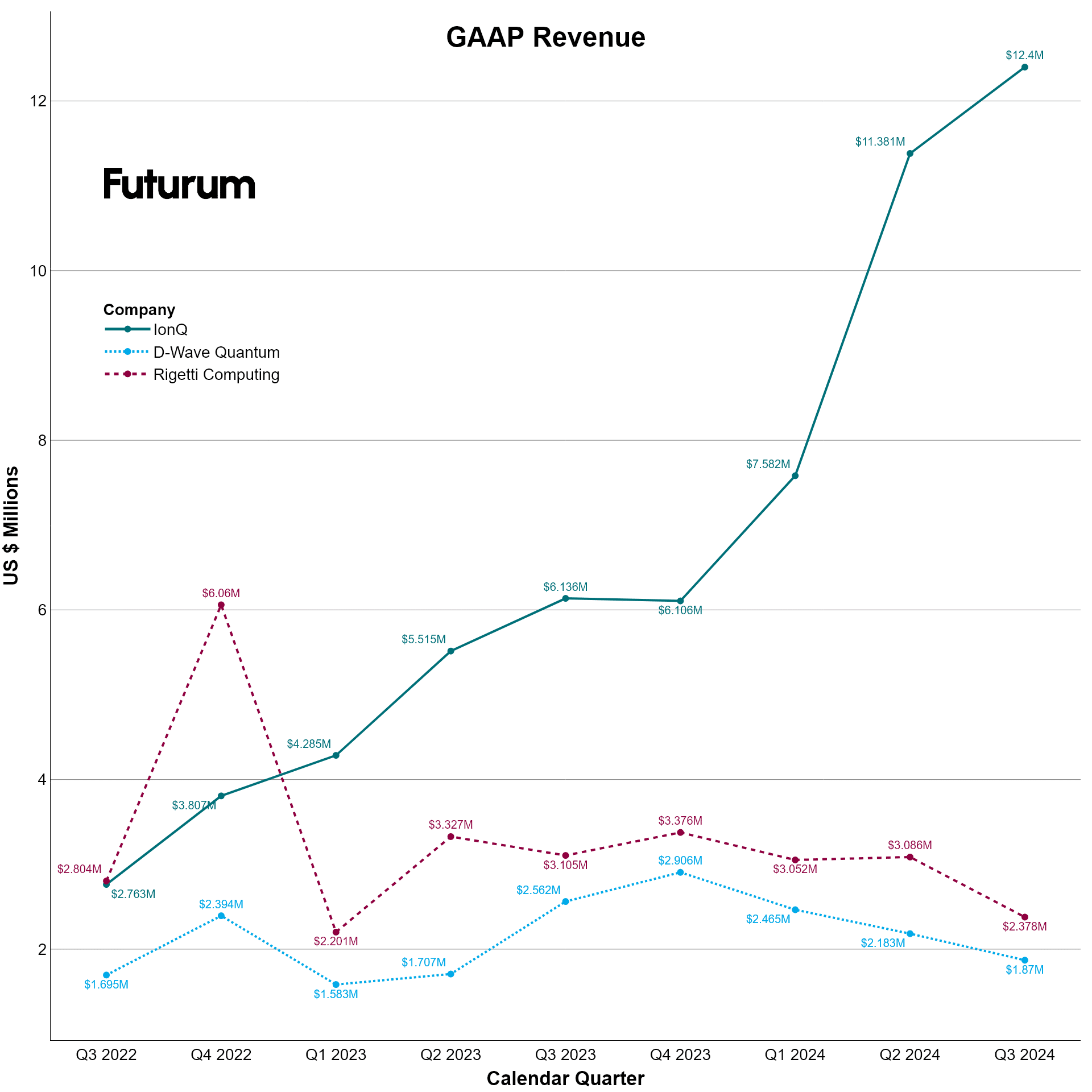
The News: In early November, the three quantum companies that went public via SPACs reported their 3Q 2024 financial results. IonQ, the first to go public, stated that its GAAP revenue was $12.4M, up 102.1% year-over-year and 9.0% from the second quarter. For Rigetti Computing, year-to-year revenue was $2.378M, down 23.4% year-to-year and 22.9% from the second quarter. D-Wave Quantum registered a revenue of $1.87M, also down year-to-year and from the previous quarter, 27.0% and 14.3%, respectively.
Quantum in Context: D-Wave, IonQ, and Rigetti 3Q2024 Financial Results
Analyst Take: Revenue-wise, IonQ has continued its quarterly increases, except for a very small decrease in Q4 2023. D-Wave Quantum has done the opposite since that quarter, and Rigetti Computing has bounced up and down since Q3 2022. Allowing for the expected quarterly variations and fiscal year ends, observers should look for signs of consistency in revenue and spending, especially R&D and acquisition costs to extend portfolios. Evidently, quantum computing hardware is not yet a profitable business, given the dearth and low adoption of production-ready use cases.
The Companies
D-Wave Quantum (“D-Wave”) was founded in 1999 in British Columbia, Canada. In 2022, it went public through a Special Purpose Acquisition Company (SPAC) merger with DPCM Capital. Unlike most companies in the quantum computing industry, D-Wave Quantum uses superconducting qubits to implement quantum annealing. This is similar to classical simulated annealing, a technology introduced in the 1970s and 1980s.
In September, D-Wave announced a partnership with Staque to promote quantum annealing adoption in the Middle East.
IonQ is a quantum computing and networking company founded in 2015 and based in College Park, Maryland. It went public in 2021 via a SPAC merger with dMY Technology Group Inc. III. Its qubit modality is trapped ions using ytterbium and barium.
In its third-quarter report, IonQ highlighted its four-year $54.4M award from the United States Air Force Research Lab (AFRL).
Ex-IBM quantum scientist Chad Rigetti founded Rigetti Computing (“Rigetti”) in 2013 in Berkeley, California. It uses superconducting qubits for universal digital quantum computing in a manner similar to that of IBM and Google, tracing back to science and engineering at Yale University in the first decade of this century. The company went public in 2022 via a SPAC merger with Supernova Partners Acquisition Company II.
Rigetti stated in its report that it has co-located a 9-qubit NoveraTM quantum processing unit at the Israeli Quantum Computing Center operated by Quantum Machines at Tel Aviv University.
Financial Results Overview: The Numbers
| Company | Q3 2024 Revenue | Q3 2023 Revenue | Net Loss | R&D Expense | Cash Assets | Total Assets |
| D-Wave | $1.870M | $2.562M | ($22.712M) | $8.668M | $29.274M | $49.561M |
| IonQ | $12.400M | $6.136M | ($52.496M) | $33.178M | $30.172M | $497.911M |
| Rigetti | $2.378M | $3.105M | ($14.833M) | $12.752M | $20.286M | $157.250M |
Several points jump out at you immediately from this table:
- IonQ has nearly half a billion US dollars in total assets, ten times the amount for D-Wave.
- D-Wave and Rigetti had year-over-year quarterly revenue decreases, while IonQ doubled its.
- IonQ’s strong asset position allows it to spend significantly more on research and development.
Figure 1 shows the quarterly GAAP revenue for the three companies. Only IonQ has the desired “up and to the right” desired behavior.
Figure 1. GAAP Revenue – IonQ, D-Wave Quantum, and Rigetti Computing
Net Losses: Okay or Worrying?
Net losses are common among private startups, so they seek grants and several rounds of investment to keep going while creating sellable and presumably profitable products and offerings. Once a company goes public, they have fewer cash-inflow options and must reach a point where revenue exceeds expenses before they go bankrupt. Cash and total assets with net loss are good indicators of how long a company can last. The chart in Figure 2 shows the quarterly total assets of the three companies.
Figure 2: Quarterly Total Assets – IonQ, D-Wave Quantum, and Rigetti Computing
IonQ did very well when it went public, and its current financial position allows it to acquire the assets of companies such as Entangled Networks and Qubitekk (cost: $22M). This new expertise and intellectual property permits IonQ to extend its offerings from quantum computing into quantum networking. Networking is essential for quantum communications and scaling quantum computing to the hundreds of thousands of qubits necessary for Practical Quantum Advantage.
To my knowledge, from public sources, neither D-Wave nor Rigetti have made any acquisitions. Their net losses are primarily from operating expenses.
Figure 3 shows the quarterly net losses for the three companies. Rigetti, in particular, shows an unusual pattern of net loss increase and then decrease from quarter to quarter.
Figure 3: Quarterly Net Loss – IonQ, D-Wave Quantum, and Rigetti Computing

What to Watch:
- The Fiscal Year 2024 and Q4 financial statements
- More significant bookings for D-Wave and Rigetti
- Any progress made by D-Wave for quantum annealing versus the dozens of companies supporting universal digital and analog quantum approaches
- Details on costs to IonQ for the AFRL contract and whether it can keep the deal pipeline and bookings active and large after this award
For additional details, see
- the “D-Wave Reports Third Quarter 2024 Results” press release,
- the “IonQ Announces Third Quarter 2024 Financial Results” press release, and
- the “Rigetti Computing Reports Third Quarter 2024 Financial Results and Business Updates” press release.
Disclosures: The Futurum Group is a research and advisory firm that engages or has engaged in research, analysis, and advisory services with many technology companies, including those mentioned in this article. Bob Sutor is a former employee of IBM and has an equity position in the company. The analyst has no equity position in any other company mentioned in this article.
Analysis and opinions expressed herein are specific to the analyst individually and data and other information that might have been provided for validation, not those of The Futurum Group as a whole.
Other insights from The Futurum Group:
Quantum in Context: A Qubit Primer
D-Wave Reports Second Quarter 2024 Results
IonQ Reports Second Quarter 2024 Financial Results
Rigetti Computing Reports Second Quarter 2024 Financial Results
Author Information

Dr. Bob Sutor is an expert in quantum technologies with 40+ years of experience. He is the accomplished author of the quantum computing book Dancing with Qubits, Second Edition. Bob is dedicated to evolving quantum to help solve society's critical computational problems.