Analyst(s): Olivier Blanchard
Publication Date: February 20, 2026
The release of the Pixel 10A signals a strategic, albeit cautious, approach from Google’s Pixel team. While the “A-series” has traditionally been the volume driver for Pixel, the Pixel 10A could underwhelm consumers looking for more Pixel 10-derivative features.
What is Covered in This Article:
- The Pixel 10A’s release is a strategic move for the mid-range market, but it features conservative year-over-year updates and minimal hardware evolution.
- The decision to retain the Tensor G4 chip and 8GB of RAM is a key disappointment, raising concerns about its ability to run advanced on-device AI features and its longevity over the 7-year support cycle.
- Despite its hardware stagnation, the $499 price and Google’s superior computational photography maintain the Pixel 10A’s healthy competitive position, particularly against the Samsung Galaxy A56.
- Strategically, the minimal update is viewed as a tactical move to protect margins and serve as a sufficient upgrade for owners of older A-series phones, though it may struggle to attract new Pixel users.
The News: Google has announced the Pixel 10A, the latest mid-range smartphone in its lineup. Priced at $499, the device aims to maintain Google’s momentum in the budget Android market, particularly in key markets like North America and Japan, where the Pixel A-series has become a “default” choice for consumers looking for high-quality experiences without flagship prices. However, the 10A’s relatively conservative year-over-year updates, which retained several specifications from the previous generation rather than inheriting the flagship innovations of the standard Pixel 10 series, could weaken its appeal.
Google Debuts Pixel 10A Amidst Minimal Hardware Evolution
Analyst Take — Hardware Stagnation and Supply Chain Realities: The decision to stick with the Tensor G4 chip and 8GB of RAM is probably the most obvious disappointment. With increasingly AI-enabled smartphones requiring high memory overhead to process LLMs (Large Language Models) directly on-device, an 8GB ceiling is likely to prevent the Pixel 10A from running Google’s most advanced new features, like Magic Cue.
While customers operating in the sub-$500 range should learn to temper their on-device AI expectations, even in the Pixel line, skyrocketing RAM prices may also have forced the Pixel product team to make some hard choices to keep the device at a $499 price point in a challenging inflationary environment.
The Feature Trickle-Down Gap
The challenge with setting high expectations is that consumers can easily be disappointed when a product generation delivers slightly less than they have been trained to expect. Typically, the A-series benefits from a “trickle-down” effect of the previous year’s flagship. To some extent, this remains the case here: The Pixel 10A does gain SOS satellite communications, for instance – a critical safety parity move – and Gorilla Glass 7i, but it lacks the broader architectural leaps of the Pixel 10 that could have unlocked useful AI-first features in the 10A.
The biggest problem for Google here may be that this creates a wider-than-usual gap between its mid-range and flagship tiers. This could nudge prosumer budget buyers who haven’t yet made the switch to Pixel toward alternatives. (Note that I am not talking about existing Pixel A customers moving into their next upgrade cycle. I will address that group in a moment.)
Best case scenario, potential consumers that Google might reasonably expect to be considering the Pixel 10A as a good entry point into the Pixel ecosystem could simply decide to move up to the more expensive and feature-rich Pixel 10. Worst-case scenario, these same shoppers could decide to go with “better” specs in that price tier, outside of the Pixel ecosystem.
Market Positioning
Despite the “minimal” nature of the update, Google remains in a healthy competitive position: By keeping the Pixel 10A at $499, Pixel remains the “default” recommendation for North American carriers, even as Samsung’s Galaxy A56 offers superior raw hardware (larger battery, faster charging) at a slightly lower street price.
Competitive Note: Pixel 10A vs. Samsung Galaxy A56
Samsung’s Galaxy A56 could present a significant challenge, particularly for users who value display real estate and charging speeds over Google’s “clean” software experience. Looking at the performance of both of these products side by side will provide valuable insight into 1) what consumer priorities really are in that price tier, and 2) how effective Pixel marketing will be at pushing back against Samsung’s considerable brand equity.
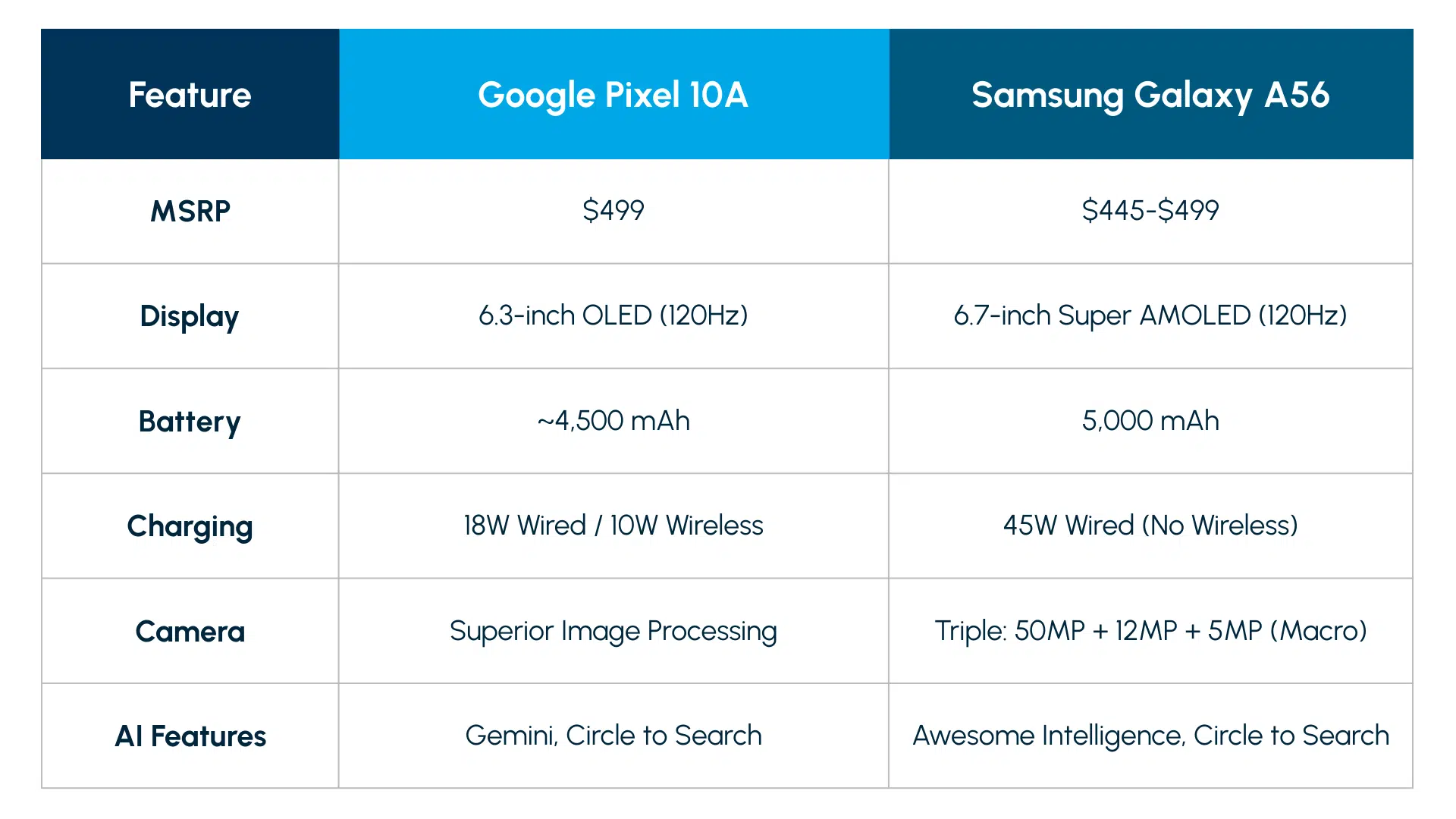
Pixel’s focus on delivering “life-proof” features in the A-series, like SOS, better glass, and IP68, rather than focusing on flashier AI features, may appeal to pragmatic smartphone users who prioritize durability and reliability over AI features they may not feel that they absolutely need just yet.
The one thing that actually concerns me is that while the 8GB RAM ceiling may be fine for today’s Android 16, especially with so many critical AI applications still running in the cloud, I wonder how well the Pixel 10A will handle the later years of its promised 7-year support and update cycle. I don’t think the market appreciates quite how important the 7-year support promise is to the Pixel value proposition, and I worry that the 10A’s 8GB of RAM won’t age well.
A second but far less troublesome worry is that the landscape for $500 Android phones is thinning in North America. On this point, though, I feel that Pixel benefits from a decent double-hedge:
- Even with older silicon, Google’s computational photography remains the benchmark for this price bracket. Consumers looking for the best phone camera at this price point know that Pixel will deliver premium-quality images without the premium price tag, and for those who really care about getting the best possible image quality out of their budget phone, Pixel should continue to operate as the segment’s north star.
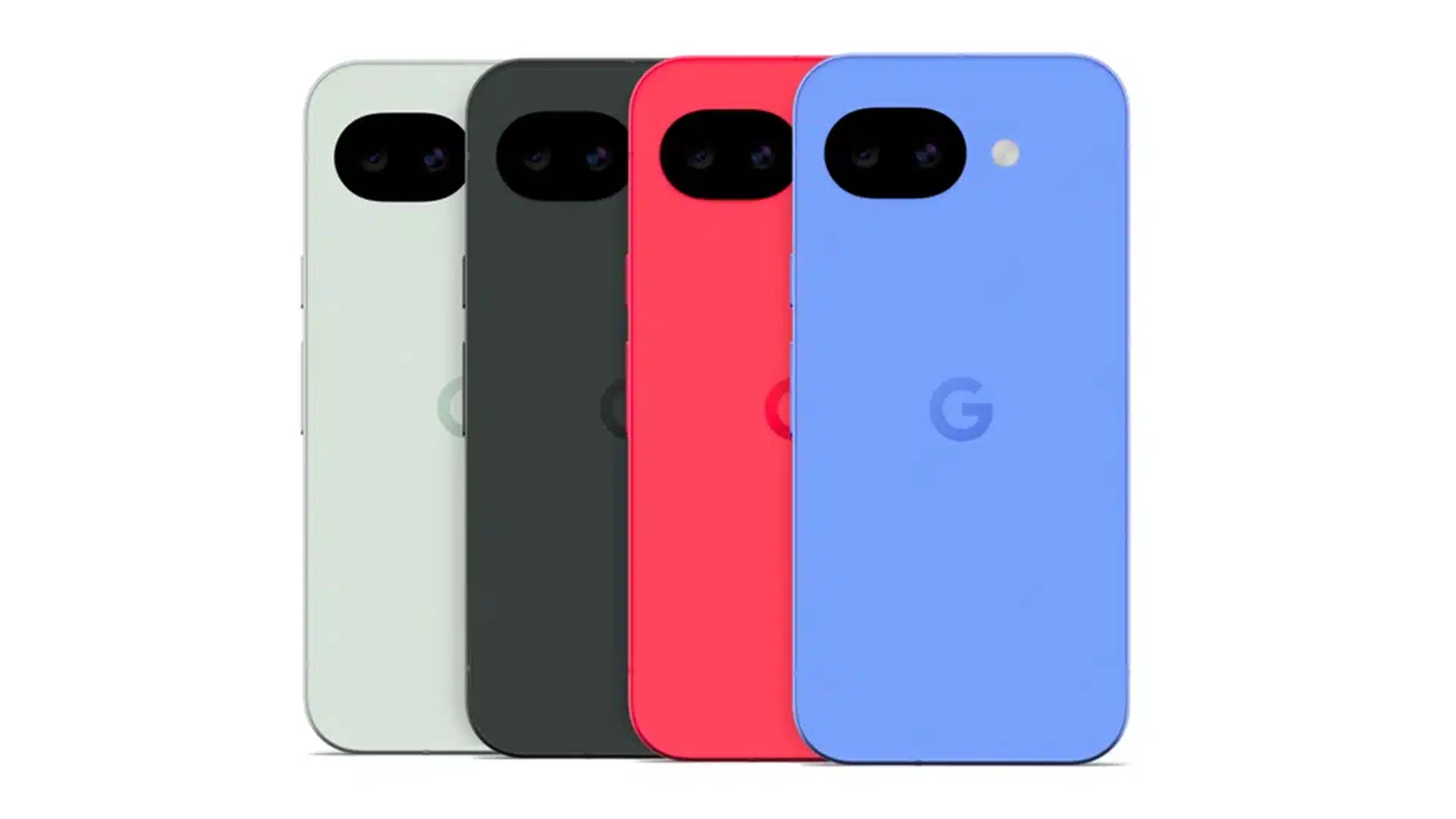
- Pixel aesthetics may not be everyone’s cup of tea, but they do appeal to many consumers looking for something different from both the iPhone and from other mainstream Android options. The introduction of vibrant options like the “Berry” colorway, for example, deepens Pixel’s increasing pivot toward lifestyle-centric marketing. Note that this strategy, which has always worked well for Apple, is also working rather well for Motorola. To Google’s credit, the Pixel product team has been executing extremely well on this front lately. As superficial as that may seem, Pixel’s ability to help consumers express themselves through their phone’s design and styling is a strategic plus for the brand, and a vehicle to continue to attract former iPhone users looking for an equivalent Android option.
Strategic Outlook
Broadly, while the Pixel 10A feels a bit disappointing at first glance, it works on a purely tactical level:
- It helps protect margins, which, after all, is always critical.
- While less satisfying for consumers looking to upgrade their Pixel 9A, it should be perfectly fine for those upgrading from older Pixel A generations (like the Pixel 7A). Given what we understand about the upgrade cycle at that price point, the Pixel 10A’s features start making a lot more sense.
I think that’s the right lens through which to look at the choices made by the Pixel team. Caveat: While Pixel 10A’s relatively unimpressive features probably won’t underwhelm existing Pixel A users looking to upgrade their device this year, it could keep potential net new customers from entering the Pixel A ecosystem, at least this year.
For Google, the challenge moving forward will be balancing the rising costs of hardware components with the heavy RAM requirements of its Gemini AI roadmap. If mid-range devices cannot support the company’s broad AI-first vision, Google’s “AI for everyone” brand promise could lose some traction – or at the very least some consistency across price tiers.
Read more on the Pixel 10a release on Google’s blog.
Disclosure: Futurum is a research and advisory firm that engages or has engaged in research, analysis, and advisory services with many technology companies, including those mentioned in this article. The author does not hold any equity positions with any company mentioned in this article.
Analysis and opinions expressed herein are specific to the analyst individually and data and other information that might have been provided for validation, not those of Futurum as a whole.
Other Insights from Futurum:
At CES, NVIDIA Rubin and AMD “Helios” Made Memory the Future of AI
Will Google Gemini Enterprise for Customer Experience Deliver Context?
Five9 Expands Google Cloud Partnership With a Unified Enterprise CX AI Platform
Image Credit: Google
Author Information

Olivier Blanchard is Research Director, Intelligent Devices. He covers edge semiconductors and intelligent AI-capable devices for Futurum. In addition to having co-authored several books about digital transformation and AI with Futurum Group CEO Daniel Newman, Blanchard brings considerable experience demystifying new and emerging technologies, advising clients on how best to future-proof their organizations, and helping maximize the positive impacts of technology disruption while mitigating their potentially negative effects. Follow his extended analysis on X and LinkedIn.