
Austin, Texas, USA, January 23, 2026
Futurum’s IT Decision-Maker Report Finds That These Supply Chain Vendors Are Leveraging AI and Integrations to Dominate the Market
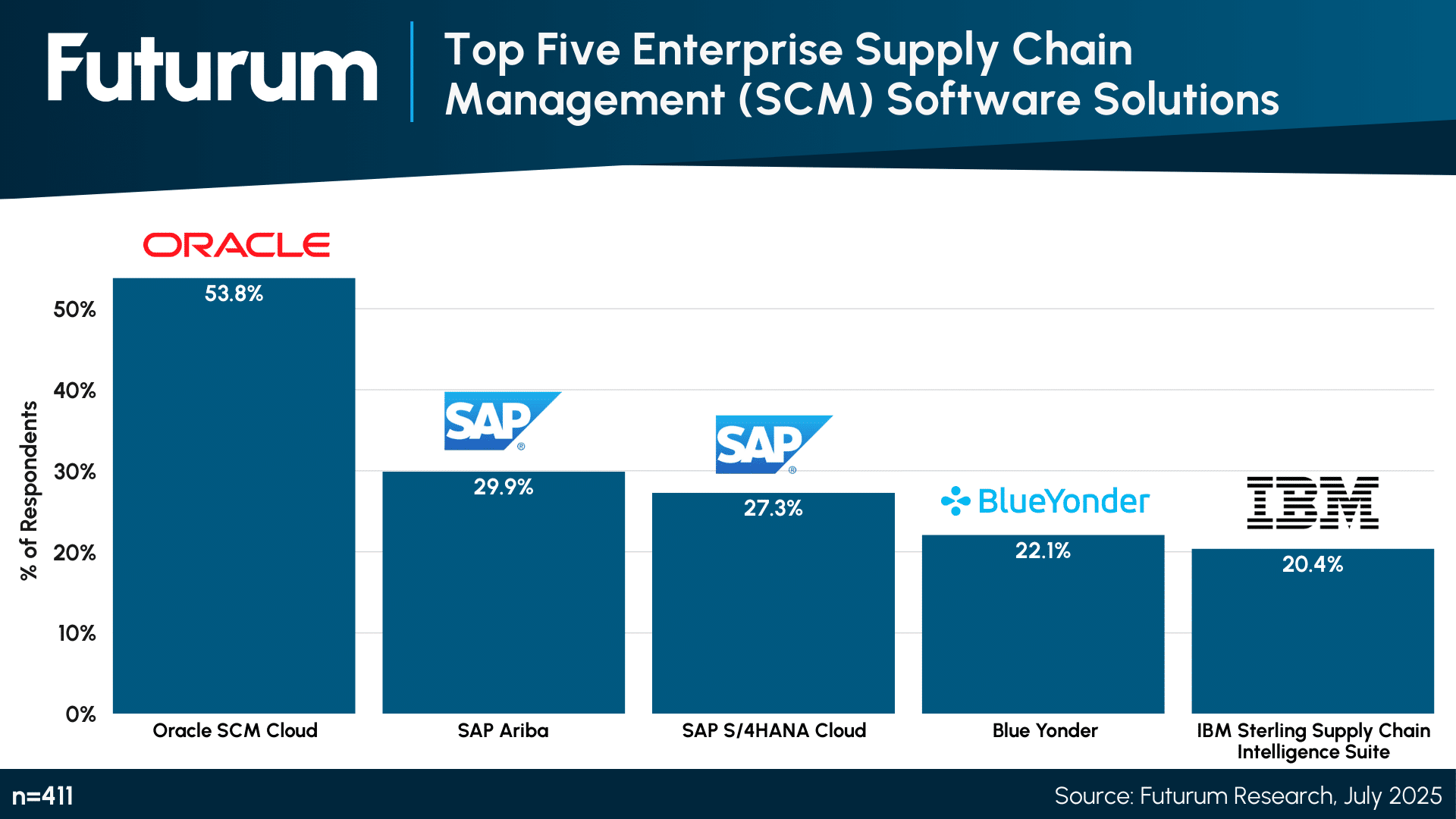
Oracle and SAP are the most widely used vendors in the enterprise Supply Chain Management (SCM) market, according to Futurum’s 1H 2025 Enterprise Software IT Decision Makers Survey conducted in July 2025. When asked about the top five vendors currently supplying their organizations with SCM software, Oracle SCM Cloud was named by 53.8% of respondents, making it the most widely deployed SCM software application, according to 411 global respondents.
However, SAP’s Ariba and S/4Hana Cloud offerings, which were named by 29.9% and 27.3% of respondents, respectively, earned the German software vendor a combined percentage of 57.2%, vaulting SAP slightly ahead of Oracle. Other vendors, including Blue Yonder (22.1%) and IBM Sterling Supply Chain Intelligence Suite (20.4%), were also named by at least one-fifth of the respondent base as providing part or all of their organization’s supply chain functionality.
Figure 1: Top Five Enterprise Supply Chain Management (SCM) Software Solutions
Keith Kirkpatrick, Research Director with Futurum, said, “Increasingly, organizations are focusing on the use of large, widely available SCM software platforms that enable leadership to manage the supply chain as an end-to-end, governed operating system, rather than as a collection of disconnected point tools. This is because supply chain problems are usually cross-functional rather than isolated – a shortage becomes a planning issue, then a procurement issue, then a fulfillment issue, then a finance/customer issue – resulting in the desire for software that can provide end-to-end visibility and control.”
Based on current data from the Enterprise Software & Digital Workflows dashboard, the top three key purchase drivers for Supply Chain Management (SCM) software are as follows (ranked by importance):
- Features & Functionality (18.7%): Enterprises are prioritizing robust, end-to-end capabilities to support their complex, evolving supply chain needs.
- Generative AI Capabilities (13.2%): There is a growing emphasis on advanced AI—specifically generative AI and agentic workflows—to drive predictive analytics, automation, and improved decision-making within SCM platforms.
- Cost & Pricing Model (8.9%): Organizations continue to closely evaluate overall cost, TCO, and flexible pricing that aligns with usage and value.
“It’s important to note that most organizations are seeking solutions that can address not just these three top issues or capabilities, but can also interface with other disparate data and systems, given that individual suppliers may use a number of different types of commercial or home-grown software to manage their operations,” said Kirkpatrick. “Ultimately, these larger platforms tend to win because they can provide system-wide coordination, strong governance and controls, manage complex processes and handle data standardization, and easily scale to manage global supply chains.”
Additional data points and purchase decision drivers for the Supply Chain Management (SCM) software market, along with many other software categories, can be found in the “1H 2025 Enterprise Software & Digital Workflows Decision Maker Survey Report” on the Futurum Intelligence Platform. Non-subscribers can click here for more information.
About Futurum Intelligence for Market Leaders
Futurum Intelligence’s Enterprise Software & Digital Workflows IQ service provides actionable insight from analysts, reports, and interactive visualization datasets, helping leaders drive their organizations through transformation and business growth. Subscribers can log into the platform at https://app.futurumgroup.com/, and non-subscribers can find additional information at Futurum Intelligence.
Follow news and updates from Futurum on X and LinkedIn using #Futurum. Visit the Futurum Newsroom for more information and insights.
Other Insights from Futurum:
Will IFS’ Acquisition of Softeon Help Attract New Supply Chain Customers?
Unlocking Enterprise Value: The Real-World Benefits and ROI of SAP’s Embedded Business AI
Oracle Q2 FY 2026: Cloud Grows; Capex Rises for AI Buildout
Author Information

Keith Kirkpatrick is VP & Research Director, Enterprise Software & Digital Workflows for The Futurum Group. Keith has over 25 years of experience in research, marketing, and consulting-based fields.
He has authored in-depth reports and market forecast studies covering artificial intelligence, biometrics, data analytics, robotics, high performance computing, and quantum computing, with a specific focus on the use of these technologies within large enterprise organizations and SMBs. He has also established strong working relationships with the international technology vendor community and is a frequent speaker at industry conferences and events.
In his career as a financial and technology journalist he has written for national and trade publications, including BusinessWeek, CNBC.com, Investment Dealers’ Digest, The Red Herring, The Communications of the ACM, and Mobile Computing & Communications, among others.
He is a member of the Association of Independent Information Professionals (AIIP).
Keith holds dual Bachelor of Arts degrees in Magazine Journalism and Sociology from Syracuse University.

