
Austin, Texas, USA, November 21, 2025
Futurum’s Sales, Marketing, and Service Signal Report focuses on the key elements that will drive platform success for vendors.
Sales, marketing, and service functions have become increasingly intertwined, primarily due to the vast amount of data available across each touchpoint in a customer’s journey, from initial marketing contact through the sales process and into the support function. If the customer is satisfied and delighted throughout each step of the journey, it is that much easier to generate repeat business, a far easier process than trying to constantly drive revenue through new customer acquisitions alone.
For vendors seeking to provide a platform capable of handling each of these core functions – sales, marketing, and service – they must excel in several key battlegrounds, according to The Futurum Group’s Signal report. The research, which incorporates a combination of public-facing data, along with proprietary and licensed data, analyst insights and research, and direct vendor engagement activity, is then assessed by an AI model guided, grounded, and guarded by Futurum Group analysts.
The result is an assessment of 11 vendors across five core measures, which found that the key differentiators that will likely spell success in the future are the maturity and trustworthiness of a vendor’s AI capabilities, their architectural approach to data unification, the vibrancy of their partner ecosystems, and their ability to demonstrate clear, quantifiable business value. Vendors that can seamlessly connect front-office customer data with back-office operational data (such as information from ERP and supply chain systems) will have a considerable competitive advantage.
Success in this new era will depend not solely on the technological sophistication of autonomous systems, but critically on vendors’ ability to equip customers to responsibly manage the operational and ethical challenges of large-scale deployment. The market leaders will be defined by those who offer not only powerful tools but also the necessary governance frameworks to ensure their effective and responsible use.
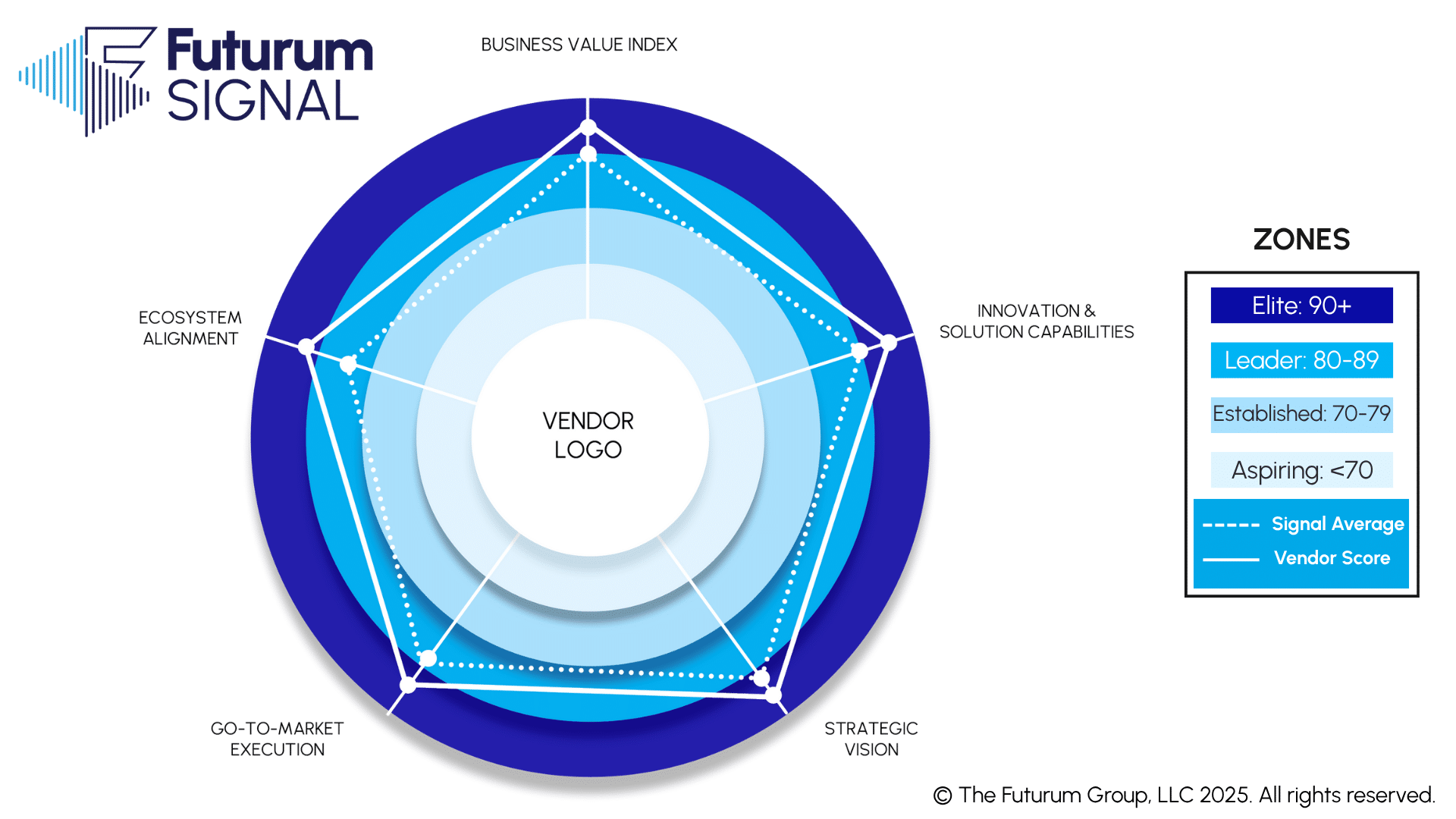
To understand a vendor’s unique DNA, the Vendor Radar provides a concise, visual fingerprint of a single company’s performance across the Signal’s five core analytical dimensions. It instantly reveals a vendor’s strategic balance, highlighting their areas of decisive strength and exposing where they have critical ground to cover against the competition.
Figure 1: Sample Signal Vendor Radar
Keith Kirkpatrick, Research Director, Enterprise Software & Digital Workflows at Futurum, said, “The future success in the market for sales, marketing, and service platforms is not driven by a single factor, but a comprehensive effort to address the disparate needs of enterprise buyers and users. The Signal report assesses these vendors across a variety of factors to pinpoint areas of strength, weakness, and opportunity.”
The Signal research reveals several key characteristics that are present among the leaders within the Sales, Marketing, and Service platform marketplace:
- Leadership in the Business Value Index category is defined by the ability to consistently deliver and validate scalable financial impact for customers. Vendors with lower scores often struggle to transition from feature-based selling to articulating and proving strategic business outcomes.
- Successful sales, marketing & service platforms also have a robust and self-sustaining network of partners, developers, and third-party applications that create a powerful flywheel effect, where the platform’s value grows with every new integration. This strategy is one that vendors with more closed or nascent ecosystems are finding challenging to replicate.
- Dominance in the Go-to-Market Execution category requires the ability to effectively bring innovation to market and scale adoption globally.
- Product innovation leadership is not just about having a long feature list; it’s about defining the future of the market through the redefinition of what a modern customer platform should be.
- A top score in the Strategic Vision category requires an unwavering long-term vision that anticipates market shifts and aligns the entire organization, from R&D to marketing to sales.
“The findings underscore a clear trend toward vendors understanding the diverse and complex needs of their customers,” noted Kirkpatrick. “While the vendors assessed still face some challenges, it’s clear that most are willing and able to continue to invest to ensure their platforms continue to enhance their functionality, integration of AI, platform robustness, and ecosystem health.
Read more in the Sales, Marketing, and Service Platforms Signal Report, which contains the 11 vendors and where they landed on the Signal assessment. You can also access other Signal Reports, each available for free download via the Futurum Intelligence Platform.
About Futurum Intelligence for Market Leaders
Futurum Intelligence’s Enterprise Software & Digital Workflows IQ service provides actionable insight from analysts, reports, and interactive visualization datasets, helping leaders drive their organizations through transformation and business growth. Subscribers can log into the platform at https://app.futurumgroup.com/, and non-subscribers can find additional information at Futurum Intelligence.
Follow news and updates from Futurum on X and LinkedIn using #Futurum. Visit the Futurum Newsroom for more information and insights.
Other Insights from Futurum:
Intelligence at Scale: How SAP’s AI Platform Delivers Enterprise-Wide Impact
Will Asana’s Teammates Drive Better Collaboration Between Humans and AI Agents?
Microsoft 365 Copilot Expands Researcher Agent with Secure Computer Use
Author Information

Keith Kirkpatrick is VP & Research Director, Enterprise Software & Digital Workflows for The Futurum Group. Keith has over 25 years of experience in research, marketing, and consulting-based fields.
He has authored in-depth reports and market forecast studies covering artificial intelligence, biometrics, data analytics, robotics, high performance computing, and quantum computing, with a specific focus on the use of these technologies within large enterprise organizations and SMBs. He has also established strong working relationships with the international technology vendor community and is a frequent speaker at industry conferences and events.
In his career as a financial and technology journalist he has written for national and trade publications, including BusinessWeek, CNBC.com, Investment Dealers’ Digest, The Red Herring, The Communications of the ACM, and Mobile Computing & Communications, among others.
He is a member of the Association of Independent Information Professionals (AIIP).
Keith holds dual Bachelor of Arts degrees in Magazine Journalism and Sociology from Syracuse University.

