
Analyst(s): Ray Wang
Publication Date: November 13, 2025
Futurum’s New Silicon Data provides clear visibility into the global AI hardware landscape, combining performance metrics, supply-chain capacity, and vendor analytics in one unified dataset. Covering everything from foundry nodes and HBM packaging to system-level efficiency, it helps executives and investors quantify real performance, cost, and availability risks across competing AI platforms. In a market clouded by marketing benchmarks, Futurum’s Silicon Data turns hardware complexity into actionable, evidence-based insight for strategic decision-making.
Key Points:
- AI hardware spending has outpaced understanding. Enterprise buyers are committing billions to accelerator deployments based on inconsistent or vendor-defined performance metrics, creating blind spots in benchmarking, utilization, and total cost of ownership.
- The AI supply chain is highly concentrated and capacity-constrained. Dependence on TSMC for fabrication and SK Hynix for HBM memory introduces potential risks in the supply chain, given the continually tightening capacity amid strong AI demand.
- Not just the silicon choice is the differentiator. True competitiveness now depends on understanding cross-layer trade-offs among architecture, packaging, power, and performance. Futurum’s Silicon Data and Tracker provide the analytical visibility needed to align technology, procurement, and investment decisions with the realities of AI hardware economics.
Overview:
The rapid acceleration of AI investment has transformed silicon from a technical component into a strategic asset. Yet while AI hardware spending has exploded, understanding of its underlying performance, cost drivers, and supply constraints has not kept pace. Futurum’s Silicon Tracker addresses this gap by consolidating detailed insights across the AI hardware stack—from GPU, CPU, and custom ASIC architecture to packaging, memory, and foundry dependencies.
Figure 1: Futurum Silicon Tracker
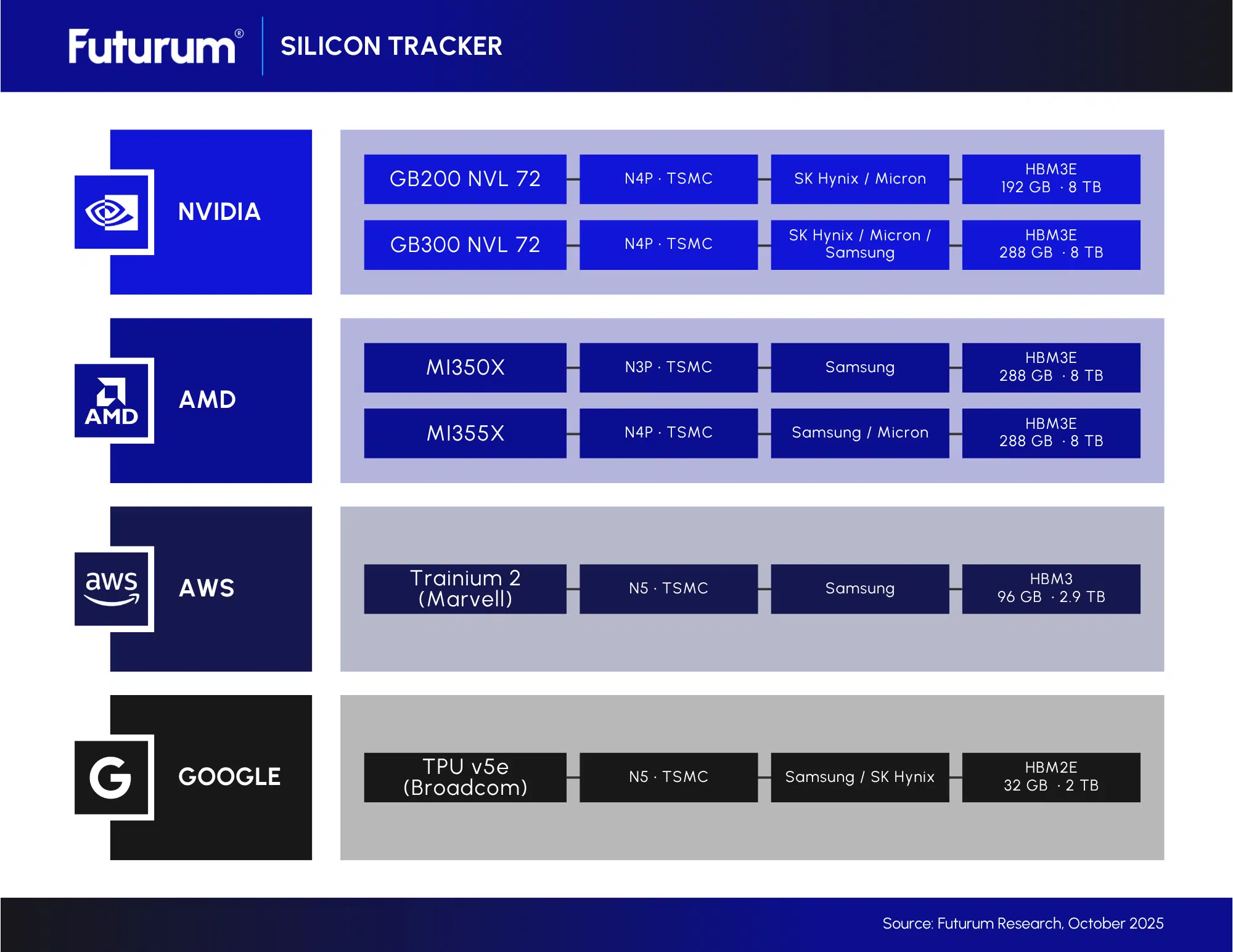
As AI infrastructure becomes the foundation of digital transformation, the ability to interpret silicon data is emerging as a competitive differentiator. Futurum’s analysis connects technical realities with strategic decision-making, highlighting where risk, value, and opportunity converge across the supply chain. By identifying key industry participants, performance efficiency, and vendor exposure, this report helps executives move beyond marketing claims toward data-driven planning for the next phase of AI hardware evolution.
Better Insights in AI Hardware Are Vital
AI has become a top corporate spending priority, yet the technical understanding behind these investments lags far behind. Futurum’s analysis of 30 accelerators shows that while vendors promote impressive TFLOPS and FP8 figures, real-world utilization often falls below 60%, revealing a costly gap between marketing and performance. True competitiveness now depends on mastering system-level factors—interconnect bandwidth, HBM3E memory throughput, software stack efficiency, and architecture scalability—that determine actual cost per computation. Meanwhile, the AI hardware supply chain is rapidly converging and fragmenting, as chipmakers, system integrators, and infrastructure vendors blur traditional boundaries. In this evolving landscape, deeper, cross-layer insight into silicon performance and supply dynamics is essential for smarter investment and strategic decision-making.
Silicon Choice Could Be a Risk, but Not Understanding It Is a Bigger One
The AI hardware ecosystem is becoming increasingly concentrated, with most major initiatives dependent on TSMC for fabrication and SK Hynix for HBM memory, creating systemic exposure when packaging capacity tightens. The real challenge, however, is not vendor selection but failing to understand the trade-offs—from node maturity and packaging yield to interconnect and memory bandwidth—that determine real-world performance and cost. As AI infrastructure becomes the backbone of enterprise productivity, treating silicon strategy as a core design decision—not a procurement exercise—is critical for long-term competitiveness.
Beyond Performance
The next phase of AI infrastructure will be defined less by raw speed and more by predictability, energy efficiency, and supply-chain resilience. As enterprises seek stable delivery cycles and sustainable cost structures, visibility into the broader silicon and packaging ecosystem becomes mission-critical. Futurum’s Silicon Tracker provides that visibility—offering a unified view of the AI hardware value chain from wafers and interconnects to systems. By providing supply chain data and performance analytics, it helps leaders identify hardware’s capability, differentiation, and risk. In a market where marketing claims often obscure reality, Silicon Tracker delivers the clarity and foresight executives, investors, and policymakers need to make confident, long-term decisions in the AI era.
The full report is available via subscription to Futurum Intelligence’s Semiconductors, Supply Chain, & Emerging Technology IQ service—click here for inquiry and access.
Futurum clients can read more about it in the Futurum Intelligence Platform, and non-clients can learn more here: Semiconductors, Supply Chain, & Emerging Technology Practice.
About the Futurum Semiconductors, Supply Chain, & Emerging Technology Practice
The Futurum Semiconductors, Supply Chain, & Emerging Technology Practice provides actionable, objective insights for market leaders and their teams so they can respond to emerging opportunities and innovate. Public access to our coverage can be seen here. Follow news and updates from the Futurum Practice on LinkedIn and X. Visit the Futurum Newsroom for more information and insights.
Author Information

Ray Wang is the Research Director for Semiconductors, Supply Chain, and Emerging Technology at Futurum. His coverage focuses on the global semiconductor industry and frontier technologies. He also advises clients on global compute distribution, deployment, and supply chain. In addition to his main coverage and expertise, Wang also specializes in global technology policy, supply chain dynamics, and U.S.-China relations.
He has been quoted or interviewed regularly by leading media outlets across the globe, including CNBC, CNN, MarketWatch, Nikkei Asia, South China Morning Post, Business Insider, Science, Al Jazeera, Fast Company, and TaiwanPlus.
Prior to joining Futurum, Wang worked as an independent semiconductor and technology analyst, advising technology firms and institutional investors on industry development, regulations, and geopolitics. He also held positions at leading consulting firms and think tanks in Washington, D.C., including DGA–Albright Stonebridge Group, the Center for Strategic and International Studies (CSIS), and the Carnegie Endowment for International Peace.
