
Austin, Texas, USA, March 24, 2026
Futurum Decision Maker Survey finds most Decision Makers Plan to Adopt Both Optical Technology and Quantum Accelerators
Enterprise compute decision makers are signaling a strong intent to adopt emerging compute architectures beyond traditional silicon designs. This momentum drove strong outcomes at last week’s Optical Fiber Communication Conference and Exhibition (OFC), highlighted by the formation of the Optical Compute Interconnect (OCI) Multi-source Agreement led by partners including AMD, Broadcom, Meta, Microsoft, NVIDIA, and OpenAI.
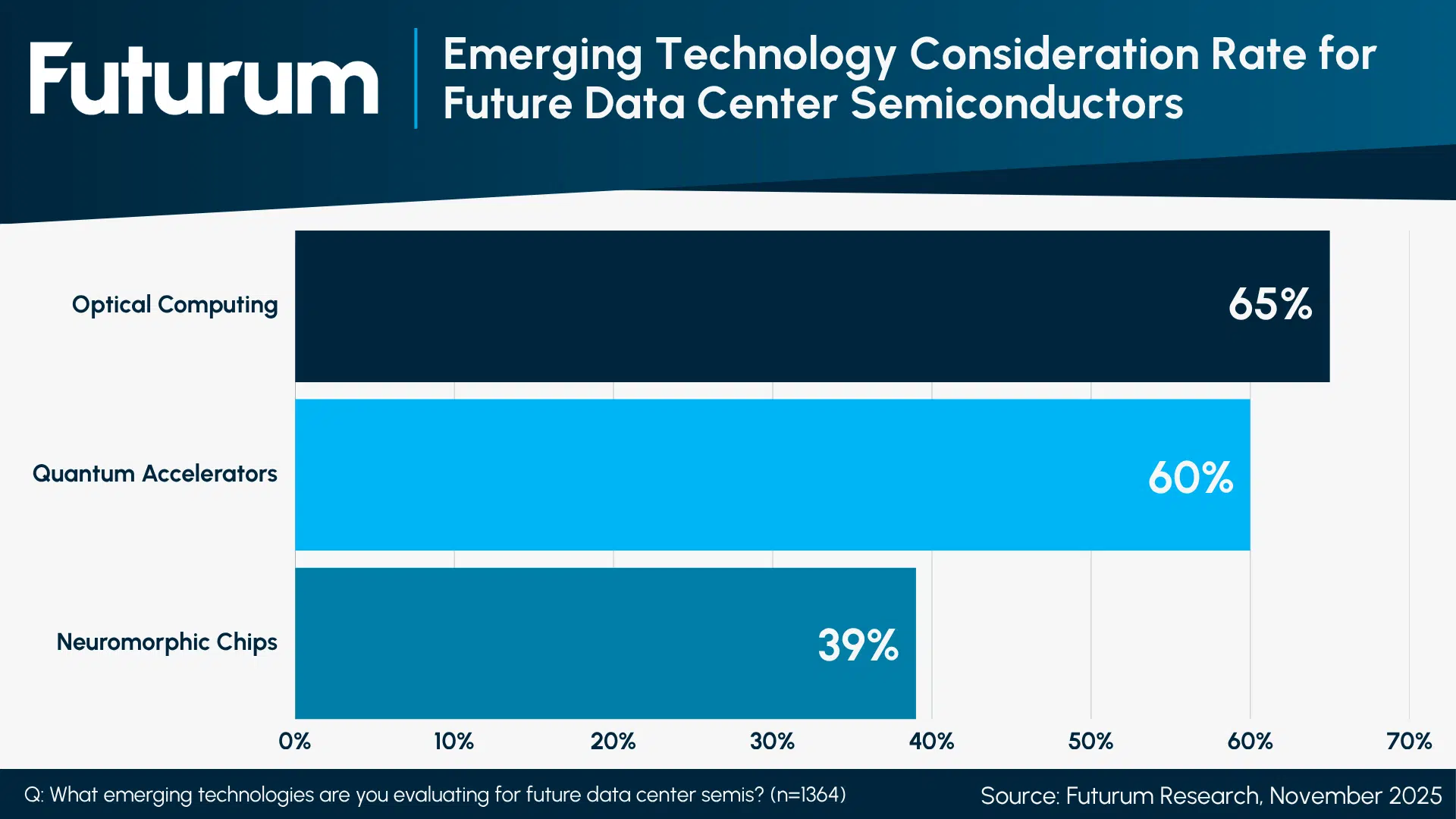
According to Futurum’s Data Center Semiconductors Decision Maker survey, 65% of enterprise compute decision makers plan to adopt optical computing for use in data center semiconductors, 60% plan to use quantum accelerators, and ~39% plan to deploy neuromorphic chips.
Figure 1: Emerging Technology Consideration Rate for Future Data Center Semiconductors
Brendan Burke, Research Director at Futurum, said, “The pace of optical computing growth will be driven by customer demand. The technology faces supply chain, reliability, and cost issues, yet demand for high throughput and low power continues to drive it forward. We will soon be able to say the same for quantum computing as quantum processing units mature.”
The research reveals several key developments shaping the semiconductor landscape:
- Optical computing intent reflects the industry’s most acute pressure point: power. As Futurum’s Q4 2025 State of the Market Report noted, “power has become the single biggest bottleneck in AI infrastructure expansion” and “the industry is shifting from a narrow focus on compute performance to a more holistic optimization—balancing power efficiency, thermal design, and energy delivery across every subsystem.” Photonic interconnects and optical computing promise dramatically lower power consumption per operation and reduced thermal overhead, directly addressing a competitive differentiator at rack scale.
- Quantum accelerator intent signals that enterprises view quantum-classical hybrid architectures as increasingly viable for specific workloads, particularly optimization, molecular simulation, and cryptographic applications. While general-purpose quantum computing remains years out, accelerator-class quantum hardware designed to augment classical GPU clusters is moving from research to early commercial deployment.
- Neuromorphic chips trail at 39%, but still represent meaningful intent. Neuromorphic architectures, modeled on biological neural networks, are best suited for ultra-low latency inference at the edge and event-driven sensor processing, use cases where traditional von Neumann architectures are inherently inefficient.
“The findings reflect enterprise buyers planning beyond the GPU scaling curve,” observed Burke. “While organizations are still taking a cautious approach to adopting optical and quantum technologies, the ability to solve hard problems with superior computational and networking performance will continue to advance these fields. With co-packaged optics approaching pilot-stage integration and quantum processing units entering early testing cycles, the investment signals from decision-makers are aligning with real engineering milestones.”
The survey reveals a divergence between enterprise plans and broader market perception. While public discourse remains skeptical of the near-term efficacy of emerging technologies, enterprise buyers plan to selectively deploy them to overcome computational bottlenecks, such as power and simulation complexity. Innovation continues to compress timelines for these technologies, with co-packaged optics preparing for commercial scale in 2027 and quantum processing units moving towards functional testing in the next three years. Compute leaders actively invest in the optical supply chain and quantum computing research, accelerating deployment of these technologies.
Read more in the “2H 2025 Data Center Semiconductors Global Enterprise Decision Maker Survey Report” and “Q2 2025 Data Center Semiconductor Spot Check Report” on the Futurum Intelligence Platform.
About Futurum Intelligence for Market Leaders
Futurum Intelligence’s Semiconductor, Supply Chain, and Emerging Tech IQ service provides actionable insight from analysts, reports, and interactive visualization datasets, helping leaders drive their organizations through transformation and business growth. Subscribers can log into the platform at https://app.futurumgroup.com/, and non-subscribers can find additional information at Futurum Intelligence.
Follow news and updates from Futurum on X and LinkedIn using #Futurum. Visit the Futurum Newsroom for more information and insights.
Other Insights from Futurum:
Futurum Signal Report: AI Accelerators
Co-Packaged Optics: The Key to Unleashing AI Networking’s Full Potential – Subscribers*
AI Grid Constraints Will Push Over 33% of Data Centers Off-Grid by 2030 – Subscribers*
Can the CPU Market Meet Agentic AI Demand? – Subscribers*
Author Information

Brendan is Research Director, Semiconductors, Supply Chain, and Emerging Tech. He advises clients on strategic initiatives and leads the Futurum Semiconductors Practice. He is an experienced tech industry analyst who has guided tech leaders in identifying market opportunities spanning edge processors, generative AI applications, and hyperscale data centers.
Before joining Futurum, Brendan consulted with global AI leaders and served as a Senior Analyst in Emerging Technology Research at PitchBook. At PitchBook, he developed market intelligence tools for AI, highlighted by one of the industry’s most comprehensive AI semiconductor market landscapes encompassing both public and private companies. He has advised Fortune 100 tech giants, growth-stage innovators, global investors, and leading market research firms. Before PitchBook, he led research teams in tech investment banking and market research.
Brendan is based in Seattle, Washington. He has a Bachelor of Arts Degree from Amherst College.
