
Austin, Texas, USA, December 16, 2025
New Futurum Research Reveals CIOs Are Consolidating Platform Spend Around AI-Ready Ecosystems as AI Shifts From Experimentation to Revenue-Driving Operations Across the Enterprise.
Enterprise CIOs are no longer funding AI as a series of isolated pilots. Instead, they are reshaping their entire platform portfolios to support AI as a core operating capability, according to new findings from Futurum Research’s CIO Insights Global Survey, Q3 2025.
The survey of 248 global CIOs reveals that 79% now identify AI/ML-enabled technology as their top innovation priority, while spending patterns indicate a decisive shift toward platform consolidation and reallocation, rather than broad IT budget expansion. CIOs are concentrating investment on platforms that combine AI, automation, integration, and governance, while pulling back from systems viewed as less differentiated or cost-efficient.
This marks a structural inflection point in enterprise IT strategy: AI is no longer an overlay on existing systems; it is becoming the organizing principle for platform decisions, workload placement, and modernization priorities.
CIO Platform Spending Signals Strategic Reallocation, Not Budget Inflation
CIOs report reallocating spend across major enterprise platforms to align with AI readiness and operational leverage. Platforms with strong AI roadmaps and automation depth are attracting increased investment, while consolidation and “spend less” signals are rising across legacy and overlapping systems.
Figure 1: Planned Shifts in Enterprise Platform Spending
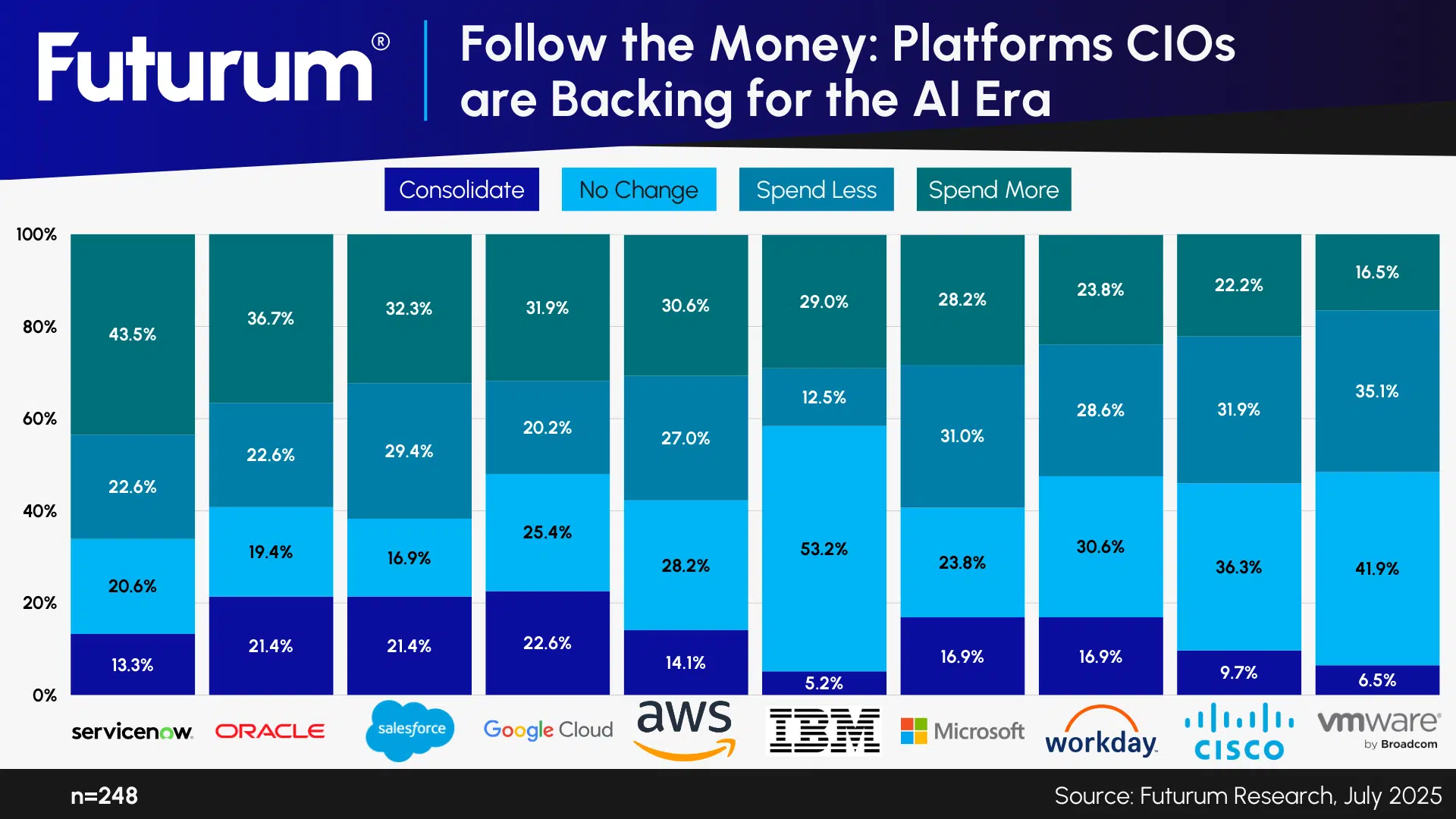
ServiceNow, Salesforce, Oracle Cloud, Microsoft Azure, and Google Cloud show the strongest “spend more” signals, reflecting their role as anchors for workflow automation, AI integration, and enterprise-wide execution. At the same time, CIOs are applying greater cost discipline to mature infrastructure and tooling categories, using consolidation as a lever to free budget for AI-driven initiatives.
AI Crosses the Rubicon From Experimentation to Revenue Infrastructure
The survey data confirms that AI adoption has reached a new phase. Every CIO surveyed reports AI usage somewhere in the organization, eliminating the “non-adopter” category entirely. More importantly, AI is moving into functions directly tied to revenue and execution.
Operations (68%) and Sales (59%) now lead AI adoption, overtaking customer support, which dominated earlier cycles. This shift indicates that CIOs are prioritizing AI where it can deliver measurable business impact, including faster execution, improved forecasting, and enhanced customer engagement.
Rather than signaling retrenchment, this pattern reflects portfolio quality control. CIOs are narrowing platform stacks to reduce complexity, improve governance, and accelerate AI deployment at scale.
Figure 2: AI Moves From Pilot to Revenue Engine
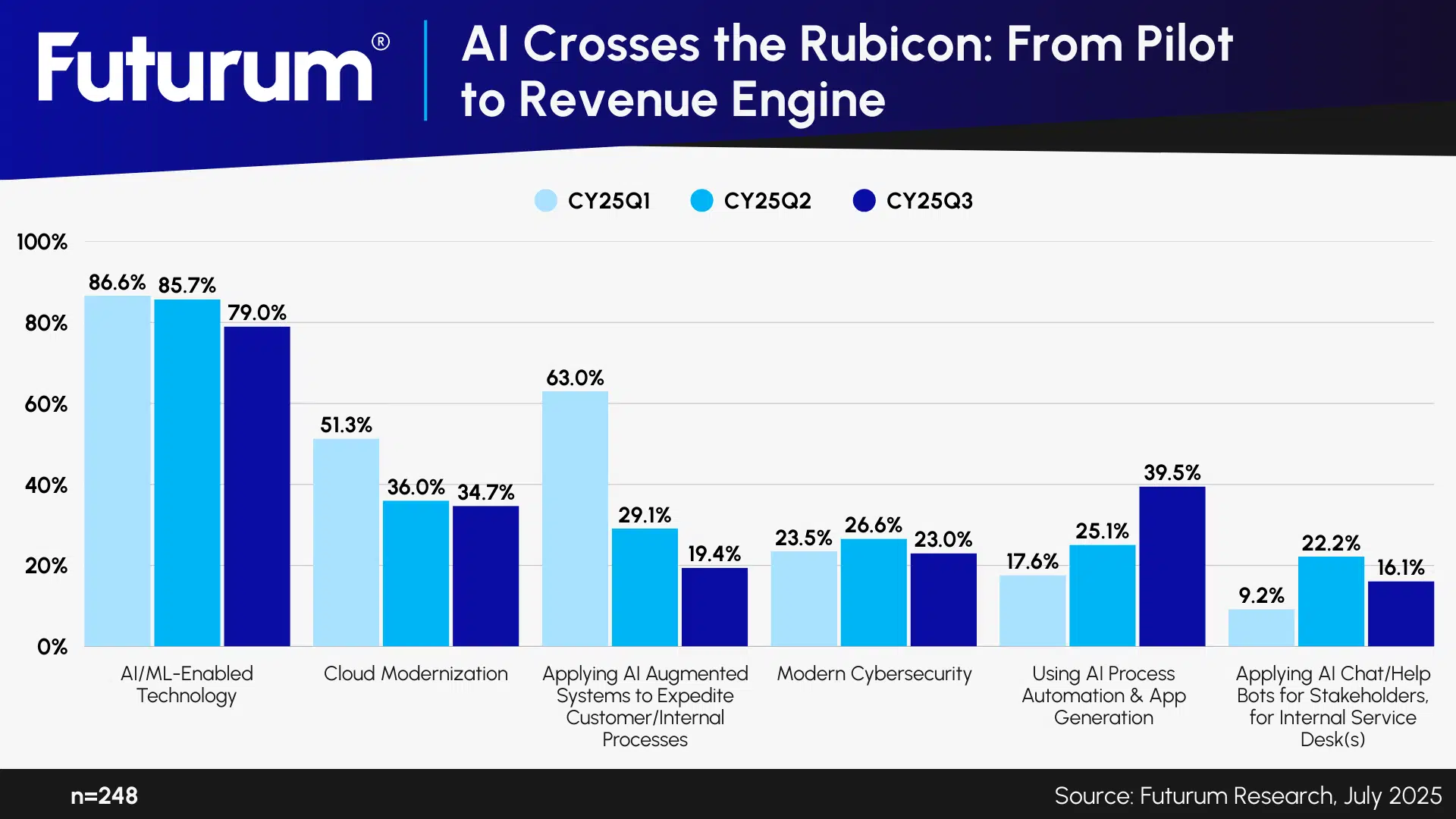
Process automation and AI-generated applications are now the most cited near-term AI initiatives, while more than one in ten CIOs report building enterprise-specific LLMs. AI is no longer confined to productivity experiments; it is becoming embedded in the core operating fabric of the enterprise.
Consolidation, Cloud Precision, and Modernization Converge Around AI
The reallocation of platform spend is closely tied to broader architectural shifts. CIOs are simultaneously modernizing legacy systems, reassessing cloud workload placement, and strengthening security posture, all with AI scale in mind.
More than half of CIOs are migrating legacy applications to modern cloud platforms, while nearly 30% report actively shifting workloads between public and private cloud environments. These moves reflect a transition from cloud migration to cloud precision, where performance, sovereignty, cost, and AI integration determine placement decisions.
Cybersecurity remains the most persistent constraint, with more than half of CIOs citing threat detection and ransomware as top concerns. Talent scarcity compounds the challenge, underscoring the need for platforms that minimize operational friction and integrate AI responsibly, rather than adding complexity.
What the Q3 2025 Data Reveals
Taken together, the findings show CIOs managing transformation through architecture, not experimentation. Platform consolidation, AI operationalization, and disciplined budget reallocation are converging into a single strategy focused on durability and scale.
“CIOs are no longer asking whether to invest in AI; they’re deciding which platforms can support AI as an enterprise operating system,” said Dion Hinchcliffe, Practice Lead, CIO Insights at Futurum. “The shift we’re seeing is from technology adoption to structural commitment. AI, security, cloud, and modernization are now inseparable decisions.”
The implication for vendors is clear: winning CIO mindshare in 2025 will depend less on standalone features and more on how well platforms collapse complexity, integrate AI safely, and deliver repeatable business outcomes.
Subscribers can read more in the report “CIO Insights Global Survey, Q3 2025” on the Futurum Intelligence Platform. Non-subscribers can click here for more information.
About Futurum Intelligence for Market Leaders
Futurum Intelligence’s CIO Insights IQ service provides actionable insight from analysts, reports, and interactive visualization datasets, helping leaders drive their organizations through transformation and business growth. Subscribers can log into the platform at https://app.futurumgroup.com/, and non-subscribers can find additional information at Futurum Intelligence.
Follow news and updates from Futurum on X and LinkedIn using #Futurum. Visit the Futurum Newsroom for more information and insights.
Other Insights from Futurum:
Google Public Sector Launches a New Era of Mission-Ready AI
Are CIOs Ready to Bet Their Agentic Operating Model on Salesforce?
Is Teradata About to Leapfrog Agentic AI for Regulated Enterprises?
Author Information

Dion Hinchcliffe is a distinguished thought leader, IT expert, and enterprise architect, celebrated for his strategic advisory with Fortune 500 and Global 2000 companies. With over 25 years of experience, Dion works with the leadership teams of top enterprises, as well as leading tech companies, in bridging the gap between business and technology, focusing on enterprise AI, IT management, cloud computing, and digital business. He is a sought-after keynote speaker, industry analyst, and author, known for his insightful and in-depth contributions to digital strategy, IT topics, and digital transformation. Dion’s influence is particularly notable in the CIO community, where he engages actively with CIO roundtables and has been ranked numerous times as one of the top global influencers of Chief Information Officers. He also serves as an executive fellow at the SDA Bocconi Center for Digital Strategies.
