
Austin, Texas, USA, January 16, 2026
Vendors Win by Operationalizing AI With Built-in Observability and Software Security, Not by Shipping More AI Features
The Futurum Group has released its 1H 2026 Software Lifecycle Engineering Decision Maker Survey Report, based on responses from 828 global enterprise IT leaders spanning software development, observability, platform engineering, DevOps, and operations.
The report captures a clear inflection in how organizations are pursuing software delivery speed, with AI investment now overtaking hiring as the primary lever for acceleration. Decision makers are redirecting budgets toward generative AI, machine learning, agents, and automation to increase capacity without expanding headcount.
Figure 1: Top 5 Drivers For Accelerating Software Delivery
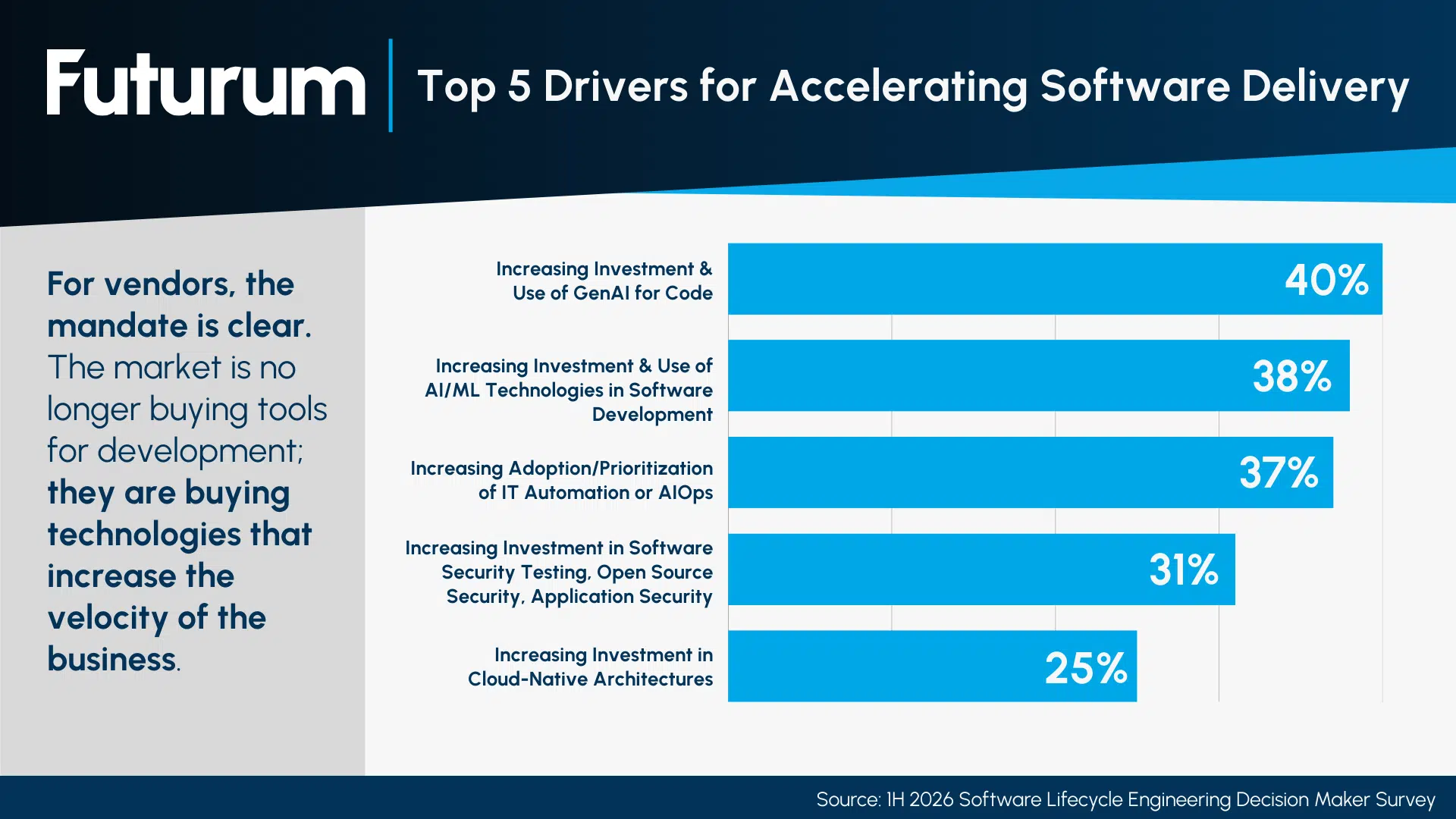
The data shows “Increasing investment in Generative AI” (40%) and “AI/ML technologies” (39%) as the two most critical actions for accelerating software delivery over the next 12-18 months, nearly doubling “Increasing hiring of IT personnel” (23%).
Figure 2: Areas Targeted for Significant Spending Increases Over the Next 12-18 Months
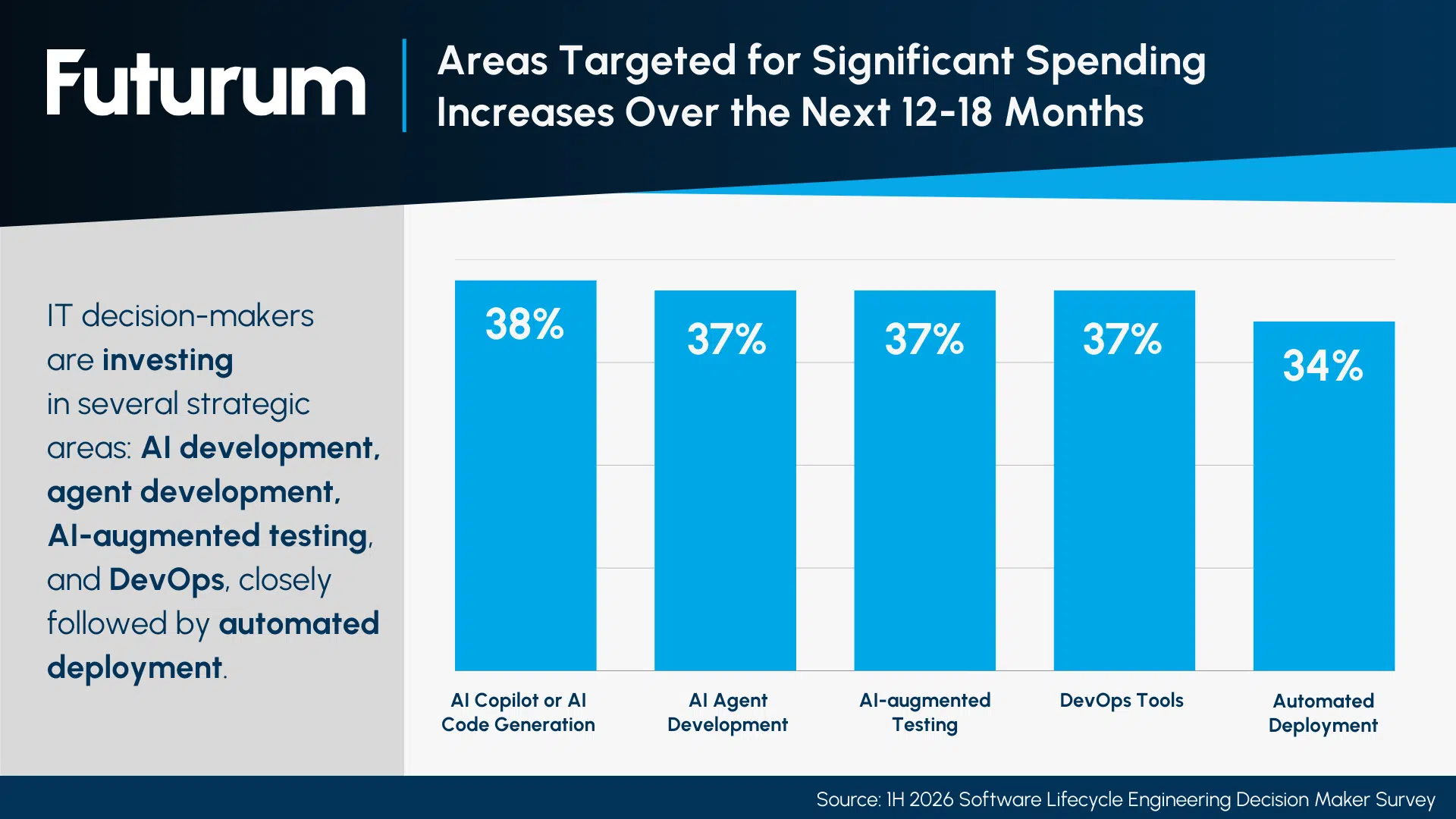
Application and software supply chain security also emerge as drivers of speed rather than a constraint. Observability is moving upstream into software development and agent workflows, becoming a prerequisite for operating AI-driven systems with confidence. Planned increases in security and observability spending signal a shift toward embedding guardrails directly into development and delivery pipelines.
The report concludes that vendors and enterprises alike must treat AI as core delivery infrastructure, not an add-on, and focus on platforms that convert AI adoption into measurable execution gains across the full software lifecycle.
“Enterprises have reached the limit of what DevOps maturity alone can deliver. The data shows organizations are no longer trying to run faster by adding people, but by increasing execution capacity with AI, automation, and AIOps,” said Mitch Ashley, Vice President and Practice Lead for Software Lifecycle Engineering at The Futurum Group. “Winners in this space are vendors who take AI beyond adding more features, guide customers in their transformation in the uses of AI, while increasing observability and security early in the AI development lifecycle.”
Our research also highlights several key developments in the software engineering landscape:
- The Rise of AIOps: Operational complexity is forcing a shift toward automation. “Increasing adoption of IT Automation or AIOps” (37%) now outranks foundational efforts like “Cloud-native architectures” (25%) as a driver for acceleration.
- Kubernetes as the Default OS: Kubernetes usage has reached saturation, with 66% of organizations using it for internal business software and 48% for customer-facing services, necessitating automated intervention to manage signal noise.
- AI Adoption Gap Narrowing: The gap between AI use in development and operations is closing rapidly. While 60% of organizations use AI in development, 37% are already applying it to Operations, signaling a move toward fully AI-augmented lifecycles.
- Security as a Speed Multiplier: Security investment is no longer seen as a bottleneck but as a velocity driver. Planned spending on “Software Security Testing” (39%) and “API Security” (36%) is rising as leaders implement DevSecOps “guardrails” to prevent late-stage rework.
Read more in the “1H 2026 Software Lifecycle Engineering Decision Maker Survey Report” on the Futurum Intelligence Platform. Non-subscribers can click here for more information.
About Futurum Intelligence for Market Leaders
Futurum Intelligence’s Software Lifecycle Engineering IQ service provides actionable insight from analysts, reports, and interactive visualization datasets, helping leaders drive their organizations through transformation and business growth. Subscribers can log into the platform at https://app.futurumgroup.com/, and non-subscribers can find additional information at Futurum Intelligence.
Follow news and updates from Futurum on X and LinkedIn using #Futurum. Visit the Futurum Newsroom for more information and insights.
Other Insights from Futurum:
Software Lifecycle Management – Subscribers*
Karpathy’s Thread Signals AI-Driven Development Breakpoint
GitHub Boldly Maps Out The Agentic Development Universe
Author Information

Mitch Ashley is VP and Practice Lead of Software Lifecycle Engineering for The Futurum Group. Mitch has over 30+ years of experience as an entrepreneur, industry analyst, product development, and IT leader, with expertise in software engineering, cybersecurity, DevOps, DevSecOps, cloud, and AI. As an entrepreneur, CTO, CIO, and head of engineering, Mitch led the creation of award-winning cybersecurity products utilized in the private and public sectors, including the U.S. Department of Defense and all military branches. Mitch also led managed PKI services for broadband, Wi-Fi, IoT, energy management and 5G industries, product certification test labs, an online SaaS (93m transactions annually), and the development of video-on-demand and Internet cable services, and a national broadband network.
Mitch shares his experiences as an analyst, keynote and conference speaker, panelist, host, moderator, and expert interviewer discussing CIO/CTO leadership, product and software development, DevOps, DevSecOps, containerization, container orchestration, AI/ML/GenAI, platform engineering, SRE, and cybersecurity. He publishes his research on futurumgroup.com and TechstrongResearch.com/resources. He hosts multiple award-winning video and podcast series, including DevOps Unbound, CISO Talk, and Techstrong Gang.
