
Austin, Texas, USA, March 18, 2026
The Futurum Group today released findings from its “1H 2026 AI Platforms Decision Maker Survey Report,” a study of 820 global enterprise AI decision-makers that reveals enterprise AI maturity is driven less by which models organizations deploy and more by how they govern, lead, and scale them. The research exposes a sharp divide between AI leaders and laggards — one defined by organizational structure and strategic discipline, not technology access.
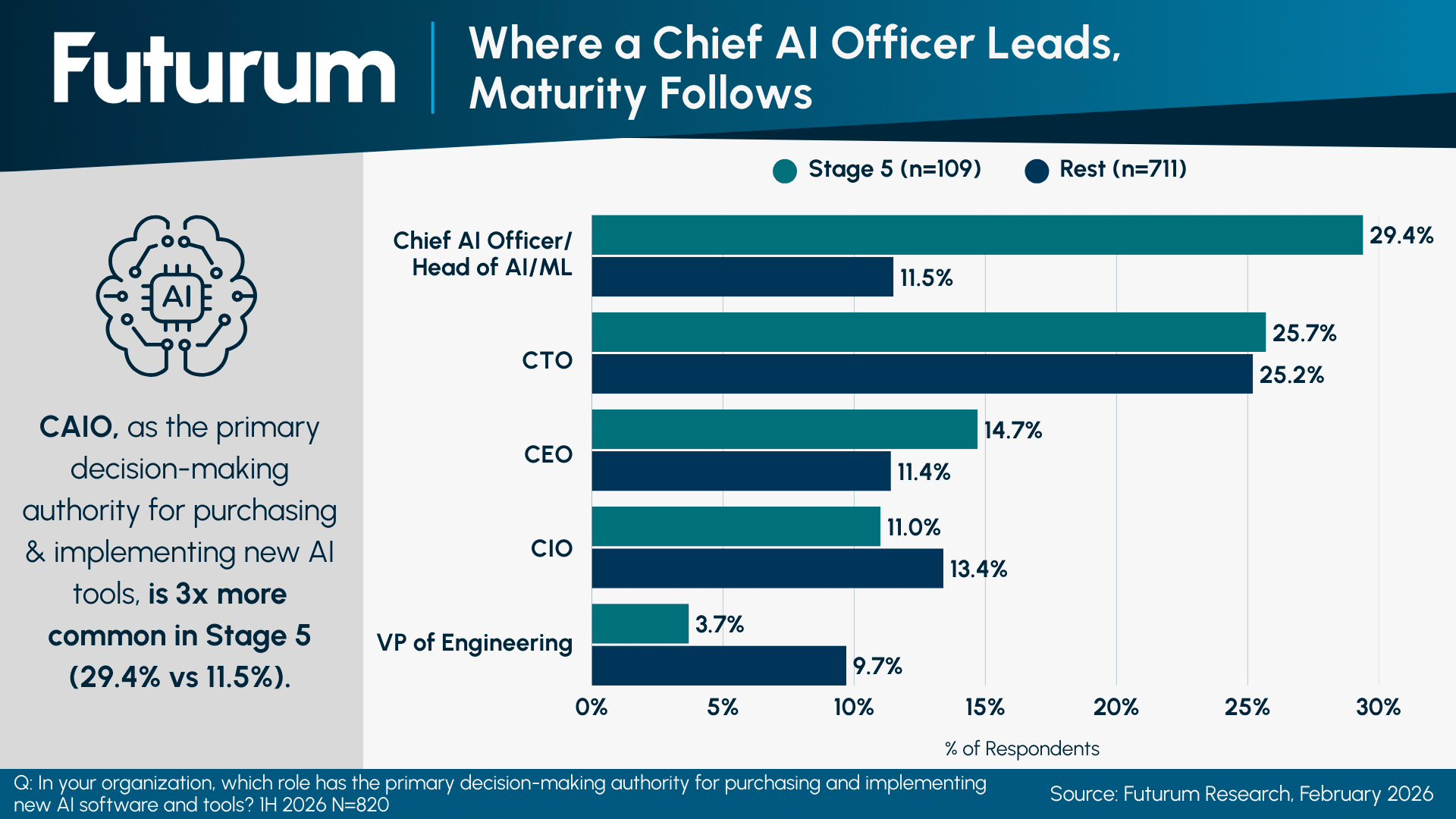
At the heart of the findings is a leadership signal that separates the most advanced organizations from all others. Stage 5 organizations — those at the highest level of AI maturity (13.3% of the sample, n=109) — are nearly three times more likely to have a Chief AI Officer (CAIO) as their primary AI decision-maker (29.4% vs 11.5% across all other stages). This is the starkest leadership difference in the dataset, and it holds across size and sector. Where AI strategy is driven by business unit leaders rather than a central C-suite executive, maturity scores fall to their lowest levels. The implication is direct: dedicated AI governance may be as consequential as any model selection decision.
The survey also identifies the friction points that define organizational lag. Respondents who rate themselves behind their peers (n=105) face a distinct challenge profile: workforce adaptation is 12.4 percentage points more prevalent than among ahead organizations, and legacy system integration is 13.1 percentage points higher — the two structural barriers that most sharply distinguish lagging from leading organizations. In contrast, ahead organizations actually report higher rates of agent reliability concerns (58.5% vs 50.5%), suggesting that technical challenges intensify with scale rather than diminish. Meanwhile, organizations averaging 3.8 models in their AI portfolios — with OpenAI (57.3%) and Azure OpenAI (55.7%) forming the dominant dual-channel backbone — face production-grade complexity that demands mature governance and measurement frameworks to manage effectively.
Figure 1: Where a Chief AI Officer Leads, Maturity Follows
Measurement discipline emerges as another defining differentiator. Performance metric tracking correlates with AI maturity at r=0.371, one of the strongest relationships in the dataset. Stage 5 organizations have shifted their priorities away from inference cost (22.0%) toward uptime and availability (57.8%), signaling a transition from cost optimization to production reliability as AI moves into mission-critical operations. Agentic advancement is equally stark: 78% of Stage 5 organizations have reached the Orchestrating or Autonomous Ecosystem stages, compared to just 13.1% of all other organizations. Security and data privacy remain the top agentic concern at every deployment stage, suggesting this concern scales with complexity rather than receding with experience.
“Enterprise AI maturity is no longer a function of which models you deploy — it is a function of how your organization is structured to govern and scale them,” said Nick Patience, Vice President & Research Director, AI Practice Lead at The Futurum Group. “The CAIO signal is unambiguous: organizations with dedicated AI leadership dramatically outpace those that leave AI strategy to business units or secondary IT roles. Vendors that anchor their enterprise engagement around governance, observability, and agentic orchestration will win with the buyers who matter most.”
- CAIO Leadership Drives Enterprise AI Maturity: Stage 5 organizations are nearly three times more likely to have a Chief AI Officer as their primary AI decision-maker (29.4% vs 11.5%), the starkest leadership gap in the dataset. Business-unit-led AI correlates with the lowest maturity and weakest competitive self-assessment of any governance model.
- Structural Gaps Define Laggards, Not Fewer Challenges: Organizations rating themselves behind peers (n=105) report nearly the same total challenge count as leaders (mean 4.31 vs 4.22), but diverge sharply on workforce adaptation (+12.4pp) and legacy system integration (+13.1pp) — the two barriers that most distinguish lagging from leading organizations.
- Multi-Model Portfolios Are the Enterprise Norm: Organizations deploy an average of 3.8 models, with OpenAI (57.3%) and Azure OpenAI (55.7%) forming the dominant dual-channel backbone. No single portfolio combination exceeds 3.3% of the sample. DeepSeek (17.8%) is being added to existing large portfolios, not replacing incumbents.
- Metric Discipline Predicts Maturity: Performance metric tracking correlates with AI maturity at r=0.371 (p<0.001). Stage 5 organizations shift away from inference cost (22.0%) toward uptime and availability (57.8%), signaling a move from cost optimization to production reliability as AI enters mission-critical operations.
- Agentic Advancement Defines Stage 5: 78% of Stage 5 organizations have reached the Orchestrating or Autonomous Ecosystem agentic stages, versus just 13.1% of all others. Security and data privacy remain the top agentic concern at every deployment stage (21–28%), and unlike regulatory concerns, do not diminish with experience.
The full “1H 2026 AI Platforms Decision Maker Survey Report” is available now for Futurum Intelligence subscribers. Non-subscribers can click here for more information.
About Futurum Intelligence for Market Leaders
Futurum Intelligence’s IQ service provides actionable insight from analysts, reports, and interactive visualization datasets, helping leaders drive their organizations through transformation and business growth. Subscribers can log into the platform at https://app.futurumgroup.com/, and non-subscribers can find additional information at Futurum Intelligence.
Follow news and updates from Futurum on X and LinkedIn using #Futurum. Visit the Futurum Newsroom for more information and insights.
Other Insights from Futurum:
S3NS & Sovereignty: Can Thales-Google Venture Make AI Sovereignty Work at Scale?
Elastic Q3 FY 2026: Strong Quarter, but Reacceleration Thesis Unproven
NVIDIA Q4 FY 2026 Earnings Highlight Durable AI Infrastructure Demand
Author Information

Nick Patience is VP and Practice Lead for AI Platforms at The Futurum Group. Nick is a thought leader on AI development, deployment, and adoption - an area he has researched for 25 years. Before Futurum, Nick was a Managing Analyst with S&P Global Market Intelligence, responsible for 451 Research’s coverage of Data, AI, Analytics, Information Security, and Risk. Nick became part of S&P Global through its 2019 acquisition of 451 Research, a pioneering analyst firm that Nick co-founded in 1999. He is a sought-after speaker and advisor, known for his expertise in the drivers of AI adoption, industry use cases, and the infrastructure behind its development and deployment. Nick also spent three years as a product marketing lead at Recommind (now part of OpenText), a machine learning-driven eDiscovery software company. Nick is based in London.

