
Analyst(s): Brad Shimmin
Publication Date: February 24, 2026
Quest Software has launched the Trusted Data Management Platform, a unified SaaS solution designed to address the fragmented data foundations that are stalling enterprise AI. By introducing an Automated Data Product Factory and a comprehensive trust-scoring system, Quest aims to slash data delivery times and shift the focus from manual engineering to high-level AI governance. This report analyzes Quest’s architectural strategy, its competitive positioning against legacy incumbents, and the critical role of trust in the age of autonomous agents.
Key Points:
- Quest’s new platform integrates data modeling, governance, cataloging, and quality into a single control plane, featuring an AI-driven factory that reportedly reduces data product delivery times from months to days.
- A proprietary nine-component trust-scoring framework provides the quantified confidence levels enterprises need to move from experimental AI to autonomous, production-grade workflows.
- By unifying disparate data functions, Quest promises a significant reduction in TCO, challenging organizations to abandon fragmented point solutions in favor of a cohesive “AI Shepherd” approach.
Overview:
The enterprise AI landscape in 2026 is defined by a stark transition from experimental pilot programs to the demand for production-grade returns. Corporate boards are no longer asking if AI works, but why substantial capital outlays have not yet yielded operational efficiency. The answer, almost universally, lies in the fractured state of enterprise data foundations where governance, quality, and modeling exist in silos. Quest Software’s launch of the Trusted Data Management Platform (TDMP) seeks to address this critical friction point by forcing the convergence of these disciplines into a singular, SaaS-native control plane. By moving away from disparate point solutions, Quest is making a contrarian bet that the only way to scale the agentic enterprise is to automate the manufacturing of trust itself, rather than relying on traditional practices and increased headcount.
Central to this platform is the debut of the Automated Data Product Factory, which is a part of TDMP. In a market where data teams are historically bogged down by manual engineering tasks, Quest leverages natural language prompts and advanced AI to automate the end-to-end creation of governed data products. This capability is not merely a productivity enhancement; it represents a fundamental shift in the role of the data practitioner. Quest is effectively facilitating a transition from data plumbing to “AI Shepherding,” where human experts shift their focus from writing code to auditing the semantic integrity of AI-generated assets. This operational shift is underpinned by a proprietary nine-component trust scoring framework. As we move from read-only AI to autonomous agents capable of executing transactions, this scoring system aims to provide the quantified, mathematical ground truth needed for systems to operate without constant human intervention.
Architecturally, Quest differentiates itself by rejecting the “Franken-platform” approach common among competitors, where suites are stitched together through aggressive M&A rather than cohesive engineering. Quest emphasizes that TDMP is built on a common architecture from the ground up, designed to eliminate the process gaps where critical governance typically falls through the cracks. This unity allows Quest to position itself as a neutral “Switzerland” in a polarized cloud ecosystem. By deeply integrating with hyperscale heavyweights such as Microsoft Fabric, Databricks (Unity Catalog), and Snowflake (Horizon), Quest provides a decoupled governance layer that protects enterprises from vendor lock-in while enhancing the capabilities of the underlying lakehouse architectures.
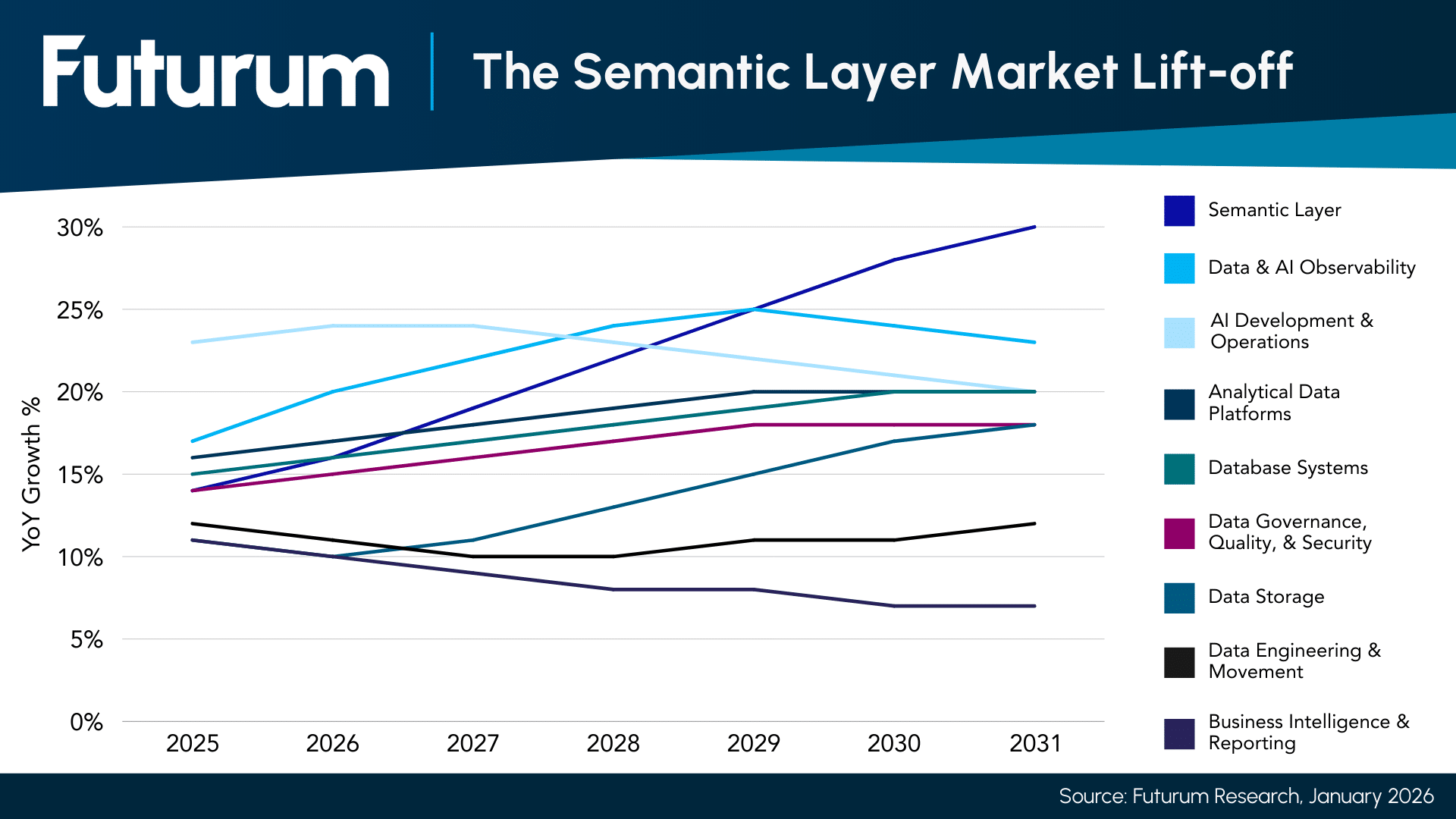
The economic implications of this launch are significant for the C-Suite. With the market for Data Intelligence, Analytics, and Infrastructure accelerating toward US$541.1 billion in 2026, and the Semantic Layer projected to grow on a “Rocket Ship” trajectory of 30% by 2031 (see Figure 1), efficiency is paramount. Quest’s promise of reduced Total Cost of Ownership (TCO) aligns perfectly with the emerging discipline of AI FinOps. As organizations grapple with energy constraints and the high cost of redundant data movement, the ability to deliver trusted data products faster is not just an operational metric; rather, it is a competitive necessity for the modern, data-driven enterprise.
Figure 1: The Semantic Layer Market Lift-off
Conclusion
Quest is challenging the status quo of patchworked data tools with a unified vision that prioritizes speed and trust. By offering a faster time to delivery and significant TCO reductions, Quest presents a compelling case for IT and business leaders to converge their purchasing power. However, success will depend on the platform’s ability to prove its “low-talent-dependency” in real-world scenarios and maintain its status as a neutral governance layer amid aggressive hyperscaler expansion.
The full report is available via subscription to Futurum Intelligence’s Data Intelligence, Analytics, and InfrastructureIQ service—click here for inquiry and access.
See the complete press release on the Quest Trusted Data Management Platform launch on the Quest Software website.
Futurum clients can read more in the Futurum Intelligence Platform, and non-clients can learn more here: Data Intelligence, Analytics, & Infrastructure Practice.
About the Futurum Data Intelligence, Analytics, & Infrastructure Practice
The Futurum Data Intelligence, Analytics, & Infrastructure Practice provides actionable, objective insights for market leaders and their teams so they can respond to emerging opportunities and innovate. Public access to our coverage can be seen here. Follow news and updates from the Futurum Practice on LinkedIn and X. Visit the Futurum Newsroom for more information and insights.
About Futurum Intelligence for Market Leaders
Futurum Intelligence’s IQ service provides actionable insight from analysts, reports, and interactive visualization datasets, helping leaders drive their organizations through transformation and business growth. Subscribers can log into the platform at https://app.futurumgroup.com/, and non-subscribers can find additional information at Futurum Intelligence.
Follow news and updates from Futurum on X and LinkedIn using #Futurum. Visit the Futurum Newsroom for more information and insights.
Author Information

Brad Shimmin is Vice President and Practice Lead, Data Intelligence, Analytics, & Infrastructure at Futurum. He provides strategic direction and market analysis to help organizations maximize their investments in data and analytics. Currently, Brad is focused on helping companies establish an AI-first data strategy.
With over 30 years of experience in enterprise IT and emerging technologies, Brad is a distinguished thought leader specializing in data, analytics, artificial intelligence, and enterprise software development. Consulting with Fortune 100 vendors, Brad specializes in industry thought leadership, worldwide market analysis, client development, and strategic advisory services.
Brad earned his Bachelor of Arts from Utah State University, where he graduated Magna Cum Laude. Brad lives in Longmeadow, MA, with his beautiful wife and far too many LEGO sets.

