Analyst(s): Brendan Burke
Publication Date: February 10, 2026
Texas Instruments (TI) has agreed to acquire Silicon Labs for $7.5 billion in cash, combining TI’s analog and embedded processing scale with Silicon Labs’ wireless connectivity portfolio. The deal highlights a strategic bet on manufacturing capabilities and embedded markets.
What is Covered in this Article:
- Transaction: Texas Instruments (TI) to acquire Silicon Labs for $231 per share ($7.5 billion enterprise value) in an all-cash deal.
- Vertical Integration: The move signals a shift toward vertical integration in the silicon supply chain, mirroring trends like GlobalFoundries’ acquisition of Synopsys’ ARC IP and positioning fabs as the new center of gravity for design innovation.
- Edge AI Acceleration: Silicon Labs’ Series 3 platform gains access to TI’s expanded 28nm nodes to drive the cost efficiencies needed for mass edge AI adoption.
- Market Alignment: While data center power management makes data center TI’s fastest-growing market, this deal fortifies its core revenue pools in industrial and automotive sectors, capitalizing on the fragmented analog market’s projected cash generation uptrend.
The News: Texas Instruments (TI) has agreed to acquire Silicon Labs for $231.00 per share in cash, implying a total enterprise value of approximately $7.5 billion. The transaction has been unanimously approved by both boards. The deal combines Silicon Labs’ ~1,200 wireless connectivity products with TI’s massive analog and embedded processing scale and internally owned manufacturing footprint. Notably, Silicon Labs brings its next-generation Series 3 platform, which boasts a 10x increase in coremark and 100 AI GOPS (Giga Operations Per Second), positioning the combined entity to address complex edge AI devices. TI expects to generate approximately $450 million in annual manufacturing and operational synergies within three years of closing by reshoring Silicon Labs’ production to its own fabs. The acquisition is expected to be accretive to earnings per share in the first full year after closing.
Texas Instruments Buys Silicon Labs To Fuel Edge AI Scale
Analyst Take — Fabs are the Center of Gravity in the Silicon Supply Chain: TI’s acquisition of Silicon Labs reinforces a critical structural shift in the semiconductor industry: the fabrication facility is becoming the center of gravity for value creation. This move extends the trend observed with GlobalFoundries acquiring Synopsys’ ARC processor IP, demonstrating that the separation between fabless design and foundry manufacturing is blurring for edge applications. By vertically integrating Silicon Labs’ wireless IP with its own manufacturing capabilities, TI can optimize the feedback loop between process technology and chip design. This creates structural cost advantages and performance tuning capabilities that are difficult for fabless competitors to replicate, particularly as the industry seeks the efficiencies required to scale AI at the edge.
Scaling Edge ML with Vertical Efficiencies
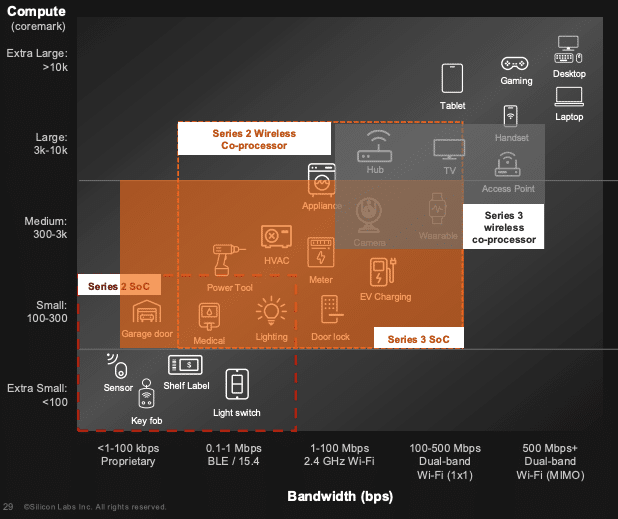
The integration is timely given the technical trajectory of Silicon Labs’ portfolio. With the Series 3 platform delivering 100 AI GOPS and a 10x uplift in coremark to 3,000 from 300 in Series 2, Silicon Labs has moved beyond simple connectivity into robust edge compute. Launching in 2026, Series 3 allows Silicon Labs to move up market to complex embedded systems, including wireless gateways, cameras, and wearable devices. The company projects integration with 10 billion devices per year by 2035. TI’s ability to manufacture these complex SoCs on its cost-effective 300mm wafers allows for the mass deployment of smart connectivity ahead of the launch of Silicon Labs’ SiXG302 SoCs. The combination marries TI’s dominance in power management with Silicon Labs’ compute and radio capabilities, creating a comprehensive solution for the intelligent edge.
Consolidation in Fragmented Analog and Embedded Markets
The analog and embedded processing industries remain highly fragmented, making them ripe for consolidation. Texas Instruments’ core analog business resides in a sector poised for an uptrend in cash generation, given the capacity added over the past two years. With tailwinds from this cyclical turn and exposure to AI, TI is utilizing its balance sheet to lock in scalable IP to its embedded portfolio. While TI’s power management chips currently make the data center its fastest-growing market, the bulk of its revenue remains in industrial and automotive sectors. Silicon Labs’ portfolio is perfectly aligned with these core revenue pools, ensuring that while TI chases hyperscale growth in the cloud, it simultaneously fortifies its leadership in industrial sensing, smart home, connected healthcare, and other embedded markets.
Regulatory and Geographic Exposure Considerations
Regulatory approval remains a key gating factor, particularly given both companies’ exposure to China, where Silicon Labs derives roughly 15% of sales and TI around 20%. While antitrust concerns in the US are limited due to the fragmented nature of the IoT semiconductor market, approval from China’s State Administration for Market Regulation may be required. The expected H1 2027 closing timeline reflects these regulatory complexities and the scale of the integration involved. Termination fees of $259 million for Silicon Labs and $499 million for TI further underscore the transaction’s conditional nature. Regulatory outcomes will play a material role in determining whether the deal’s strategic and financial objectives are ultimately realized.
What to Watch:
- Manufacturing Migration Velocity: The speed at which TI can qualify and migrate Silicon Labs’ products to its internal 28nm process will determine how quickly the $450 million in synergies are realized.
- Series 3 Roadmap Integration: Watch for announcements regarding the integration of Silicon Labs’ AI-capable Series 3 architecture with TI’s proprietary embedded processing IP.
- Competitor Consolidation: Expect further M&A activity in the fragmented analog and mixed-signal space as competitors react to TI’s increased scale and vertical capabilities.
See the complete press release on Texas Instruments’ acquisition of Silicon Labs to enhance embedded wireless connectivity on Texas Instruments’ website.
Disclosure: Futurum is a research and advisory firm that engages or has engaged in research, analysis, and advisory services with many technology companies, including those mentioned in this article. The author does not hold any equity positions with any company mentioned in this article.
Analysis and opinions expressed herein are specific to the analyst individually and data and other information that might have been provided for validation, not those of Futurum as a whole.
Other insights from Futurum:
Synopsys and GlobalFoundries Reshape Physical AI Through Processor IP Unbundling
Texas Instruments Q4 FY 2025 Earnings Highlight Industrial, Auto, DC Traction
Silicon Labs Q3 FY 2025 Delivers YoY Growth, Margin Expansion
Author Information

Brendan is Research Director, Semiconductors, Supply Chain, and Emerging Tech. He advises clients on strategic initiatives and leads the Futurum Semiconductors Practice. He is an experienced tech industry analyst who has guided tech leaders in identifying market opportunities spanning edge processors, generative AI applications, and hyperscale data centers.
Before joining Futurum, Brendan consulted with global AI leaders and served as a Senior Analyst in Emerging Technology Research at PitchBook. At PitchBook, he developed market intelligence tools for AI, highlighted by one of the industry’s most comprehensive AI semiconductor market landscapes encompassing both public and private companies. He has advised Fortune 100 tech giants, growth-stage innovators, global investors, and leading market research firms. Before PitchBook, he led research teams in tech investment banking and market research.
Brendan is based in Seattle, Washington. He has a Bachelor of Arts Degree from Amherst College.