Analyst(s): Mitch Ashley
Publication Date: February 2, 2026
What is Covered in this Article:
- Key product announcements from Dynatrace Perform 2026
- Introduction of Dynatrace Intelligence and domain-specific agents
- Expansion across cloud operations, developer workflows, and digital experience monitoring
- Initial implications for enterprises adopting agent-driven operations
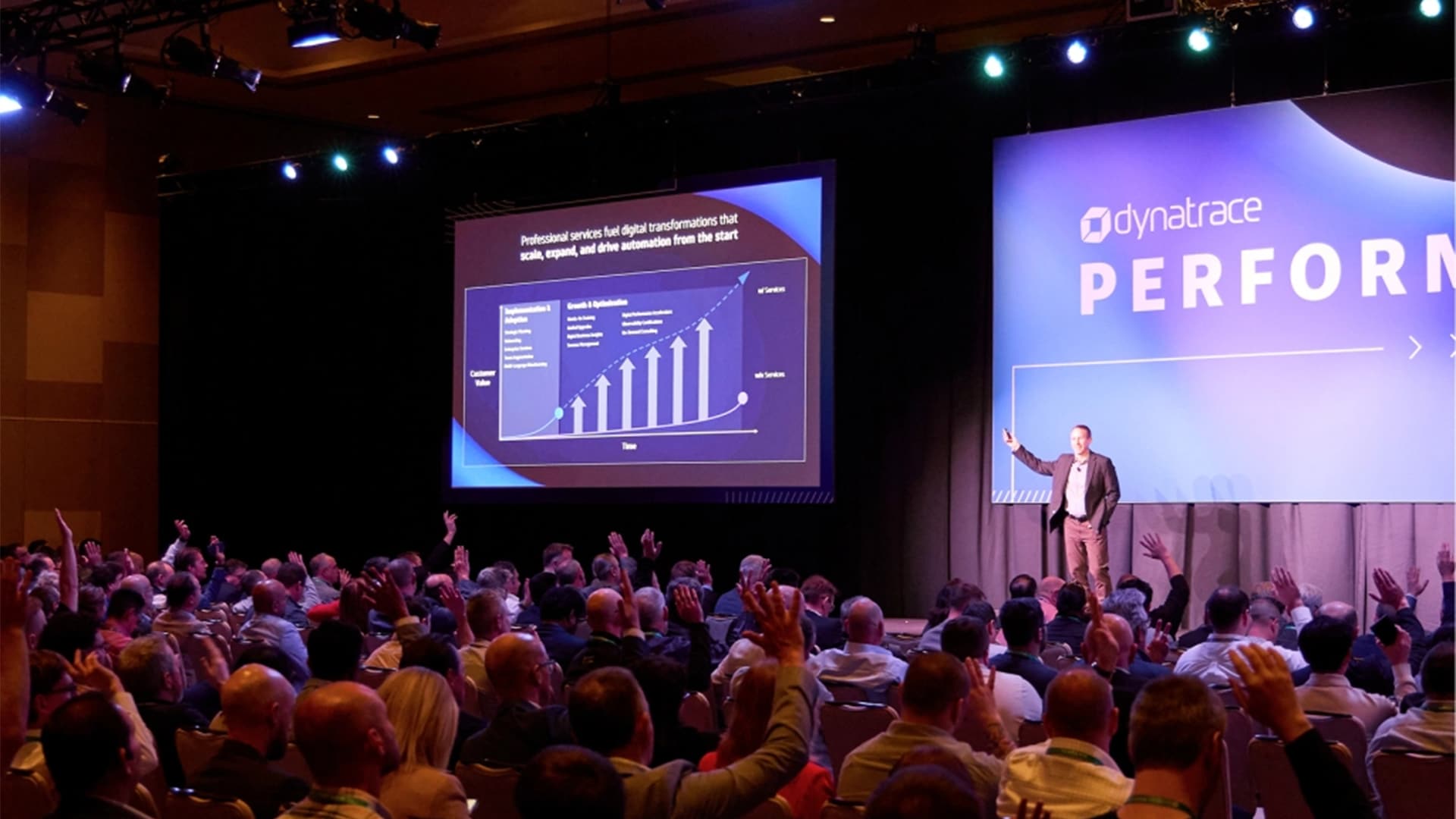
The Event — Major Themes & Vendor Moves: Dynatrace Perform 2026, held in Las Vegas, Nevada, delivered a coordinated set of product announcements that expanded the scope of the Dynatrace platform across AI-driven operations, cloud infrastructure visibility, developer workflows, and digital experience monitoring. The conference presented a portfolio of updates aimed at supporting enterprises operating increasingly complex AI-enabled environments.
The marquee announcement was the introduction of Dynatrace Intelligence, a new AI-driven capability embedded across the Dynatrace platform. Dynatrace Intelligence combines generative AI with deterministic analytics, real-time topology, and causal context derived from its Grail data lakehouse and Smartscape dependency model. The company emphasized support for agentic planning, orchestration, and supervision, along with AI-assisted investigation, summarization, and recommendation features integrated into the Dynatrace user interface.
Dynatrace also announced an expansive set of domain-specific agents for distinct enterprise roles. These include operations and SRE agents for incident investigation, root cause analysis, and remediation guidance; security agents for vulnerability analysis and security event investigation; DevOps agents to support deployment pipelines, change validation, and production readiness; and developer-focused agents that surface production context, error details, and performance insights within development workflows. Dynatrace introduced agentic workflows that allow customers to compose multi-step workflows combining deterministic analytics and AI-driven reasoning across these agents.
Cloud operations was another major focus, with Dynatrace announcing expanded capabilities across Amazon Web Services, Microsoft Azure, and Google Cloud Platform. These updates emphasized broader ingestion of cloud service telemetry, improved contextual mapping of cloud services into Smartscape topology, and enhanced analytics for cloud-native and managed services.
Perform 2026 also included announcements aimed at improving the developer and DevOps experience. Dynatrace highlighted enhancements to its Live Debugger, enabling production debugging without redeployment, and expanded support for modern IDEs, including AI-first environments such as Anysphere Cursor and Windsurf.
In the area of digital experience, Dynatrace announced updates to its Real User Monitoring (RUM) capabilities built on the third-generation Dynatrace platform and Grail. These updates include a redesigned monitoring experience with expanded support for modern web and mobile applications, along with event-based analytics to improve visibility into user journeys and frontend errors.
Dynatrace Perform 2026: Is Observability The New Agent OS?
Analyst Take: Dynatrace is deliberately repositioning observability from understanding systems to helping operate them.
The Perform 2026 announcements reflect a broader industry inflection point. As enterprises move beyond AI-assisted insight toward AI systems that perform real work, the limiting factor becomes coordination, trust, and execution authority rather than access to models. Dynatrace Intelligence and its agent framework represent an attempt to anchor that execution in real-time topology, causal relationships, and unified operational context.
This direction aligns closely with Futurum Research’s 2026 prediction that agent control planes will determine whether AI-driven software engineering can scale into production. To deploy and operate AI agents at scale, organizations must be confident they can safely coordinate agents operating across planning, build, deploy, and operate loops. Dynatrace’s announcements indicate an early effort to define a broader control surface grounded in observability rather than workflow, orchestration, or guardrails alone.
A notable element of this strategy is Dynatrace’s explicit expansion into the software delivery pipeline. By introducing DevOps and developer-focused agents alongside operations and security agents, Dynatrace is positioning observability as an operate-to-code system, where production reality informs how software is changed, validated, and released. This reflects a shift from observability as feedback to observability as an active participant in delivery workflows.
An open question is how quickly enterprises will be willing to consolidate this level of operational authority within a single vendor’s platform. Early adopters may gain speed, coordination, and confidence advantages by standardizing on an observability-led control layer, while others may wait for similar capabilities and new innovations to mature agent control planes across multiple vendors and open standards. This tension between early advantage and single vendor control will shape adoption patterns over the next several years.
Dynatrace was careful to frame its role as complementary rather than replacement-oriented, emphasizing integration with cloud providers, IT service management platforms, and developer tools. That posture strengthens credibility while underscoring a competitive reality: as observability platforms expand into agent orchestration and execution support, adjacent vendors will face pressure to clarify and realign where authority, governance, and trust ultimately reside.
We will see a wave of announcements across this domain throughout 2026 and beyond, as vendors race to define how agent-driven systems are governed, coordinated, and trusted in production environments. Dynatrace’s Perform announcements may represent an early first-mover advantage, or more likely, they will prove to be the opening salvo in a broader race to stake claims in what is emerging as the agent control plane layer.
Further analysis of how observability platforms are forming into agent control layers, and what supervised autonomy looks like in practice, will be explored in future Futurum Research analyst reports.
What to Watch:
- Enterprises will vary in their readiness to adopt supervised autonomous operations.
- Observability platforms will be tested on how quickly they can be trusted with supervised execution authority.
- Competitors across observability, IT service management, and platform engineering will respond with their own approaches to agent coordination and control.
- Developers will evaluate whether observability-driven operate-to-code workflows fit naturally into their daily tools and processes.
- The market will begin to define technical standards and governance guardrails for agent control planes.
Read about the major Dynatrace Perform 2026 announcements here.
Disclosure: Futurum is a research and advisory firm that engages or has engaged in research, analysis, and advisory services with many technology companies, including those mentioned in this article. The author does not hold any equity positions with any company mentioned in this article.
Analysis and opinions expressed herein are specific to the analyst individually and data and other information that might have been provided for validation, not those of Futurum as a whole.
Other insights from Futurum:
Harness Incident Agent: Is DevOps Now The AI Engineers of Software Delivery?
GitLab’s Salvo in the Agent Control Plane Race
Dynatrace Brings Feature Management Into the Observability Control Plane
Can Red Hat and NVIDIA Remove the Friction Slowing AI Deployments?
5 Reasons Snowflake Acquiring Observe Sets the Tone For 2026
Image Credit: Dynatrace
Author Information

Mitch Ashley is VP and Practice Lead for the CIO & Technology Buyers and Software Lifecycle Engineering practices at The Futurum Group. A multi-time CIO and CTO with 30+ years leading technical organizations, Mitch built and operated production systems spanning cybersecurity for the U.S. Department of Defense, PKI services for the broadband and 5G industries, SaaS platforms, large-scale telecom and banking systems, and a national broadband network. His work with AI began early, developing expert systems that diagnosed and repaired complex mainframe environments. That operator foundation grounds his analysis in operational consequence, covering the technology buyer's world of software engineering, cybersecurity, DevOps, cloud, and AI.