
Analyst(s): Brad Shimmin
Publication Date: January 21, 2026
In this market prediction report, Brad Shimmin analyzes the industry-wide transition from experimental AI projects to production-grade intelligence. The analysis highlights the decline of the traditional data technician in favor of the “AI Shepherd,” the obsolescence of monolithic data platforms, and the critical necessity of semantic layers to ensure data reliability in 2026.
Key Points:
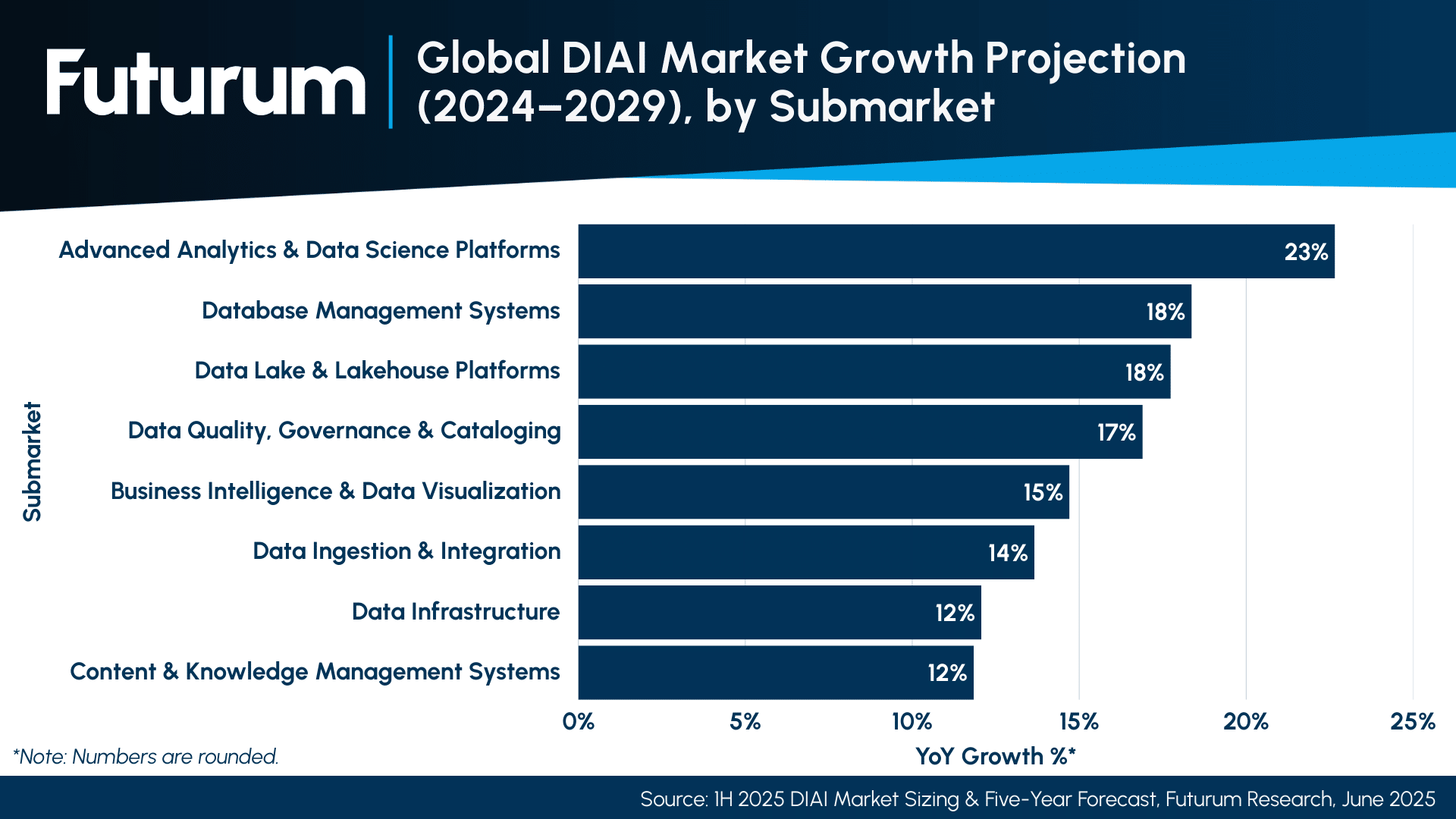
- The global Data Intelligence, Analytics, & Infrastructure (DIAI) market is projected to surpass US$475 billion in 2025, growing at a 16.5% CAGR through 2029.
- The “AI Shepherd” is replacing the data technician, with 73% of data professionals shifting focus from technical execution to strategic logic validation.
- Monolithic platforms are losing ground to Composable Intelligence Stacks that rely on open standards such as Apache Iceberg and universal semantic layers to prevent AI hallucinations.
Overview:
The ambiguity that characterized the early days of generative AI is clearing, revealing a market where impressive demonstrations no longer guarantee budget approval. We have entered a period of acceleration where the primary benchmarks for success are reliability, scale, and tangible value.
Organizations are recognizing that a raw Large Language Model (LLM) connected to a disorganized data warehouse is a liability. Consequently, the industry is shifting toward a Composable Intelligence Stack. This architectural update is not about adding AI features to legacy systems; it is a fundamental shift toward an intelligent stack that emphasizes speed and trust.
Figure 1: Global DIAI Market Growth Projection (2024–2029), by Submarket
The Rise of the AI Shepherd
Natural language is becoming the primary interface for data analysis, rendering the traditional “data technician,” who is customarily focused almost entirely on SQL syntax, less relevant. Futurum research indicates that 73% of data professionals are moving toward business-facing, strategic activities. This has given rise to the concept of the “AI Shepherd.” Rather than constructing queries from scratch, these professionals act as the human-in-the-loop, auditing AI-generated logic and ensuring that agents interpret metrics such as “churn” or “net recurring revenue” consistently.
Fracturing the Monolith
The concept of the single, all-in-one data platform has proven to be a flawed architectural premise. In 2026, the monolithic platform is losing ground to the composable intelligence stack. Enterprises are selecting best-in-class components for storage, MLOps, and analytics, connecting them via open standards such as Apache Iceberg and the Model Context Protocol (MCP). Data confirms this transition: 77% of organizations are currently implementing or planning to adopt decoupled lakehouse architectures.
The Semantic Layer as a Necessity
The universal semantic layer will serve as the most critical infrastructure priority for 2026. It serves as the essential translator that codifies business logic, ensuring autonomous agents can accurately interpret core metrics without falling into common patterns of hallucination. Without this layer, AI-powered queries carry a high risk of error, making initiatives such as the Open Semantic Interchange (OSI) vital for standardizing business meaning across the enterprise.
Intelligent Caching and FinOps
As AI moves into production, the cost of token consumption has become a top concern for the C-suite. This is driving the adoption of aggressive optimization practices such as semantic caching, which stores the intent of a query rather than just text matches. This shift transforms “Cache Hit Rate” into a critical FinOps KPI, directly linking infrastructure efficiency to the balance sheet.
Conclusion
The era of experimental AI is drawing to a close. Success in 2026 will be defined by an organization’s ability to operationalize AI through robust governance, open standards, and the strategic oversight of AI Shepherds. By prioritizing a universal semantic layer and adopting “Git-for-data” workflows, enterprise leaders can shift accountability for data quality to the source, ensuring their AI infrastructure delivers not just answers but trusted business intelligence.
The full report is available via subscription to Futurum Intelligence’s Data Intelligence, Analytics, & Infrastructure IQ service—click here for inquiry and access.
Futurum clients can read more in the Futurum Intelligence Platform, and non-clients can learn more here: Data Intelligence, Analytics, & Infrastructure Practice.
About the Futurum Data Intelligence, Analytics, & Infrastructure Practice
The Futurum Data Intelligence, Analytics, & Infrastructure Practice provides actionable, objective insights for market leaders and their teams so they can respond to emerging opportunities and innovate. Public access to our coverage can be seen here. Follow news and updates from the Futurum Practice on LinkedIn and X. Visit the Futurum Newsroom for more information and insights.
Author Information

Brad Shimmin is Vice President and Practice Lead, Data Intelligence, Analytics, & Infrastructure at Futurum. He provides strategic direction and market analysis to help organizations maximize their investments in data and analytics. Currently, Brad is focused on helping companies establish an AI-first data strategy.
With over 30 years of experience in enterprise IT and emerging technologies, Brad is a distinguished thought leader specializing in data, analytics, artificial intelligence, and enterprise software development. Consulting with Fortune 100 vendors, Brad specializes in industry thought leadership, worldwide market analysis, client development, and strategic advisory services.
Brad earned his Bachelor of Arts from Utah State University, where he graduated Magna Cum Laude. Brad lives in Longmeadow, MA, with his beautiful wife and far too many LEGO sets.

