
Analyst(s): Brad Shimmin
Publication Date: October 10, 2025
A new consortium of data industry leaders, including Snowflake, Salesforce, and dbt Labs, has launched the Open Semantic Interchange (OSI) to establish a vendor-neutral standard for business logic. This initiative directly confronts the challenge of semantic fragmentation, where different tools define the same business metric in conflicting ways. This critical roadblock erodes data trust and stalls the deployment of reliable AI agents.
Key Points:
- A powerful consortium, including Snowflake, Salesforce, and dbt Labs, has launched the Open Semantic Interchange (OSI) to create a vendor-neutral open standard for exchanging business logic.
- The initiative targets semantic fragmentation, a critical issue in which metrics such as “revenue” have conflicting definitions across different BI and AI tools. This erodes trust in data and stalls AI projects.
- OSI is positioned as an essential interchange protocol, a “Rosetta Stone” to translate between proprietary semantic layers, prevent vendor lock-in, and promote a best-of-breed tool ecosystem.
Overview:
The OSI has emerged as a crucial political treaty in a data ecosystem fractured by complexity and inconsistency. For years, analytics vendors have built proprietary semantic silos, resulting in a state of perpetual conflict where the definition of a key metric, such as “customer churn,” changes depending on the dashboard. This chaos is a direct assault on data trust and a primary reason many AI projects fail to reach production. The OSI initiative, led by a formidable alliance of Snowflake, Salesforce, dbt Labs, and others, represents a pragmatic effort to broker peace by standardizing the language of business logic itself.
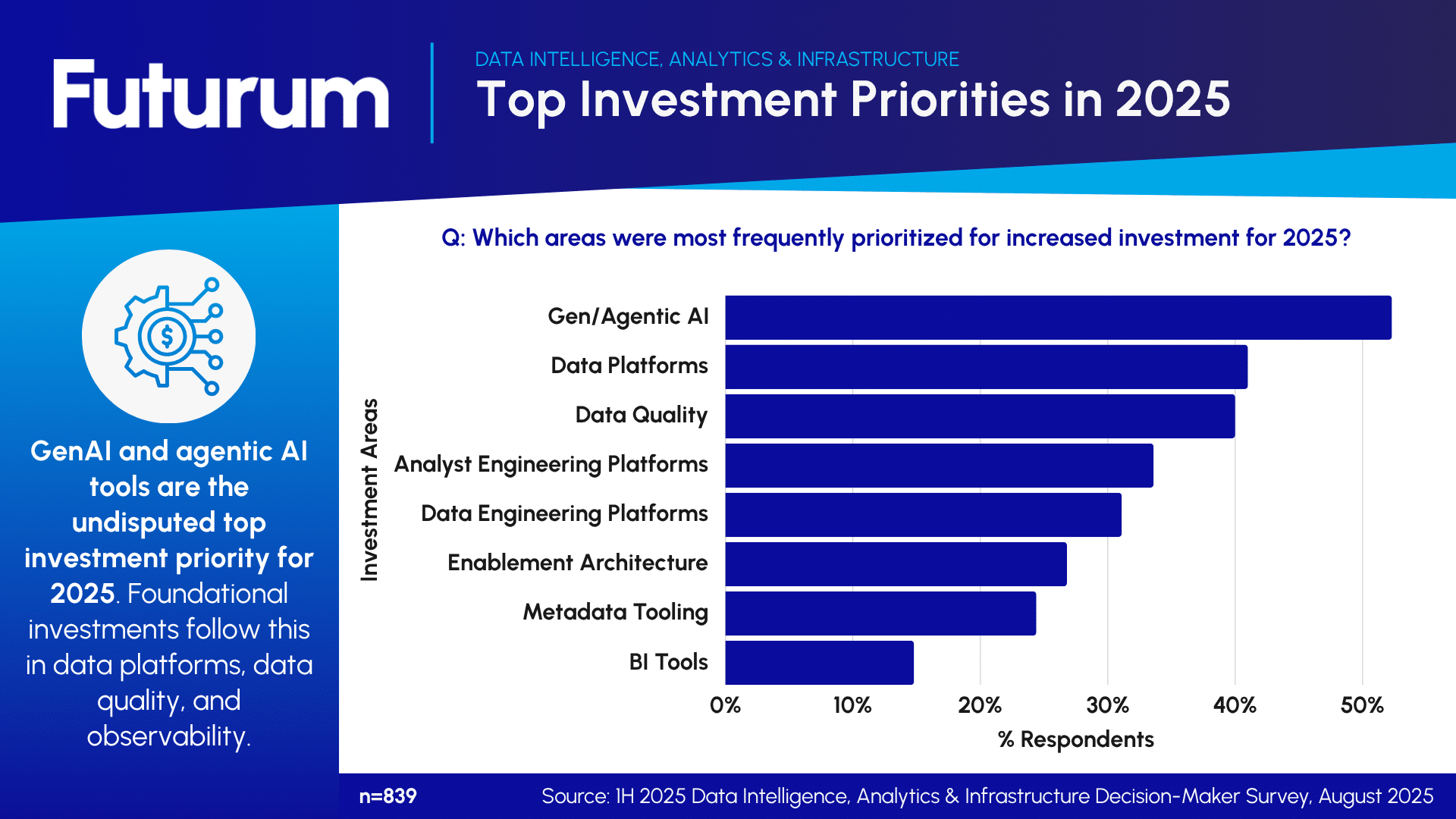
The timing of this initiative is directly linked to the explosion in generative and agentic AI investment, which has forced the industry’s hand. An AI agent cannot function reliably if it encounters multiple definitions for the same metric scattered across the enterprise. This elevates the semantic layer from a feature in BI tools to an absolute prerequisite for trustworthy AI. According to a recent Futurum Decision Maker survey, developing reliable generative and agentic AI software is a goal shared by 52% of enterprise data teams. By creating a common interchange format, OSI aims to ensure that data consumed by AI is governed, consistent, and context-rich, shifting the burden of accuracy from fragile prompt engineering to the robust discipline of context engineering.
Figure 1: Top Investment Priorities in 2025
If successful, OSI has the power to fundamentally reshape the competitive landscape by commoditizing the definition of a semantic model. Vendors will no longer be able to lock in customers with proprietary metric languages. Instead, they will need to compete on the execution of semantics, differentiating on performance, caching efficiency, security, and the sophistication of their AI integrations. The strategic motivations for the founding members are clear: Snowflake positions its Data Cloud as the neutral ground for governed data, Salesforce ensures its AI agents can reliably query business metrics from any system, and dbt Labs solidifies its role in the market’s critical transformation layer.
However, the absence of major players such as Microsoft and Databricks is significant. Their business models are predicated on vertically integrated platforms (Power BI/Fabric and Unity Catalog). They have little incentive to support a standard that commoditizes a key differentiator and enables a “best-of-breed” stack. Their decision to join, abstain, or compete will ultimately be critical to OSI’s ultimate success.
See the initial press release on the launch of OSI from founding member Snowflake.
The full report is available via subscription to Futurum Intelligence’s Data Intelligence, Analytics, and InfrastructureIQ service—click here for inquiry and access. Non-clients can learn more here: Data Intelligence, Analytics, and Infrastructure Practice.
About the Futurum Data Intelligence, Analytics, and Infrastructure Practice
The Futurum Data Intelligence, Analytics, and Infrastructure Practice provides actionable, objective insights for market leaders and their teams so they can respond to emerging opportunities and innovate. Public access to our coverage can be seen here. Follow news and updates from the Futurum Practice on LinkedIn and X. Visit the Futurum Newsroom for more information and insights.
Author Information

Brad Shimmin is Vice President and Practice Lead, Data Intelligence, Analytics, & Infrastructure at Futurum. He provides strategic direction and market analysis to help organizations maximize their investments in data and analytics. Currently, Brad is focused on helping companies establish an AI-first data strategy.
With over 30 years of experience in enterprise IT and emerging technologies, Brad is a distinguished thought leader specializing in data, analytics, artificial intelligence, and enterprise software development. Consulting with Fortune 100 vendors, Brad specializes in industry thought leadership, worldwide market analysis, client development, and strategic advisory services.
Brad earned his Bachelor of Arts from Utah State University, where he graduated Magna Cum Laude. Brad lives in Longmeadow, MA, with his beautiful wife and far too many LEGO sets.

