
Analyst(s): Dion Hinchcliffe
Publication Date: February 18, 2026
CIOs are fundamentally reshaping enterprise platform strategy as AI agents move from experimentation into operational execution. This shift is driving consolidation toward tightly integrated platforms that embed agentic AI, governance, security, and cloud infrastructure into a single operating model designed for scale, control, and regulatory readiness.
Key Points:
- CIOs are consolidating platform investments around vendors that integrate applications, AI agents, and cloud infrastructure into unified, governed operating environments.
- Agent control planes, covering observability, policy enforcement, cost governance, and security, have emerged as a primary differentiator in enterprise AI platforms.
- Regulatory pressure, sovereignty requirements, and operational risk are accelerating the move away from fragmented tooling toward AI-ready superplatforms.
Overview:
Enterprise AI strategy has entered a decisive new phase in 2026. What began as broad experimentation with copilots and generative tools has matured into a focused push to operationalize AI agents as active participants in core business workflows. As this transition unfolds, CIOs are no longer evaluating AI in isolation. Instead, they are reassessing their entire platform portfolios to ensure that agents can be deployed safely, governed consistently, and scaled across the enterprise.
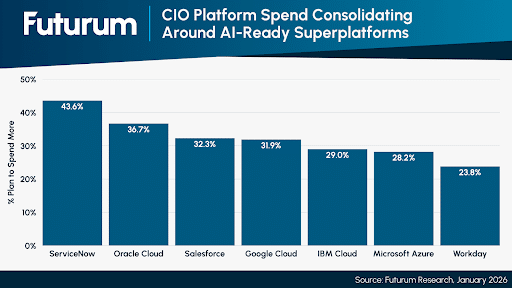
Data from Futurum Research surveys shows that early CIO intent to consolidate platforms, which was first signaled in 2023, has now translated into concrete spending decisions. CIOs are increasingly favoring vendors that can unify enterprise applications, data foundations, AI orchestration, and cloud infrastructure into a single, cohesive operating model. This consolidation reflects a recognition that AI agents function less like features and more like long-lived digital workers, requiring identity management, lifecycle oversight, and strict governance comparable to traditional enterprise systems.
A key driver of this shift is the growing importance of AI control planes. As agent autonomy expands, CIO attention has moved away from raw model performance toward visibility, accountability, and cost discipline. Platforms that provide centralized observability, deterministic policy enforcement, and auditability are gaining trust, while those that rely on loosely coupled integrations are facing increased scrutiny. Without these controls, enterprises struggle to manage risk, ensure compliance, or predict operational costs as agents become embedded in systems of record.
Figure 1: CIO Platform Spend Consolidating Around AI-Ready Superplatforms
Sovereignty and regulation further shape platform decisions. Jurisdictional control, customer-managed encryption, and operational separation are no longer optional considerations for AI deployments, particularly in highly regulated regions. CIOs now expect AI platforms to support multiple sovereignty tiers and to demonstrate compliance readiness as a built-in capability rather than an external add-on. Regulatory frameworks such as the EU AI Act are reinforcing this expectation, favoring vendors with deep governance architectures and mature enterprise controls.
Supporting market analysis reinforces this trajectory. Futurum Research indicates that CIOs pursuing platform consolidation report measurable gains in execution speed and risk reduction, while Futurum Research estimates that enterprises operating on integrated digital platforms achieve 20–30% faster AI and digital outcomes due to reduced integration friction.
Conclusion
The rise of AI agents has transformed platform strategy from a procurement exercise into an operating model decision. CIOs are backing platforms that can embed intelligence directly into workflows while maintaining control, security, and sovereignty. This consolidation is not just cyclical, it also reflects a long-term shift in how enterprises deploy, govern, and scale AI across the business.
The full report is available via subscription to Futurum Intelligence’s Digital Leadership & CIO IQ service. See the complete research coverage on CIO platform strategy and agentic AI on the Futurum Intelligence Platform.
The full report is available via subscription to Futurum Intelligence’s Digital Leadership & CIO IQ service—click here for inquiry and access.
Futurum clients can read more in the Futurum Intelligence Platform, and non-clients can learn more here: Digital Leadership & CIO Practice.
About the Futurum Digital Leadership & CIO Practice
The Futurum Digital Leadership & CIO Practice provides actionable, objective insights for market leaders and their teams so they can respond to emerging opportunities and innovate. Public access to our coverage can be seen here. Follow news and updates from the Futurum Practice on LinkedIn and X. Visit the Futurum Newsroom for more information and insights.
About Futurum Intelligence for Market Leaders
Futurum Intelligence’s IQ service provides actionable insight from analysts, reports, and interactive visualization datasets, helping leaders drive their organizations through transformation and business growth. Subscribers can log into the platform at https://app.futurumgroup.com/, and non-subscribers can find additional information at Futurum Intelligence.
Follow news and updates from Futurum on X and LinkedIn using #Futurum. Visit the Futurum Newsroom for more information and insights.
Author Information

Dion Hinchcliffe is a distinguished thought leader, IT expert, and enterprise architect, celebrated for his strategic advisory with Fortune 500 and Global 2000 companies. With over 25 years of experience, Dion works with the leadership teams of top enterprises, as well as leading tech companies, in bridging the gap between business and technology, focusing on enterprise AI, IT management, cloud computing, and digital business. He is a sought-after keynote speaker, industry analyst, and author, known for his insightful and in-depth contributions to digital strategy, IT topics, and digital transformation. Dion’s influence is particularly notable in the CIO community, where he engages actively with CIO roundtables and has been ranked numerous times as one of the top global influencers of Chief Information Officers. He also serves as an executive fellow at the SDA Bocconi Center for Digital Strategies.

